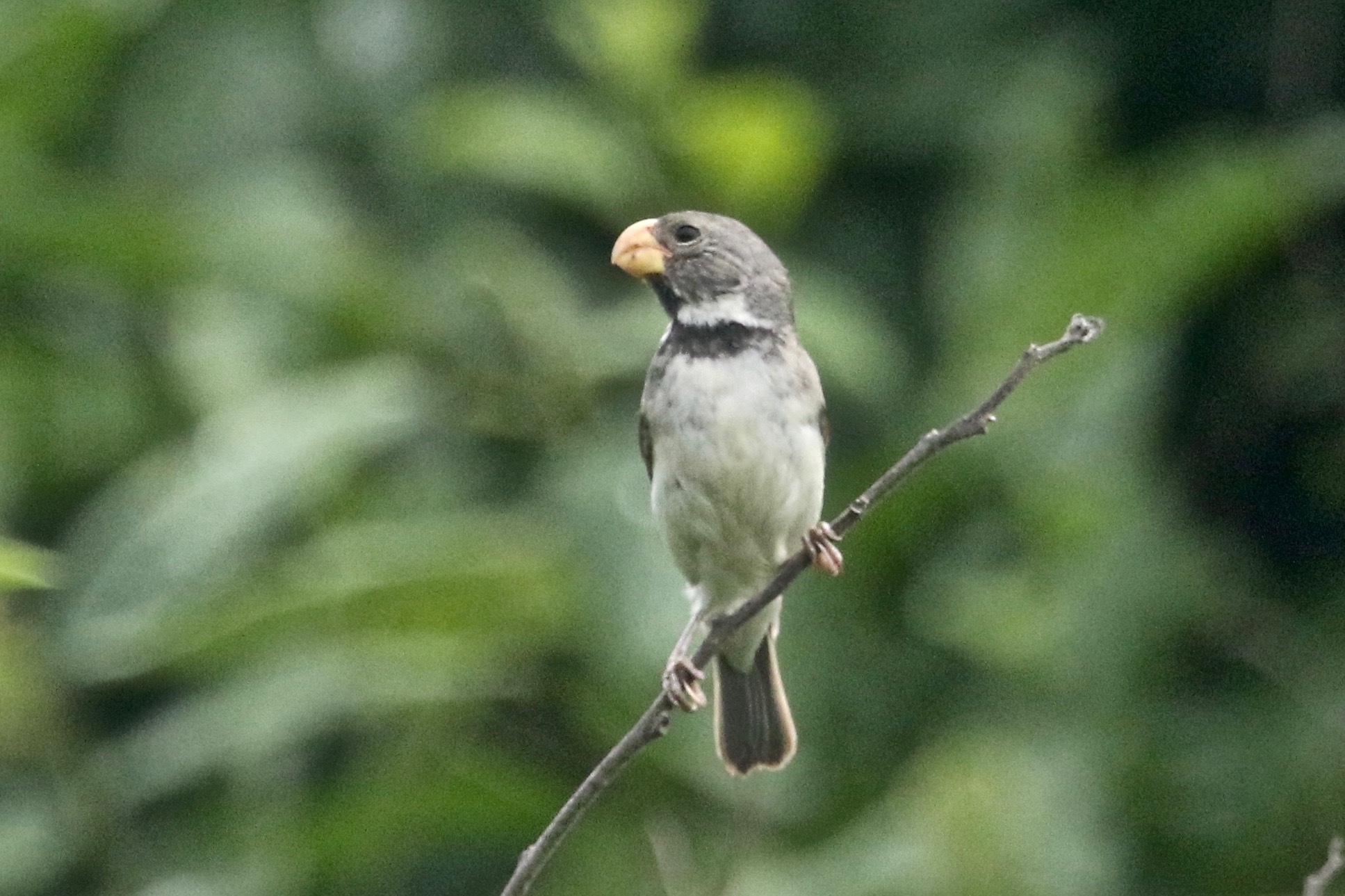
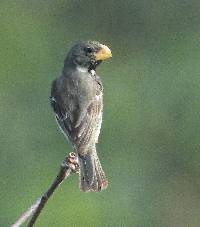
The parrot-billed seedeater (Sporophila peruviana) is a species of bird in the family Thraupidae, the tanagers and allies. It is found in Ecuador and Peru.
Taxonomy and systematics
The parrot-billed seedeater has a complicated taxonomic history. It was formally described in 1842 by René-Primevère Lesson with the binomial Callyrhynchus peruvianus. Lesson erected the genus Callyrhynchus for the species. In 1869 Philip Sclater erected a new genus for it, Neorhynchus, because he misspelled Lesson's Callyrhynchus as Callirhynchus, a genus of fishes. By the principle of priority the apparently previously assigned genus had to be changed. It was still in that genus in 1938 but by 1970 had attained its current place in Sporophila. Sporophila was a genus in the family Emberizidae. Based on studies published between 1988 and 2011, beginning in 2012 Sporophila was moved to the tanager family Thraupidae.
The parrot-billed seedeater has two subspecies, the nominate S. p. peruviana (Lesson, RP, 1842) and S. p. devronis (Verreaux, 1852).
Description
The parrot-billed seedeater is 10.5 to 12.5 cm (4.1 to 4.9 in) long and weighs an average of 12.6 g (0.44 oz). It is a small seedeater with a "massively thick bill showing distinct rounded culmen and slightly hooked tip...appearing like that of a parrot". The species is sexually dimorphic. Adult males of the nominate subspecies have a grayish head with a thin white eye-ring and a white cheek. Their upperparts are grayish brown. Their tail is mostly gray-brown with blackish central feathers. Their wings are grayish brown with buffy edges and whitish tips on the coverts that show as two wing bars. The wings have white bases on the primaries that show as a patch on the closed wing. They have a blackish throat with a white band between it and a dark gray to blackish upper breast. Their underparts are otherwise mostly white with a buffy wash on the flanks. Females have a dusty brown head, upperparts, wings, and tail. Their wings have two...