The knob-billed duck (Sarkidiornis melanotos) or African comb duck is a type of duck found along the tropical/sub-tropical wetlands and waterways of Sub-Saharan Africa and the island of Madagascar, as well as most of South Asia and mainland Indochina.
Most taxonomic authorities classify the knob-billed duck and the comb duck separately. A misidentified species of extinct Mauritian comb duck was initially described from unrecognised remains of the Mauritius sheldgoose (Alopochen mauritiana); this was realised as early as 1897, but the printed case of mistaken identity can still, occasionally, be found in modern-day sources.
Taxonomy and systematics
Uncertainty surrounds the correct systematic placement of this species. Initially, it was placed in the dabbling duck subfamily Anatinae. Later, it was assigned to the "perching ducks", a paraphyletic assemblage of waterfowl most of which are intermediate between dabbling ducks and shelducks. As the "perching ducks" were split up, the knob-billed duck was moved to the Tadorninae or shelduck subfamily.
Analysis of mtDNA sequences of the cytochrome b and NADH dehydrogenase subunit 2 genes, however, suggests that it is a quite basal member of the Anatidae, vindicating the earliest placement. But its closest living relatives cannot be resolved to satisfaction without further study.
Description
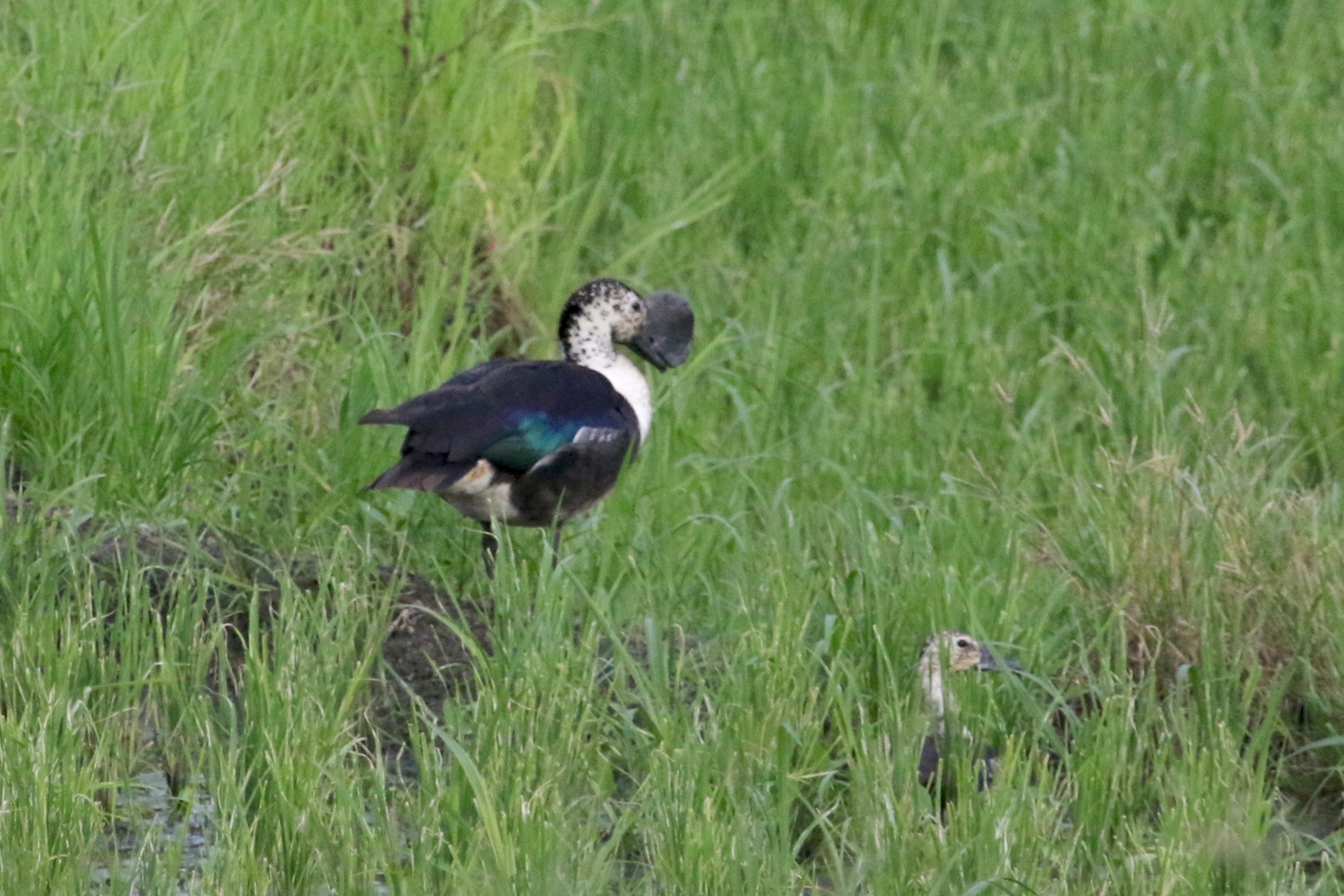
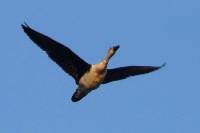
This common species is unmistakable. It is one of the largest species of duck. Length can range from 56 to 76 cm (22 to 30 in), wingspan ranges from 116 to 145 cm (46 to 57 in) and weight from 1.03 to 2.9 kg (2.3 to 6.4 lb). Adults have a white head freckled with dark spots, and a pure white neck and underparts. The upperparts are glossy blue-black upperparts, with bluish and greenish iridescence especially prominent on the secondaries (lower arm feathers). The male is much larger than the female, and has a large black knob on the bill. Young birds are dull buff below and on the face and neck, with dull brown upperparts, top of...