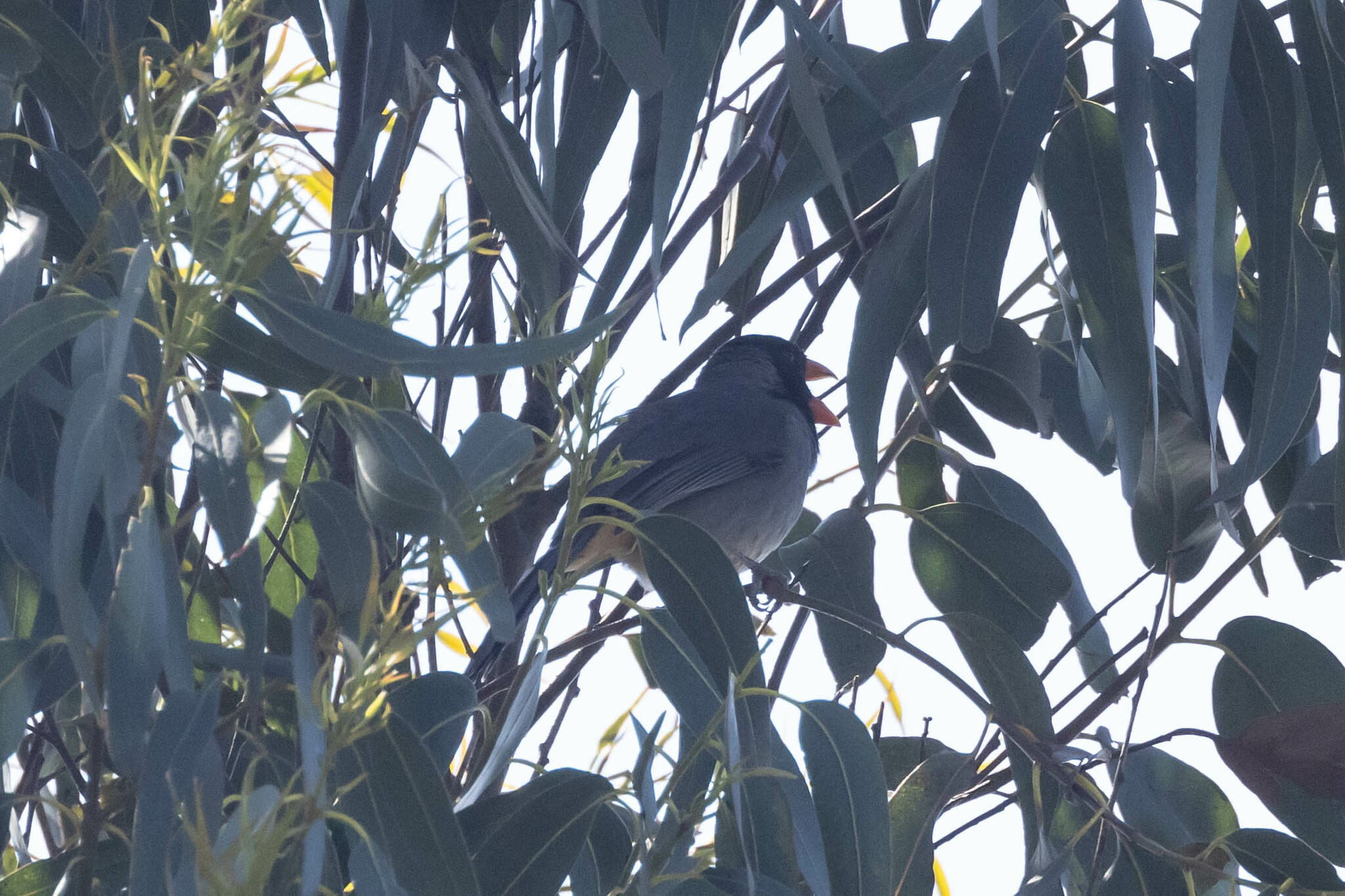
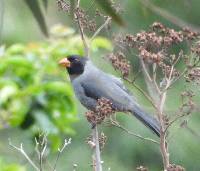
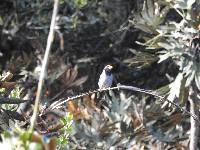
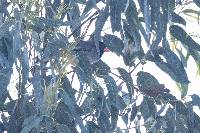
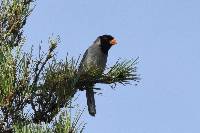
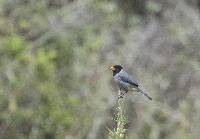
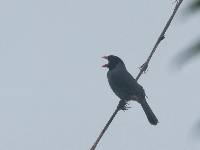
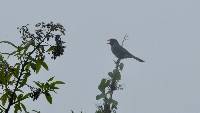
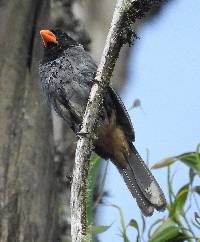
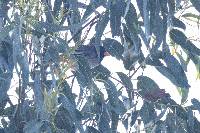
The black-cowled saltator (Saltator nigriceps) is a species of bird in the family Thraupidae, the tanagers and allies. It is found in Ecuador and Peru.
Taxonomy and systematics
The black-cowled saltator was formally described by Frank Chapman 1914 with the binomial Pitylus nigriceps. Chapman moved it to its present genus Saltator in 1927. Some twentieth century authors treated it and the golden-billed saltator (S. aurantiirostris) as conspecific.
The black-cowled saltator is monotypic.
Description
The black-cowled saltator is 22 cm (8.7 in) long; two females weighed 70 and 72 g (2.5 and 2.5 oz). The sexes have the same plumage. Adults have a mostly black head, neck, and throat with a deep gray nape. Their upperparts are deep gray with a faint olive wash that darkens to the rump. Their wings are deep gray with dusky inner webs on the remiges. Their tail is mostly deep gray with white tips on the inner webs at the ends of the two outermost pairs of feathers. Their breast and upper belly are deep gray, their lower belly warm buff, and their undertail coverts ochraceous buff. They have a chestnut brown or brown iris, a thick salmon red to yellow-orange bill, and brown, gray, or horn blue legs and feet.
Distribution and habitat
The black-cowled saltator is found along the western slope of the Andes from far eastern El Oro Province and the eastern half of Loja Province in southwestern Ecuador south into northern Peru to south-central Cajamarca Department. It inhabits the canopy and edges of humid montane forest, dense secondary forest, and scrublands. In elevation it ranges mostly between 1,700 and 2,900 m (5,600 and 9,500 ft) in Ecuador and between 1,200 and 2,500 m (3,900 and 8,200 ft) in Peru.
Behavior
The black-cowled saltator is a year-round resident.
The black-cowled saltator's diet has not been studied. It is assume to feed on berries, seeds, and insects. It usually is seen singly or in pairs and sometimes joins mixed-species feeding flocks. It forages at...