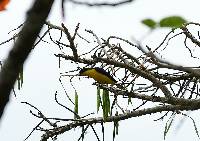
The thick-billed euphonia (Euphonia laniirostris) is a species of bird in the family Fringillidae, the finches and euphonias. It is found in Bolivia, Brazil, Colombia, Costa Rica, Ecuador, Panama, Peru, and Venezuela.
Taxonomy and systematics
The thick-billed euphonia was originally described in 1837 with its current binomial Euphonia laniirostris (though spelled as "E. lanii rostris"). The genus Euphonia had long been placed in the family Thraupidae, the "true" tanagers. Multiple studies in the late twentieth and early twenty-first centuries resulted in its being reassigned to its present place in the family Fringillidae.
The thick-billed euphonia has these five subspecies:
E. l. crassirostris Sclater, PL, 1857
E. l. melanura Sclater, PL, 1851
E. l. hypoxantha Berlepsch & Taczanowski, 1884
E. l. zopholega (Oberholser, 1918)
E. l. laniirostris D'Orbigny & Lafresnaye, 1837
Subspecies E. l. melanura was originally described as a full species. Within Euphonia laniirostris the Clements taxonomy and the American Ornithological Society treat E. l. melanura and E. l. crassirostris as the "thick-billed euphonia (black-tailed)" and the other three subspecies as the "thick-billed euphonia (thick-billed).
Description
The thick-billed euphonia is about 10 cm (3.9 in) long and weighs 13 to 16.5 g (0.46 to 0.58 oz). It is a small euphonia with one of the thicker bills of all euphonias, though it is not dramatically larger than the others'. The species is sexually dimorphic. Adult males of the nominate subspecies E. l. laniirostris have a bright yellow forehead; the patch extends slightly past the eye. The rest of their crown and their face, nape, and upperparts are glossy blue-black. Their upperwing coverts and flight feathers are dusky with a dark blue tinge. Their tail's upper surface is dark blue and its underside dark gray with white inner webs on the underside of the outer three pairs of feathers. Their throat and underparts are bright yellow. Adult females...