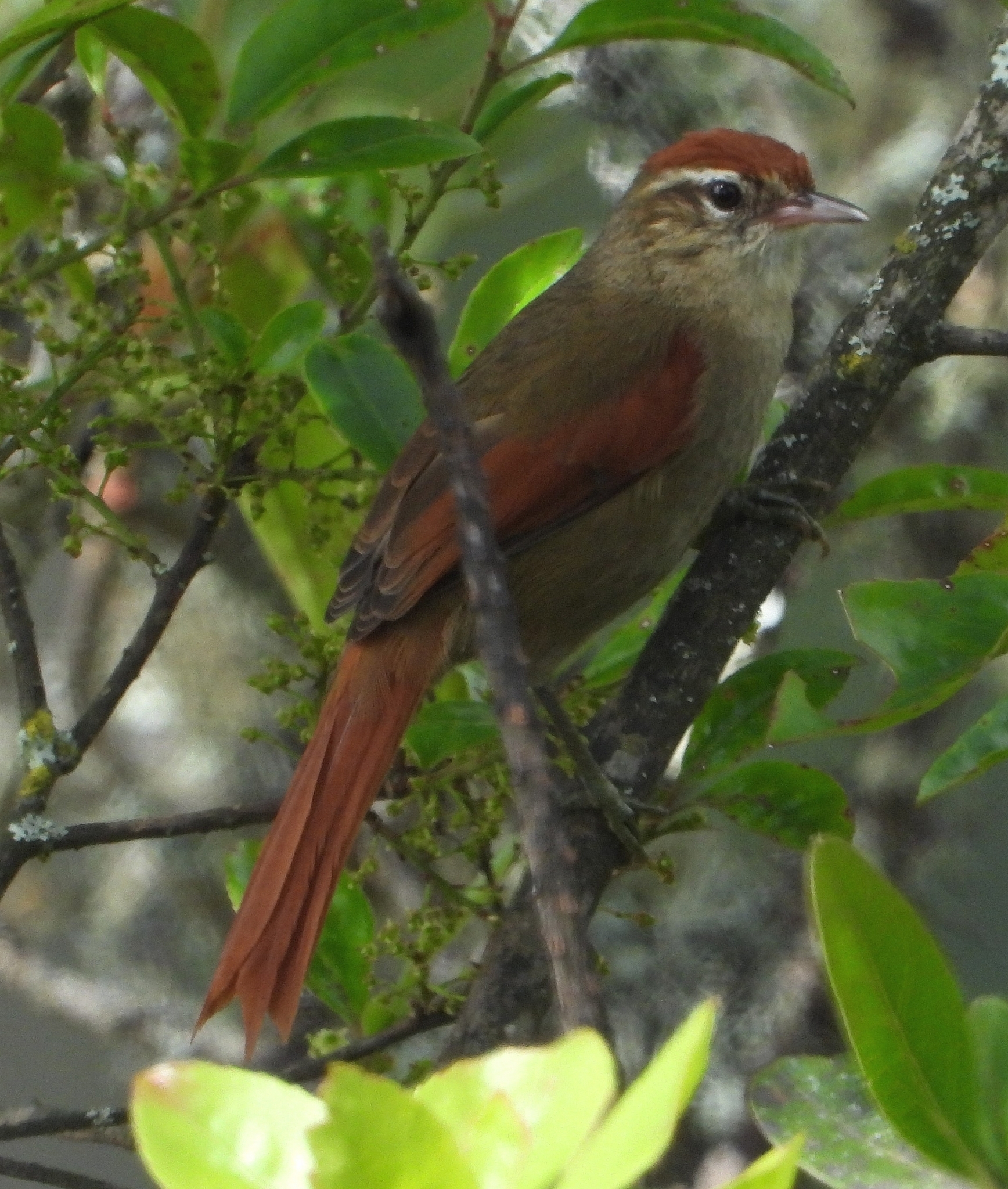
The line-cheeked spinetail (Cranioleuca antisiensis) is an arboreal species of bird in the ovenbird family Furnariidae. It is a common species in the Andes in Ecuador and Peru. Its natural habitat is subtropical or tropical moist montane forests, woodland and scrub. It is distinguished from other species by its distribution, behaviour and white supercilium. There are two recognized subspecies, which are in reality a gradient in morphology and plumage from one extreme to the other.
The IUCN Red List conservation status is rated as Least Concern, as the line-cheeked spinetail is common along its range and is presumably stable. However, since it is arboreal, the line-cheeked spinetail is vulnerable to deforestation. Yet, it is relatively tolerant to human disturbance and does well in successional vegetation.
Taxonomy
The line-cheeked spinetail was formally described in 1859 by the English zoologist Philip Sclater from a specimen collected near the town of Cuenca in Ecuador. Sclater coined the binomial name Synallaxis antisiensis. The species is now placed in the genus Cranioleuca was introduced in 1853 by the German naturalist Ludwig Reichenbach.
Five subspecies are recognised:
Cranioleuca antisiensis antisiensis (Sclater, PL, 1859) – southwest Ecuador
Cranioleuca antisiensis palamblae (Chapman, 1923) – northwest Peru
Cranioleuca antisiensis baroni (Salvin, 1895) – north Andes of Peru
Cranioleuca antisiensis capitalis Zimmer, JT, 1924 – Huánuco (central Peru)
Cranioleuca antisiensis zaratensis Koepcke, 1961 – Pasco and Lima (south-central, southwest Peru)
There are three subspecies of line-cheeked spinetails: Cranioleuca antisiensis antisiensis in the north and Cranioleuca antisiensis palamblae in the south. They are defined by the differences in plumage and size between the extremes. In general, C. a. antisiensis occurs in Ecuador and C. a. palamblae in Peru. Where the two subspecies meet, there is little phenotypic distinction. The Baron's...