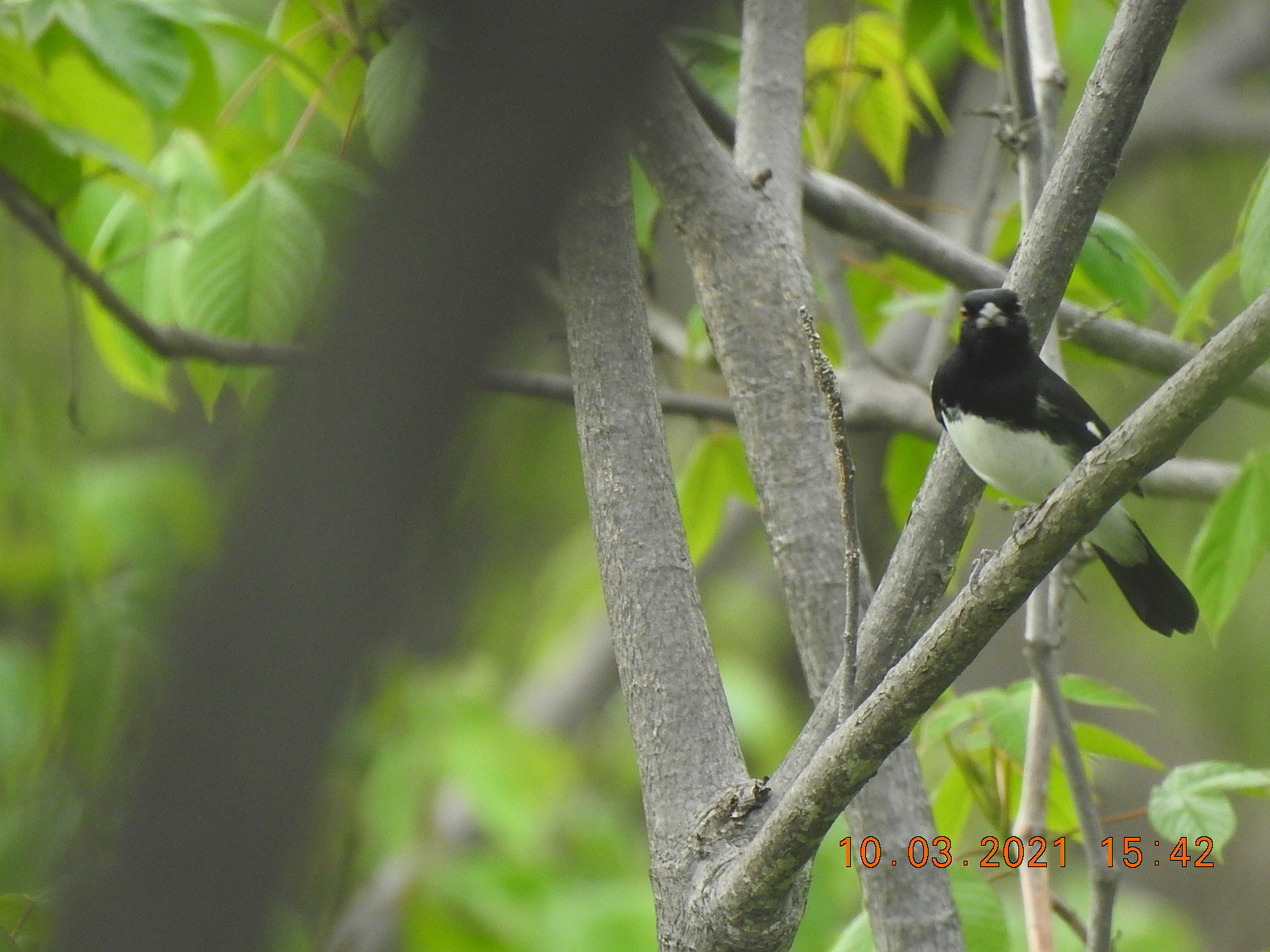
The black-and-white tanager (Conothraupis speculigera) is a bird in the family Thraupidae, the tanagers and allies. It is found primarily in Ecuador and Peru but in migration and as a vagrant has appeared in several other countries.
Taxonomy and systematics
The black-and-white tanager was formally described in 1855 with the binomial Schistochlamys speculigera. In 1880 Philip Sclater erected its present genus Conothraupis with speculigera as the type species. It now shares the genus with the cone-billed tanager (C. mesoleuca).
The black-and-white tanager is monotypic.
Illustration of black-and-white tanager by Joseph Smit, 1880
Description
The black-and-white tanager is 16 to 16.5 cm (6.3 to 6.5 in) long and weighs 23 to 28 g (0.81 to 0.99 oz). The species is sexually dimorphic. Adult males have a black head, throat, neck, upper breast, and back. Their lower back, rump, uppertail coverts, and tail are gray. Their upperwing coverts and flight feathers are glossy black with white on the outer webs of the latter near their base. Their lower breast and belly are white, their sides and flanks gray, and their underwing coverts white. Adult females have an olive head with a faint broken eye-ring and olive upperparts. Their wings are mostly olive with blackish primary coverts. Their tail is dusky with olive feather edges. Their throat is white with an olive-yellow tinge, their upper breast white with a heavy olive wash and blurry olive streaks, and their lower breast and belly buff-white or white with a yellowish tinge. Both sexes have a red-brown iris, a thickish bluish gray bill with a black tip, and dark gray legs. Juveniles resemble adult females.
Distribution and habitat
The black-and-white tanager breeds from Loja Province in southwestern Ecuador south into northwestern Peru as far as La Libertad Department. There are also scattered records further north in Ecuador. In the non-breeding season it is found mostly the length of Amazonian Peru from near Ecuador south to Madre de Dios...