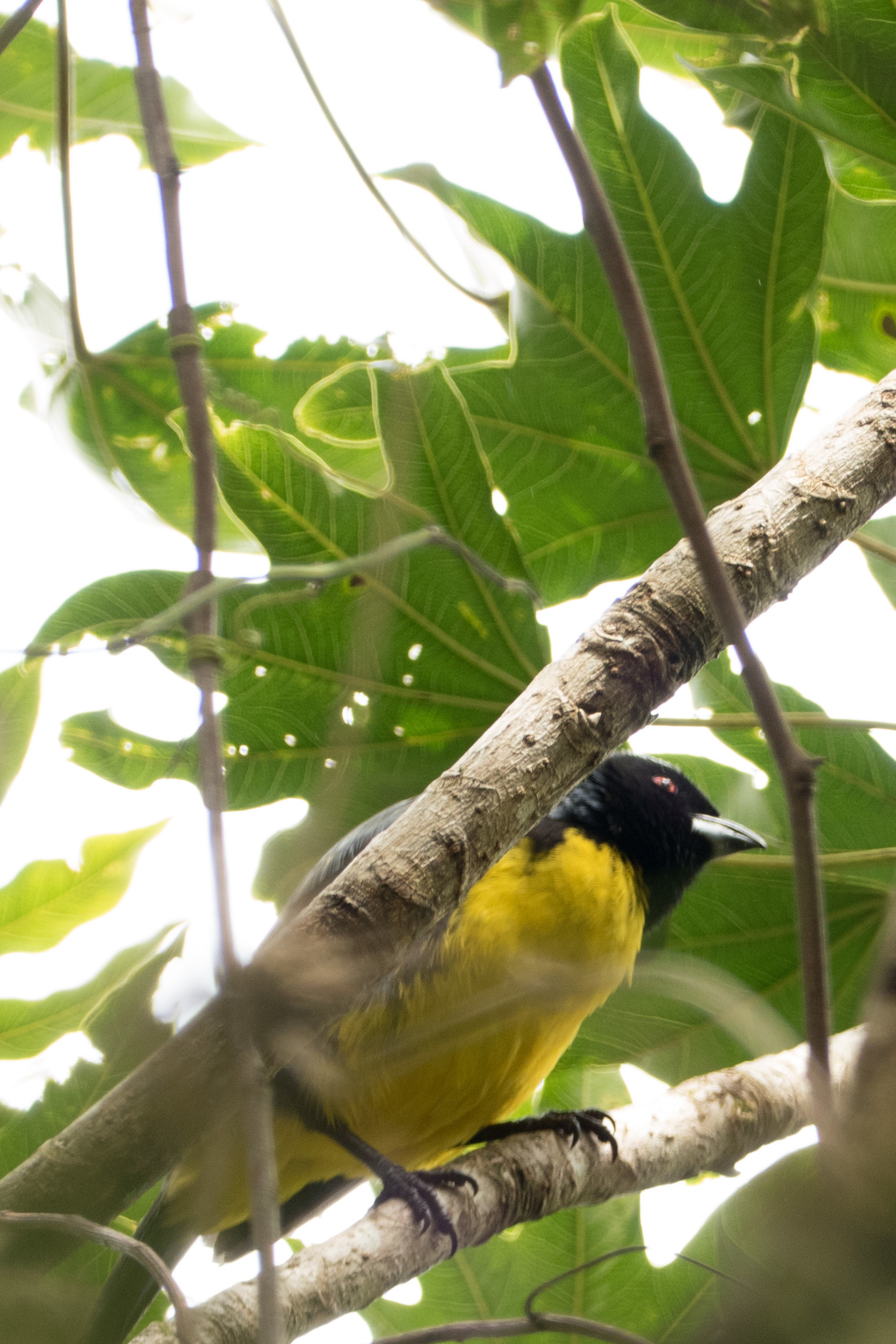
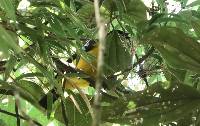
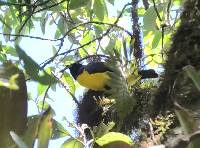
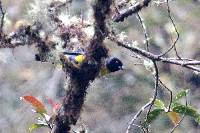
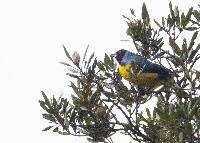
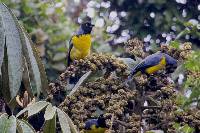
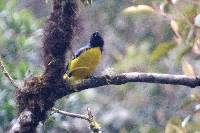
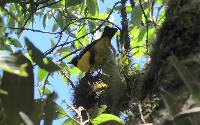
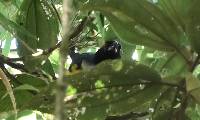
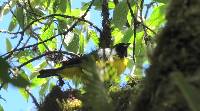
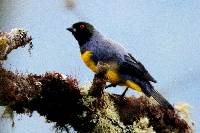
The hooded mountain tanager (Buthraupis montana) is a species of bird in the tanager family Thraupidae. It is the only member of the genus Buthraupis. It is found in the forests and woodlands of the Andean highlands of Bolivia, Colombia, Ecuador, Peru, and Venezuela, at altitudes between 1,800 and 3,000 m (5,900 and 9,800 ft). At 23 centimetres (9.1 in) and 96 grams (3.4 oz), it is one of the largest tanagers. It has a black head and thighs, a blue back and bright yellow belly, with red eyes.
Taxonomy
In Peru
The hooded mountain tanager was formally described in 1837 by the French naturalists Alcide d'Orbigny and Frédéric de Lafresnaye from a specimen collected in the Bolivian Yungas. They coined the binomial name Aglaia montana. It is now the only species placed in the genus Buthraupis that was introduced in 1851 by the German ornithologist Jean Cabanis. The genus name combines the Ancient Greek bou- meaning "huge" and thraupis, an unknown small bird but used by ornithologists to signify a tanager. The specific name is from the Latin montanus meaning "of the mountains".
Six subspecies are recognised:
Buthraupis montana venezuelana Aveledo & Perez, 1989 – northwest Venezuela
Buthraupis montana gigas (Bonaparte, 1851) – north Colombia
Buthraupis montana cucullata (Jardine & Selby, 1842) – west, central Colombia to Ecuador
Buthraupis montana cyanonota Berlepsch & Stolzmann, 1896 – north, central Peru
Buthraupis montana saturata Berlepsch & Stolzmann, 1906 – southeast Peru
Buthraupis montana montana (d'Orbigny & Lafresnaye, 1837) – west Bolivia