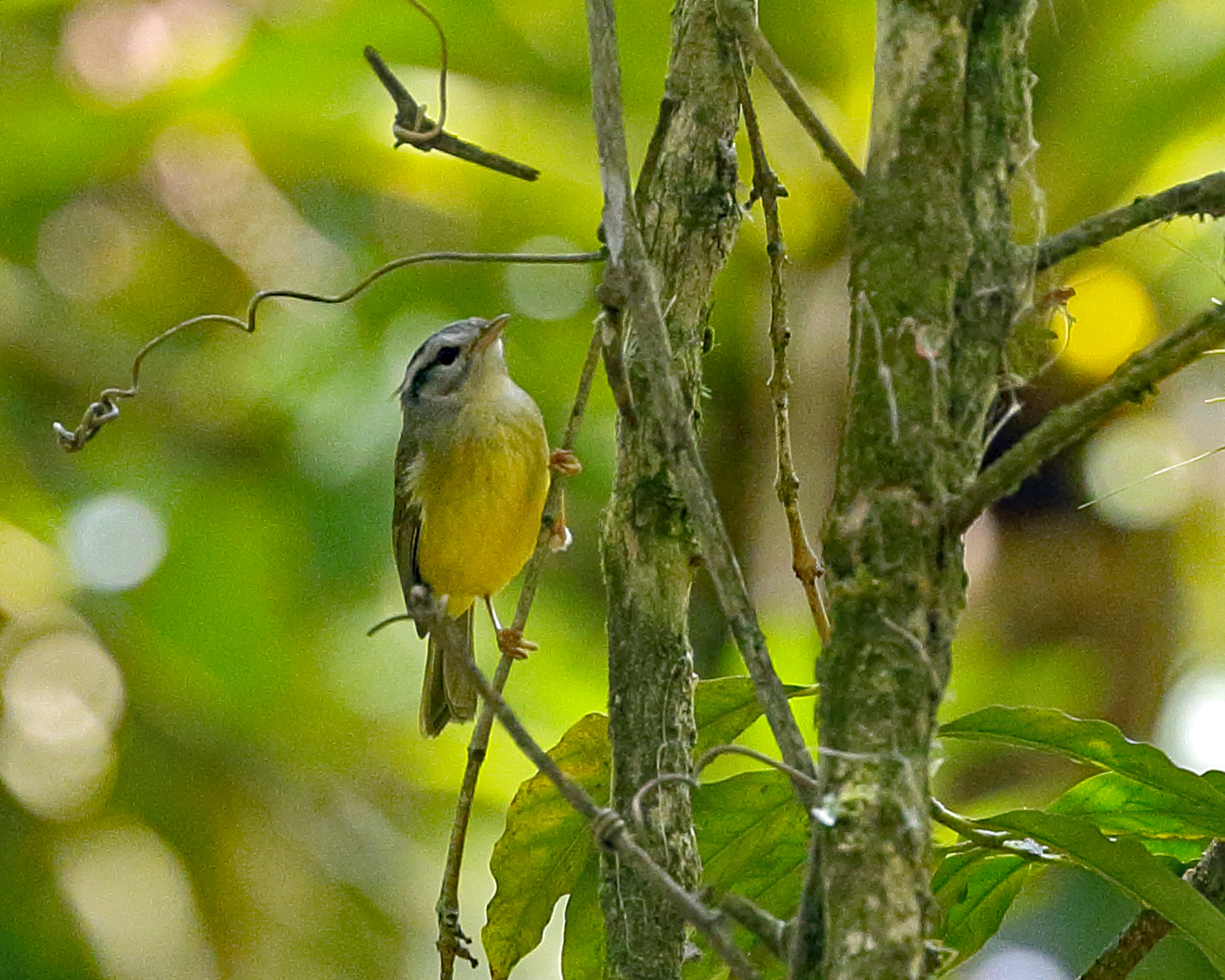
The three-striped warbler (Basileuterus tristriatus) is a species of bird in the family Parulidae, the New World warblers. It is found in the Andes from Venezuela to Bolivia.
Taxonomy and systematics
The three-striped warbler was formally described in 1844 by the Swiss naturalist Johann Jakob von Tschudi under the binomial Myiodioctes tristriatus. The specific epithet tristriatus is Modern Latin meaning "three-striped" or "three-streaked" from Latin tri- meaning "three-" and "striatus" meaning "striated". The type locality was corrected to Vitoc, Department of Junín, in central Peru by the Austrian ornithologist Carl Eduard Hellmayr in 1935. The three-striped warbler is now one of 12 species placed in the genus Basileuterus that was introduced in 1848 by the German ornithologist Jean Cabanis. The genus name is from Ancient Greek βασιλευτερος/basileuteros meaning "more kingly".
What are now the black-eared warbler (B. melanotis), the Tacarcuna warbler (B. tacarcunae), and the three subspecies of the Yungas warbler (B. punctipectus) were all previously treated as subspecies of the three-striped warbler. They were separated by most taxonomic systems based on studies published in 2012 and 2014. But as of early 2026 the South American Classification Committee had not implemented the split.
As of early 2026 most taxonomic systems recognize these eight subspecies of the three-striped warbler:
B. t. daedalus Bangs, 1908
B. t. sanlucasensis Salaman, 2015
B. t. auricularis Sharpe, 1885
B. t. meridanus Sharpe, 1885
B. t. bessereri Hellmayr, 1922
B. t. pariae Phelps, WH & Phelps, WH Jr, 1949
B. t. baezae Chapman, 1924
B. t. tristriatus (Tschudi, 1844)
However, as of late 2025 BirdLife International's Handbook of the Birds of the World did not recognize B. t. bessereri.
This article follows the majority eight-subspecies model.
Description
The three-striped warbler is about 13 cm (5.1 in) long. The sexes have the same plumage. Adults of the nominate...