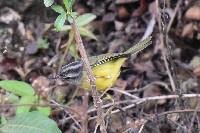
The three-banded warbler (Basileuterus trifasciatus) is a species of bird in the family Parulidae, the New World warblers. It is found in Ecuador and Peru.
Taxonomy and systematics
The three-banded warbler was formally described in 1880 with its current binomial Basileuterus trifasciatus. Some authors have treated it as a subspecies of the golden-crowned warbler (M. culicivorus).
The three-banded warbler has two subspecies, the nominate B. t. trifasciatus (Taczanowski, 1880) and B. t. nitidior (Chapman, 1924).
Description
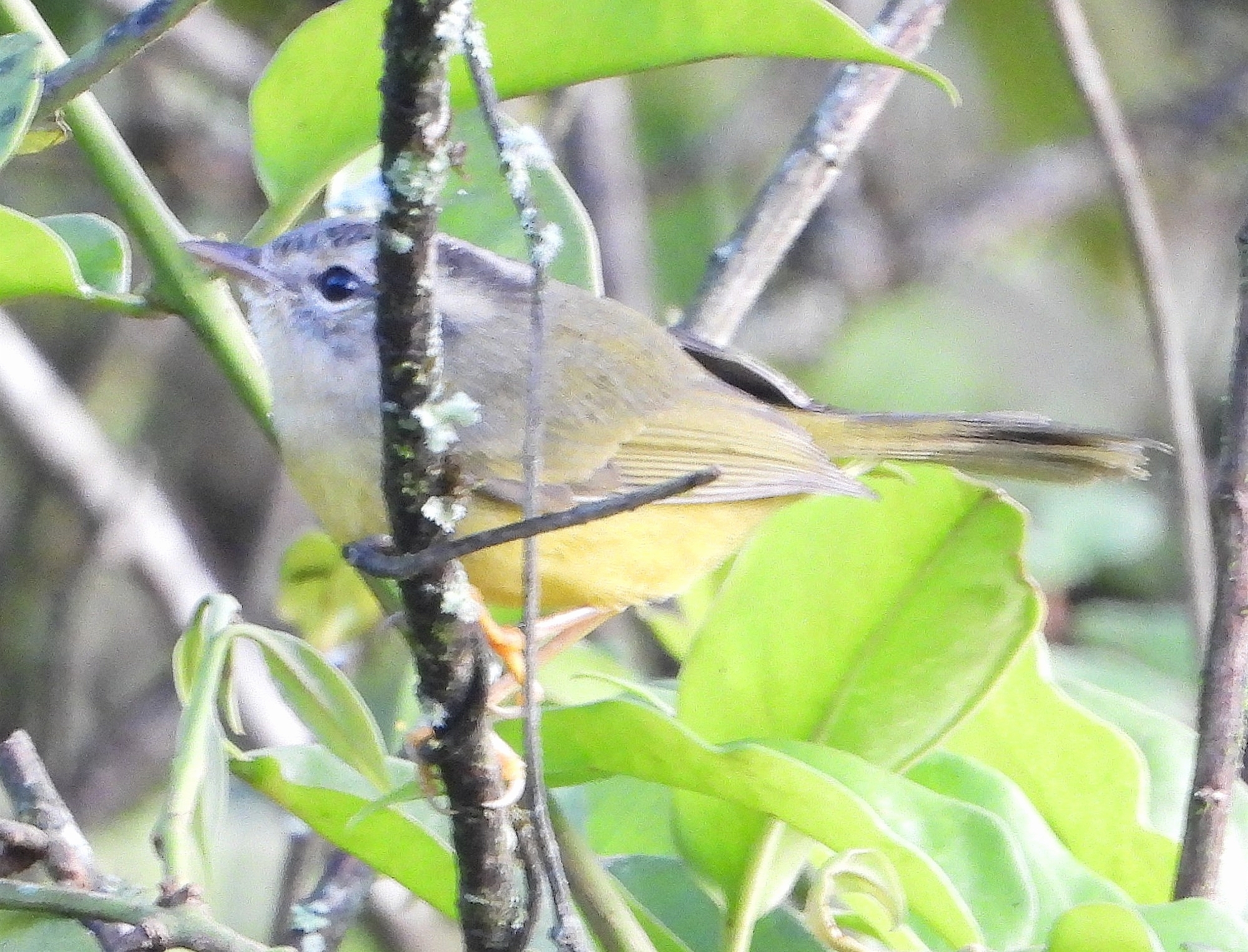
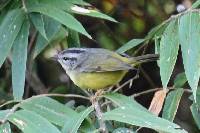
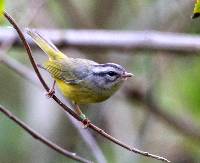
The three-banded warbler is 12.5 cm (4.9 in) long and weighs 8.5 to 11 g (0.30 to 0.39 oz). The sexes have the same plumage. Adults of the nominate subspecies have a pale gray crown stripe with black borders, grayish white lores and supercilium, a thin black stripe through the eye, and medium gray ear coverts with a blackish rear edge. Their nape and upper mantle are medium gray, their back and wings olive-gray, and their rump and tail olive. Their throat is white that becomes yellow on the rest of the underparts; the throat and upper breast are smudged with gray. Subspecies B. t. nitidior has a yellow wash on the gray crown stripe and more olive (less gray) upperparts than the nominate. Both subspecies have a dark iris, a blackish horn maxilla, a paler horn mandible, and dusky pinkish legs and feet.
Distribution and habitat
The three-banded warbler has a disjunct distribution; there is a small gap between the subspecies that the map does not show. Subspecies B. t. nitidior is the more northerly of the two. It is found on the western Andean slope in southwestern Ecuador's El Oro and Loja provinces and far northwestern Peru's adjoining Tumbes and northwestern Piura departments. The nominate is found on the western slope of the Andes from eastern Piura Department south to northern La Libertad Department. The species primarily inhabits the interior and edges of submontane and montane rainforest. It also occurs along watercourses in dryer forest and in mature secondary...