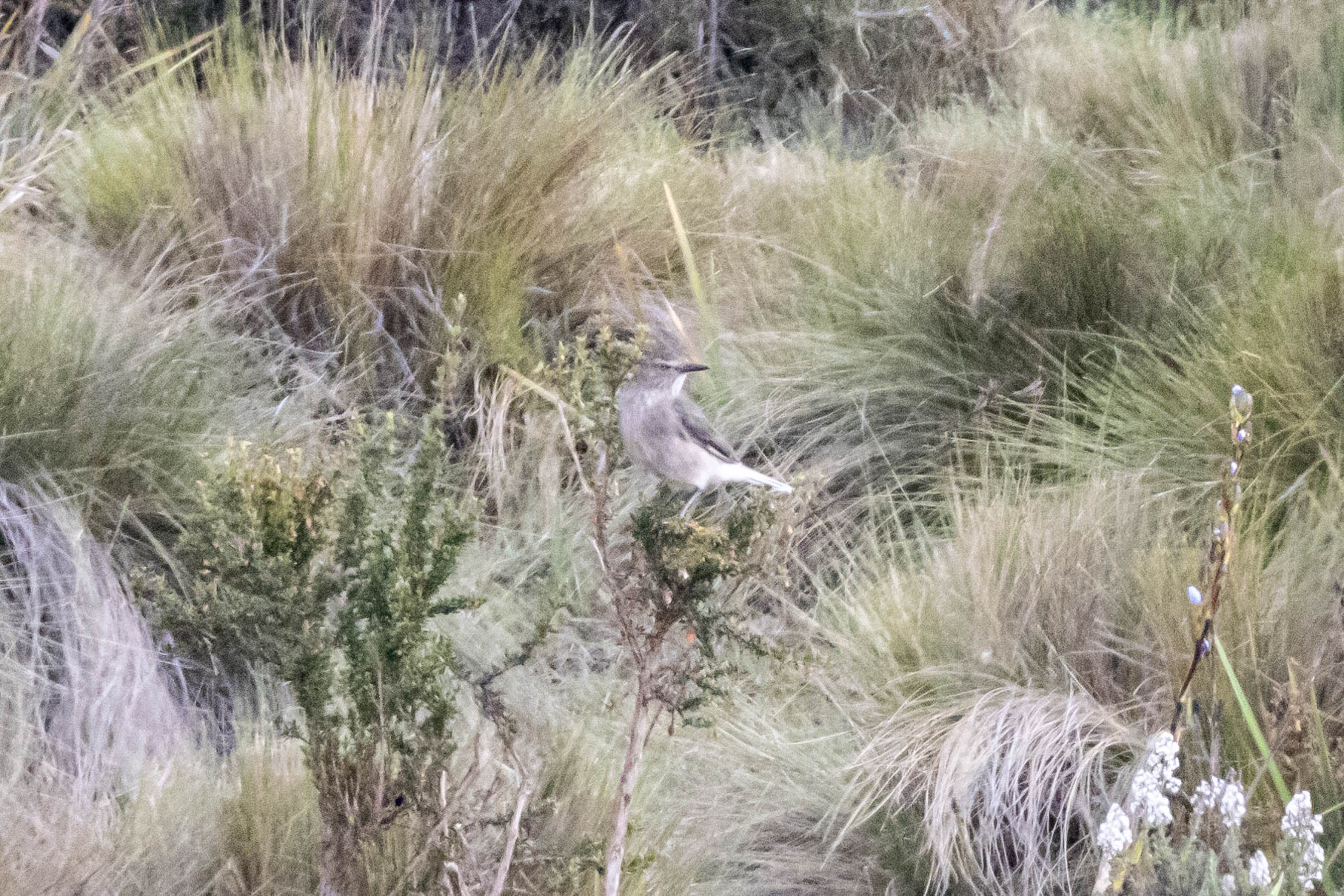
The black-billed shrike-tyrant (Agriornis montanus) is a bird species in the Tyrannidae family, the tyrant flycatchers. It is found in Argentina, Bolivia, Chile, Colombia, Ecuador, and Peru, and possibly has occurred as a vagrant to the Falkland Islands.
Taxonomy and systematics
The black-billed shrike-tyrant was formally described in 1837 as Pepoazae montana. It was later transferred to the genus Agriornis that was erected in 1839.
The black-billed shrike-tyrant's taxonomy is unsettled. The IOC recognizes these six subspecies:
A. m. solitarius Sclater, PL, 1859
A. m. insolens Sclater, PL & Salvin, 1869
A. m. intermedius Hellmayr, 1927
A. m. montanus (d'Orbigny & Lafresnaye, 1837)
A. m. maritimus (d'Orbigny & Lafresnaye, 1837)
A. m. fumosus Manuel Nores & Dario Yzurieta, 1983
However, the Clements taxonomy and BirdLife International's Handbook of the Birds of the World include A. m. fumosus within A. m. maritimus.
This article follows the six-subspecies model.
Description
The black-billed shrike-tyrant is 22 to 24 cm (8.7 to 9.4 in) long. The sexes have the same plumage. Adults of the nominate subspecies A. m. montanus have a whitish stripe above the lores, a buffish white broken supercilium, and brown-streaked white cheeks. Their crown and upperparts are dark grayish brown. Their wings are mostly dark grayish brown with whitish tips and edges on the inner flight feathers. Their underwing coverts are cinnamon-buff to buffy white. Their central pair of tail feathers is blackish; the rest are white with dark bases on their inner webs. Their throat is white with thin blackish streaks, their breast and flanks ashy brown, their mid-belly whitish-tinged brown, and their lower belly and vent whitish.
The other subspecies differ from the nominate and each other thus:
A. m. solitarius: darker than the nominate with entirely white outer tail feathers
A. m. insolens: darker than the nominate but lighter than solitarius with mostly white outer...