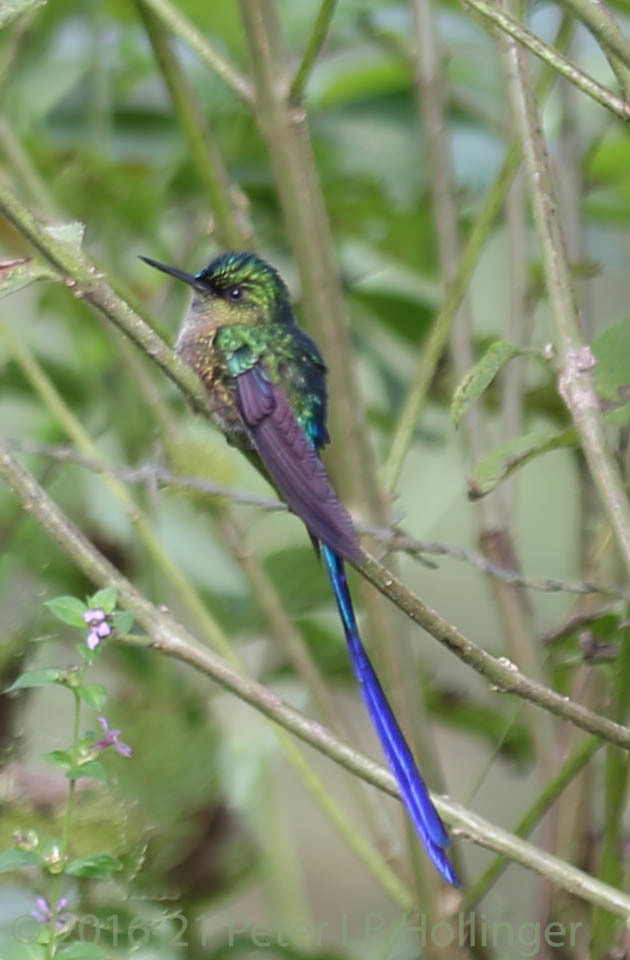
The violet-tailed sylph (Aglaiocercus coelestis) is a species of hummingbird in the "coquettes", tribe Lesbiini of subfamily Lesbiinae. It is found in Colombia and Ecuador.
Taxonomy and systematics
The taxonomy of genus Aglaiocercus and of the violet-tailed sylph in particular are complicated. The genus also includes two other sylphs, the long-tailed (A. kingii) and Venezuelan (A. berlepschi), and the three have several times been suggested to be either one species, or two with the violet-tailed being a subspecies of long-tailed. Several additional species have been proposed for inclusion but they have almost conclusively been shown to be hybrids with kingii or one of the other sylphs. Since at least the early 2000s taxonomists have settled on the three-species treatment. The violet-tailed sylph has two subspecies, the nominate A. c. coelestis and A. c. aethereus.
Description
The male long-tailed sylphs are 18 to 21 cm (7.1 to 8.3 in) long including the 10 to 15 cm (3.9 to 5.9 in) outer tail feathers. Females are 9.5 to 9.7 cm (3.7 to 3.8 in) long. The species weighs 4.6 to 5.2 g (0.16 to 0.18 oz). Both subspecies have a short black bill. Males of the nominate subspecies have a shining green crown and back, that becomes violet-blue on the rump. They have a buffy spot behind the eye, a violet-blue gorget, and green underparts. The inner tail feathers are short and the outer ones very long, and the feathers are iridescent metallic violet with blue tips. Nominate females have a glittering blue crown and a whitish spot behind the eye; otherwise their upperparts are similar to the male's. Their throat is white with green spots and is separated by a white band from the cinnamon-rufous underparts. Their tail is short and unforked, bluish green with white tips on the outer feathers. Juveniles have dull green upperparts, buffy green underparts, and buffy fringes on the head feathers.
Males of subspecies A. c. aethereus have a green gorget and females a...