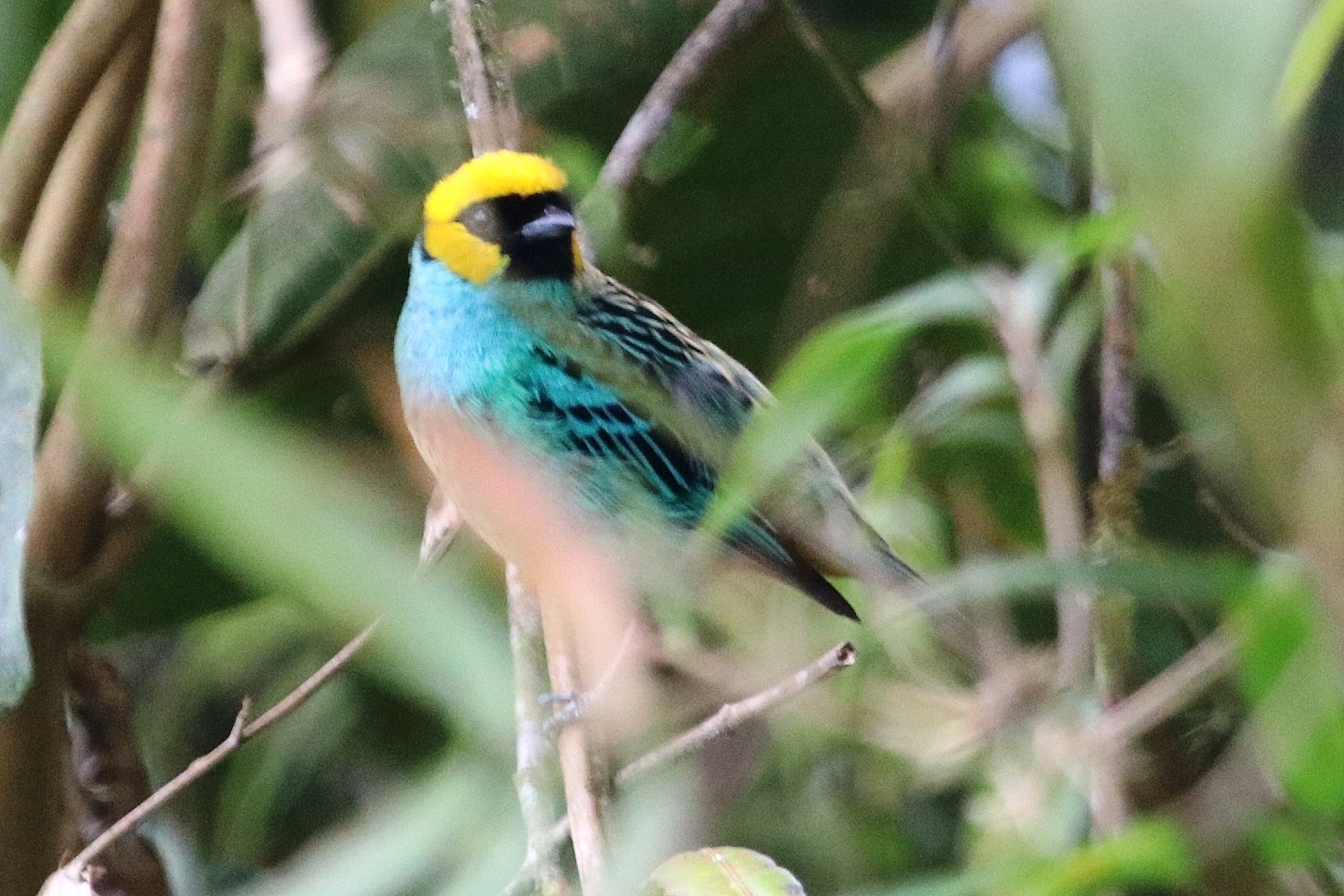
The saffron-crowned tanager (Tangara xanthocephala) is a species of bird in the family Thraupidae. Found in the northern Andes of Bolivia, Colombia, Ecuador, Peru, and Venezuela, it inhabits cloud forest, forest edges, and secondary forest, preferring areas with mossy trees. It is an average-sized species of tanager with a blue-green body and yellow head with a black forecrown, lores, orbital area, and chin.
It forages in pairs or small groups of 3–7 individuals that are part of mixed-species flocks. It is the most frugivorous species in the genus Tangara, although it also feeds on insects. It forms breeding pairs and is thought to be socially monogamous. The only known nest contained a clutch of two eggs. It is listed as being a species of least concern by the International Union for Conservation of Nature (IUCN) on the IUCN Red List, but may be threatened by habitat destruction.
Taxonomy and systematics
The saffron-crowned tanager was first described as Callospiza xanthocephala by Johann Tschudi in 1844 based on a specimen from Peru. The generic name Tangara is from the Tupí word tangara, meaning "dancer". The specific name xanthocephala is from the Ancient Greek ξανθος (xanthos), meaning yellow, and κεφαλος (kephalos), meaning -headed. Saffron-crowned tanager is the official common name designated by the International Ornithologists' Union. Other names for the species include saffron crowned tanager.
It is one of 27 species in the genus Tangara. Within the genus, it was placed in a species group with the blue-whiskered tanager, green-and-gold tanager, emerald tanager, golden tanager, silver-throated tanager, golden-eared tanager, and flame-faced tanager by Isler and Isler in 1987. This placement is supported by a 2004 study of mitochondrial DNA by Kevin Burns and Kazuya Naoki. Within the species group, the saffron-crowned tanager is sister to a clade formed by blue-whiskered tanager, green-and-gold tanager, emerald tanager, golden tanager, silver-throated...