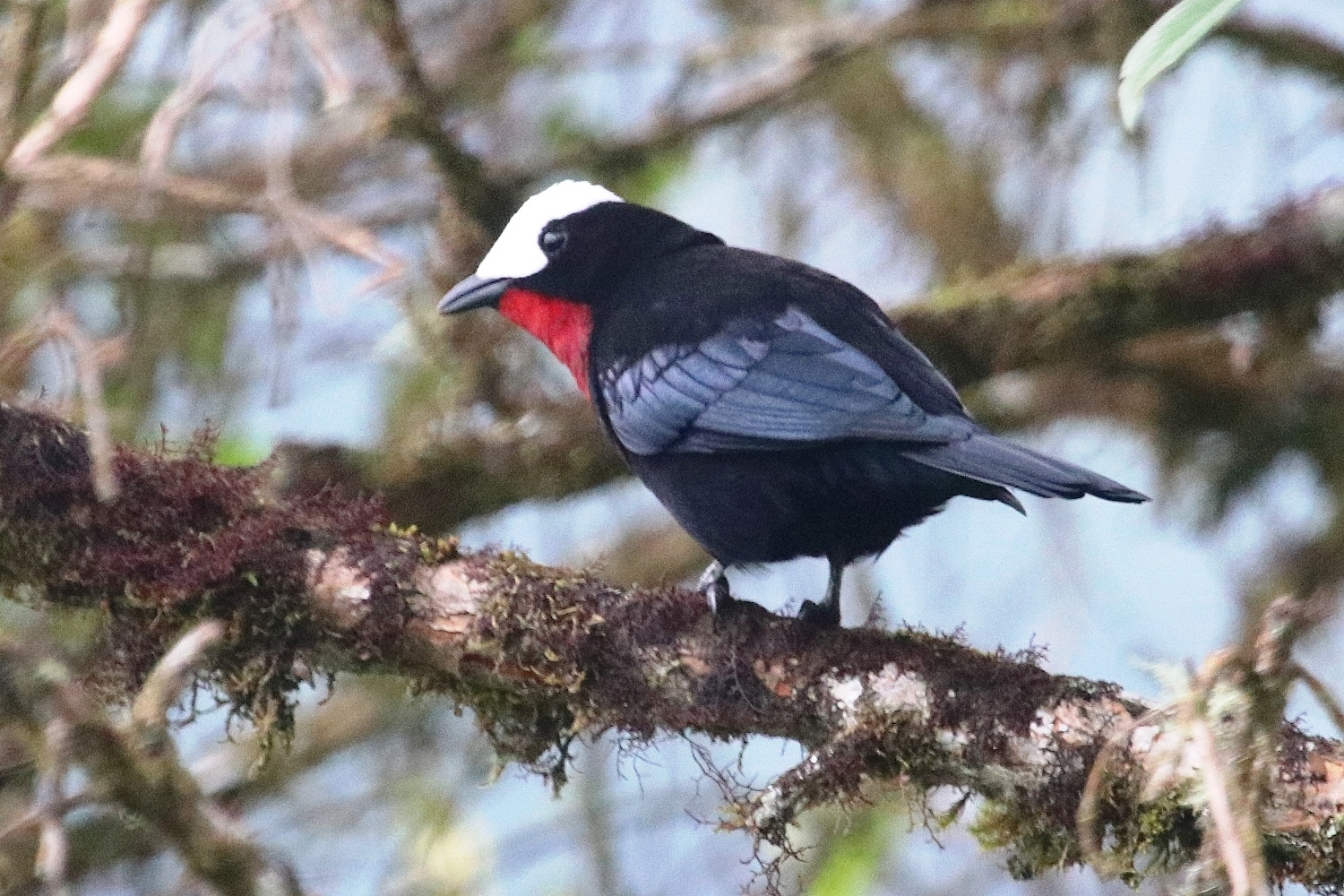
The white-capped tanager (Sericossypha albocristata) is a Vulnerable species of bird in the family Thraupidae, the tanagers and allies. It is found from Venezuela to Peru.
Taxonomy and systematics
The white-capped tanager was formally described in 1843 by the French ornithologist Frédéric de Lafresnaye under the Latin name Tangara (Lamprotes) albo-cristatus. The species is now the only species in the genus Sericossypha that was introduced in 1844 by René Lesson. The genus name combines the Ancient Greek sērikos meaning "silken" with kossuphos meaning "blackbird". The specific epithet albocristata is formed from the Latin albus meaning "white" with cristatus meaning "crested" or "plumed". The species is monotypic: No subspecies are recognized.
Description
The white-capped tanager is the heaviest member of its family. It averages 24 cm (9.4 in) long and weighs 95 to 125 g (3.4 to 4.4 oz). The species is slightly sexually dimorphic. Adult males have pure white lores, forehead, and crown with a plush texture. Their body is mostly velvety black with a bright crimson throat and breast. Their wings and tail are glossy bluish black. Adult females are less glossy than males and have a duskier throat and breast that is almost purple. Juveniles have a buffy gray crown and only a small amount of red on their chin and upper throat.
Distribution and habitat
The white-capped tanager has a disjunct distribution. It is found intermittently on the eastern slope of the Andes from extreme southern Táchira in western Venezuela south along Colombia's Eastern Andes and eastern Ecuador into Peru as far as Junín Department. It also is found in Colombia in the upper Magdalena River valley and on both slopes of the Central Andes.
The white-capped tanager inhabits the interior of humid montane forest heavy with mosses. It is found less frequently on the forest edges and secondary forest. In elevation it ranges between 1,800 and 3,000 m (5,900 and 9,800 ft) in Venezuela, between 2,000 and...