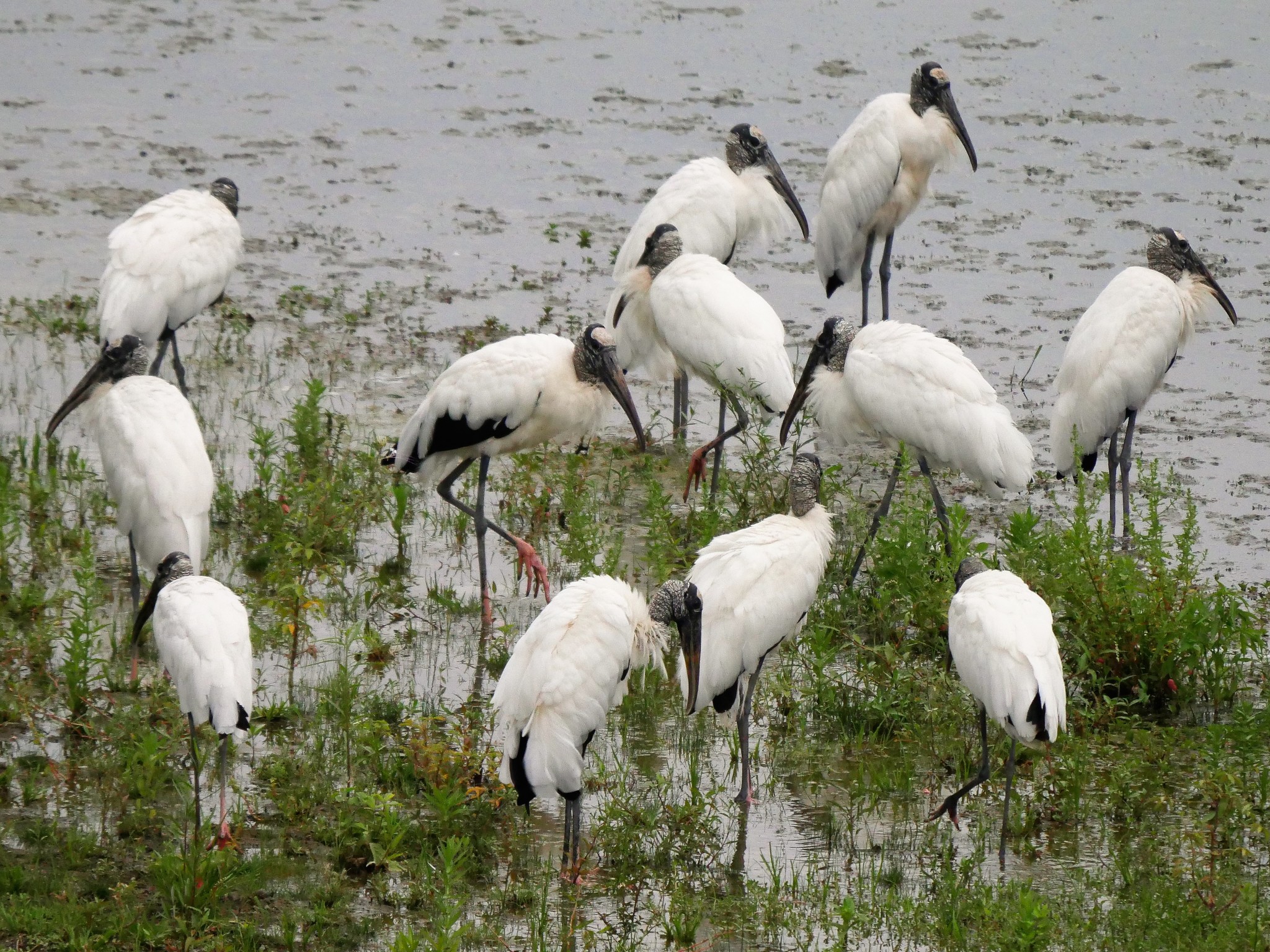
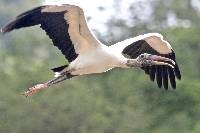
The wood stork (Mycteria americana) is a large wading bird in the family Ciconiidae (storks). Originally described in 1758 by Carl Linnaeus, this stork is native to the subtropics and tropics of the Americas, where it persists in habitats with fluctuating water levels. It is the only stork species that breeds in North America. The head and neck are bare of feathers, and dark grey in colour. The plumage is mostly white, with the exception of the tail and some of the wing feathers, which are black with a greenish-purplish sheen.
Globally, the wood stork is considered to be of least concern by the International Union for Conservation of Nature. In the United States, the wood stork was previously classified as endangered due to loss of suitable feeding habitat in the Florida Everglades, its historical population stronghold in the country. The species has been subsequently downlisted to threatened after northward range expansion and increased population size.
Taxonomy and etymology
The wood stork was first formally given its binomial name Mycteria americana by Linnaeus in 1758. Linnaeus originally named two separate species, M. americana and Tantalus loculator, based on different and slightly erroneous accounts, in his book Systema Naturae. It was later identified that these binomials referred to the same species, making M. americana and T. loculator synonymous. M. americana takes priority as it occurs before T. loculator.
The accepted generic name Mycteria derives from the Greek μυκτήρ : myktēr, meaning snout or trunk, and the species name americana references the distribution of this stork.
Likely because of its decurved bill, the wood stork has formerly been called the "wood ibis", although it is not an ibis. It also has been given the name of the "American wood stork", because it is found in the Americas. Its regional names include "flinthead", "stonehead", "ironhead", "gourdhead", and "preacher".