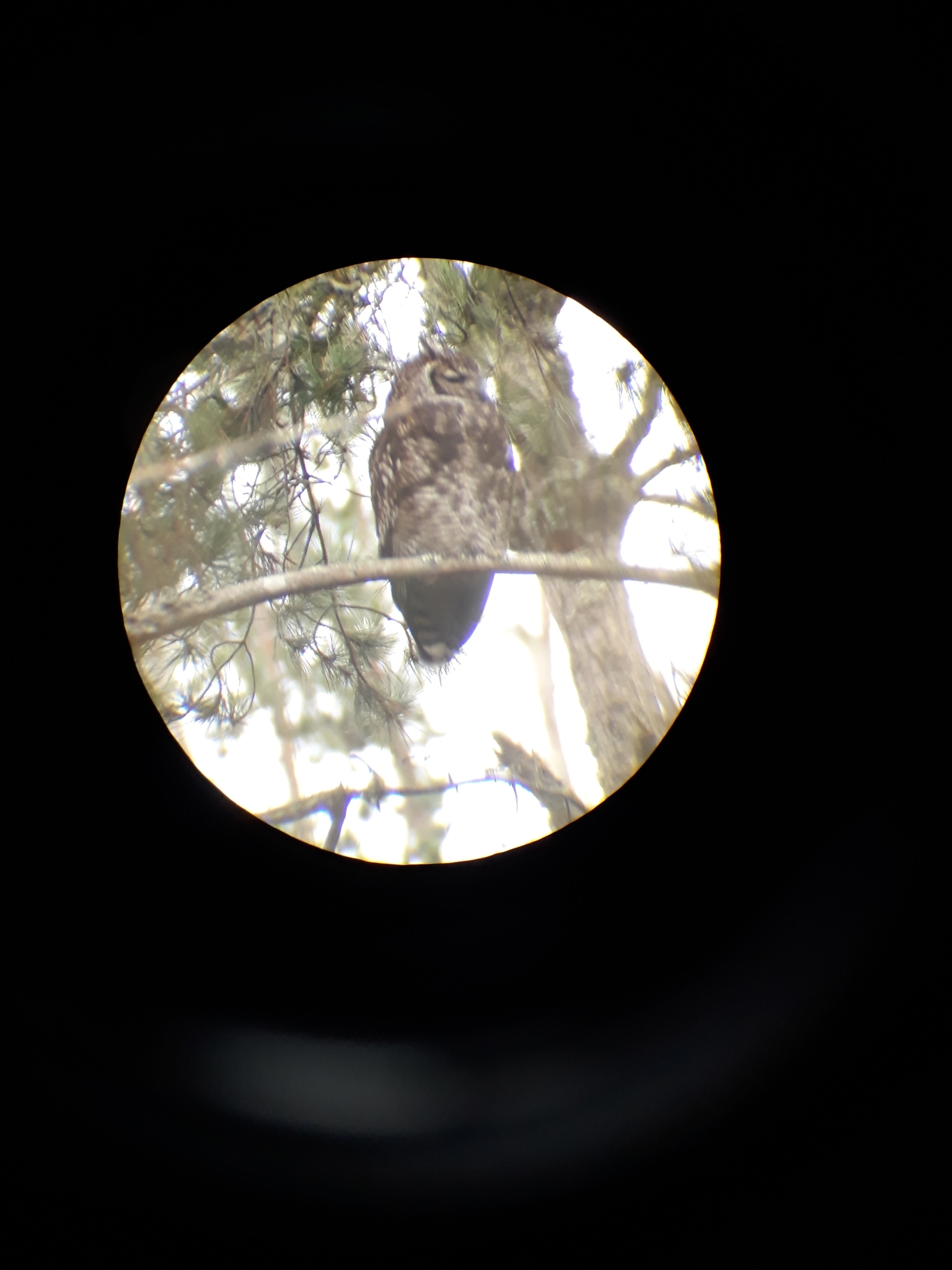
The great horned owl (Bubo virginianus), also known as the tiger owl (originally derived from early naturalists' description as the "winged tiger" or "tiger of the air") or the hoot owl, is a large owl native to the Americas. It is an extremely adaptable bird with a vast range and is the most widely distributed true owl in the Americas. Its diet consists primarily of rabbits and hares, rats and mice, and voles; it remains one of the few regular predators of skunk. Hunting also includes rodents, larger mid-sized mammals, birds, reptiles, amphibians, and invertebrates.
In ornithological study, the great horned owl is often compared to the Eurasian eagle-owl (Bubo bubo), a closely related species, which occupies the same ecological niche in Eurasia despite its notably larger size. The great horned owl is also compared to the red-tailed hawk (Buteo jamaicensis), with which it often shares similar habitat, prey, and nesting habits by day; thus the red-tailed hawk is something of a diurnal ecological equivalent. The great horned owl is one of the earliest nesting birds in North America, often laying eggs weeks or even months before other raptorial birds.
Taxonomy
Bubo virginianus nacurutu
The great horned owl was formally described in 1788 by the German naturalist Johann Friedrich Gmelin in his revised and expanded edition of Carl Linnaeus's Systema Naturae. He placed it with the other owls in the genus Strix and coined the binomial name Strix virginia. Gmelin based his description on that of English naturalist George Edwards who had described and illustrated the great horned owl in 1747 in the second volume of his A Natural History of Uncommon Birds. Edwards had seen a live specimen from Virginia at the house of the Earl of Burlington in Chiswick. Edwards also owned a preserved specimen, and another specimen formed part of the Leverian collection. The great horned owl is now placed in the genus Bubo that was introduced in 1805 by André Duméril.