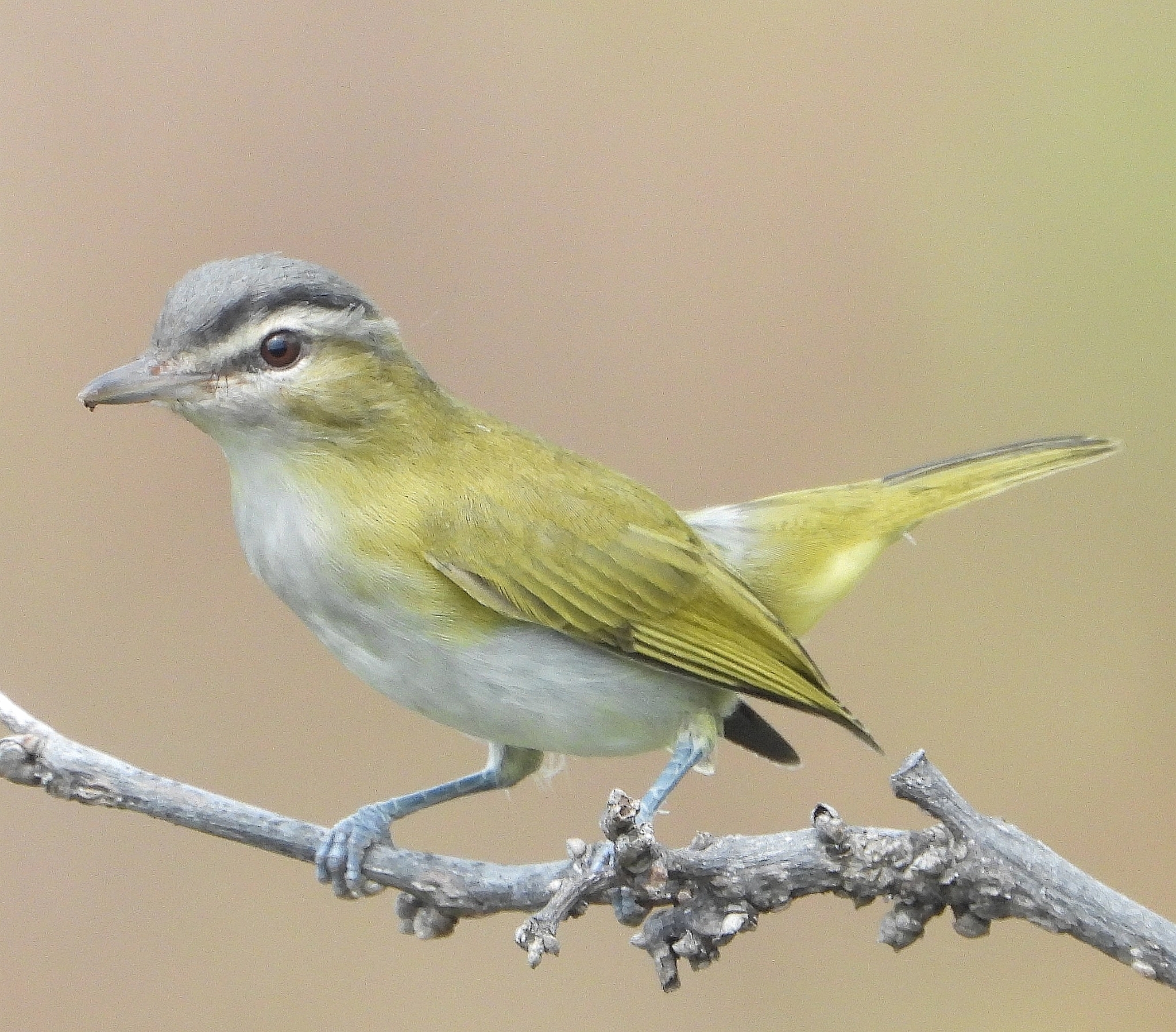
The red-eyed vireo (Vireo olivaceus) is a small American songbird. It is somewhat warbler-like but not closely related to the New World warblers (Parulidae). Common across its vast range, this species is not considered threatened by the IUCN.
Vireo is a Latin word referring to a green migratory bird, perhaps the female golden oriole, possibly the European greenfinch. The specific olivaceus is Neo-Latin for 'olive-green', from Latin oliva ('olive').
Description and systematics
Adults are mainly olive-green on the upper parts with white underparts; they have a red iris and a grey crown edged with black. There is a dark blackish line through the eyes and a wide white stripe just above that line. They have thick blue-grey legs and a stout bill. They are yellowish on the flanks and undertail coverts (though this is faint in some populations).
In the past, the yellow-green vireo (V. flavoviridis), the chivi vireo (V. chivi), and the Noronha vireo (V. gracilirostris) have been considered to be conspecific with the red-eyed vireo; the chivi vireo was split most recently. Other closely related species include the black-whiskered vireo (V. altiloquus) and the Yucatan vireo (V. magister).
Measurements:
Both sexes:
Length: 4.7–5.1 in (12–13 cm)
Weight: 0.4–0.9 oz (12–26 g)
Wingspan: 9.1-9.8 in (23–25 cm)
Song
Song
Problems playing this file? See media help.
Red-eyed vireos are one of the most prolific singers in the bird world. They usually sing high up in trees for long periods of time in a question-and-answer rhythm. This species holds the record for most songs given in a single day among bird species, with more than 20,000 songs in one day.
Songs generally consist of 1–5 syllables between 2 and 6 kHz. Songs are usually spaced 0.8–1 seconds apart, although at times they may sing at a slower or faster rate. Red-eyed vireos have a large repertoire, with one study finding an average of 31.4 song types per bird and one individual singing 73...