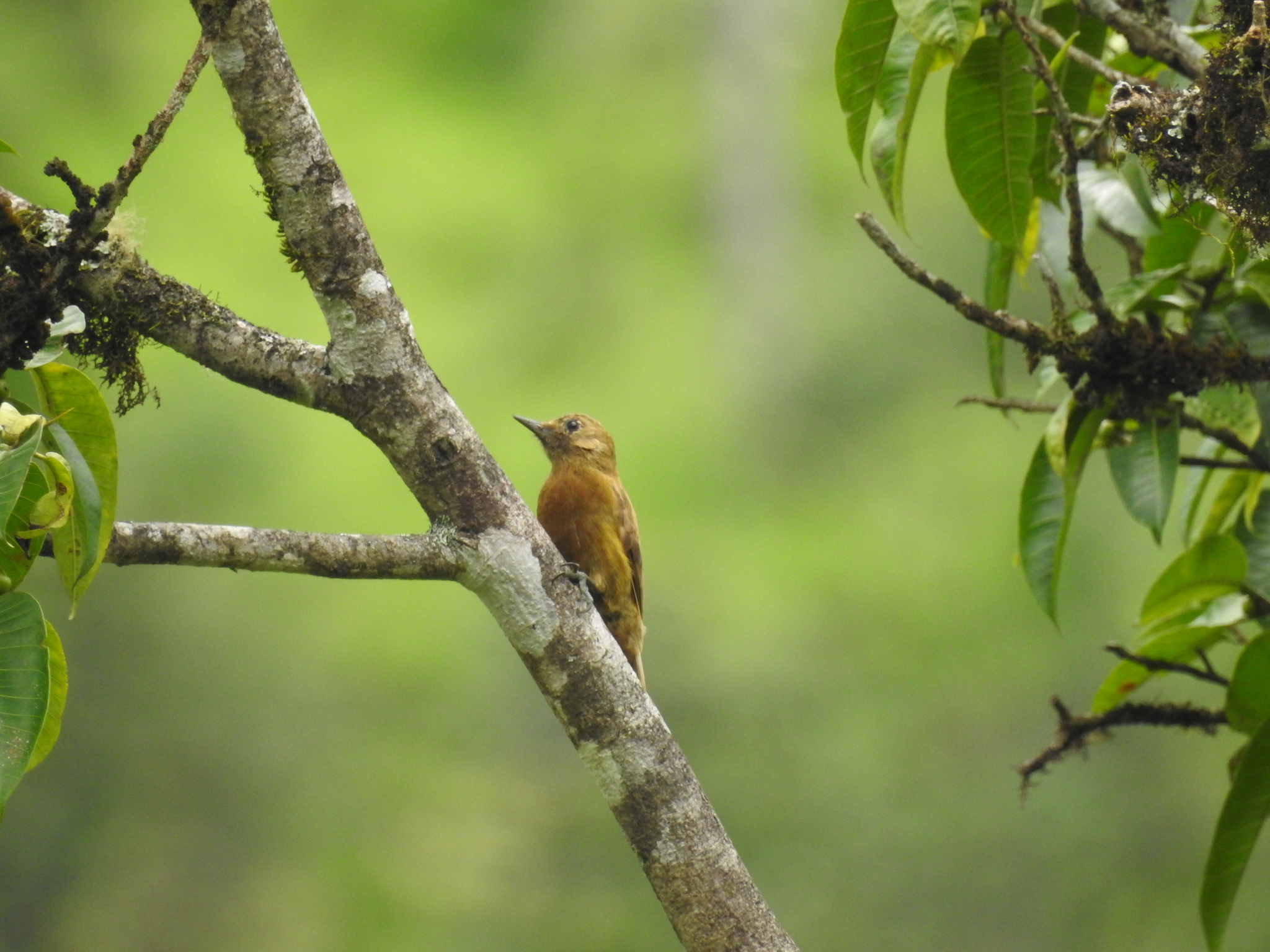
Leuconotopicus is a genus of woodpeckers in the family Picidae native to North and South America.
Taxonomy
The genus was erected by the French ornithologist Alfred Malherbe in 1845 with Strickland's woodpecker (Leuconotopicus stricklandi) as the type species. The name Leuconotopicus combines the Ancient Greek leukos meaning "white", nōton meaning "back" and pikos meaning "woodpecker". The genus is sister to the genus Veniliornis and is one of eight genera placed in the tribe Melanerpini within the woodpecker subfamily Picinae. The species now placed in this genus were previously assigned to Picoides.
The genus contains the following six species:
Genus Leuconotopicus – Malherbe, 1845 – six species
Common name
Scientific name and subspecies
Range
Size and ecology
IUCN status and estimated population
Red-cockaded woodpecker Male
Female
Leuconotopicus borealis (Vieillot, 1809)
southeastern United States from Florida to Virginia, as far west as eastern Texas and Oklahoma; formerly Kentucky, Maryland, Missouri, New Jersey, and Tennessee
Size:
Habitat:
Diet:
NT
Smoky-brown woodpecker Male
Female
Leuconotopicus fumigatus (D'Orbigny, 1840)
Five subspecies
L. f. oleagineus (Reichenbach, 1854)
L. f. sanguinolentus (Sclater, P.L., 1859)
L. f. reichenbachi (Cabanis & Heine, 1863)
L. f. fumigatus (D'Orbigny, 1840)
L. f. obscuratus (Chapman, 1927)
Argentina, Belize, Bolivia, Colombia, Costa Rica, Ecuador, El Salvador, Guatemala, Honduras, Mexico, Nicaragua, Panama, Peru, and Venezuela
Size:
Habitat:
Diet:
LC
Arizona woodpecker Male
Female
Leuconotopicus arizonae (Hargitt, 1886)
southern Arizona and New Mexico and the Sierra Madre Occidental of western Mexico
Size: