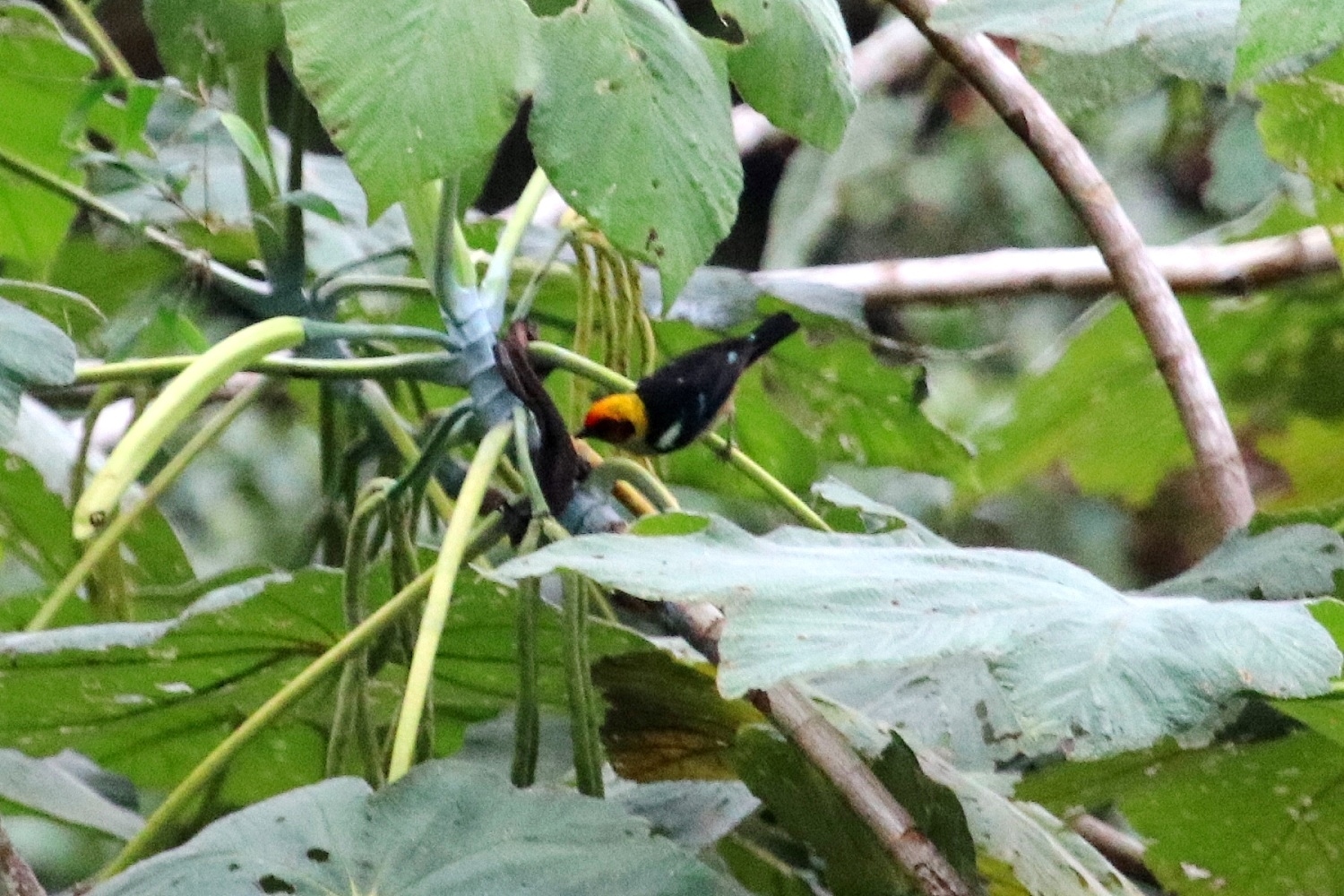
The flame-faced tanager (Tangara parzudakii) is a species of bird in the tanager family Thraupidae. It is endemic to South America and is found in the eastern Andes of Colombia, Ecuador, Peru and Venezuela. Its natural habitat is subtropical or tropical moist montane forests. It is a distinctive-looking species with black and opalescent green upperparts, opalescent green and buff underparts, and a deep red and yellow face. The subspecies lunigera lacks the deep red on the face, which is replaced with orangish-red.
It is omnivorous and feeds on fruit and arthropods. Foraging is conducted nearly exclusively on mossy branches. Breeding occurs in the rainy season. Eggs are laid in clutches of two, and are white with pale brown flecking concentrated on the larger end. Fledglings are fed by both parents. The flame-faced tanager is listed as being of least concern by the International Union for Conservation of Nature (IUCN) on the IUCN Red List. However, it is facing population declines due to habitat destruction.
Taxonomy and systematics
The flame-faced tanager was first described as Tanagra Parzudakii by Frédéric Lafresnaye in 1843, on the basis of specimens collected around Santa Fe, in Bogota, Colombia. The generic name Tangara comes from the Tupí word tangara, which means dancer. The specific epithet parzudakii is in honor of the French collector and natural history dealer Charles Parzudaki. Flame-faced tanager is the official common name designated by the International Ornithologists' Union (IOC). Other names for the species include flame faced tanager.
The flame-faced tanager is one of 27 species in the genus Tangara. Within the genus, it is put in a species group with the blue-whiskered tanager, green-and-gold tanager, emerald tanager, golden tanager, silver-throated tanager, saffron-crowned tanager, and golden-eared tanager. This placement has been supported by DNA evidence. However, it is not known which of the species in the group are sister to the flame-throated...