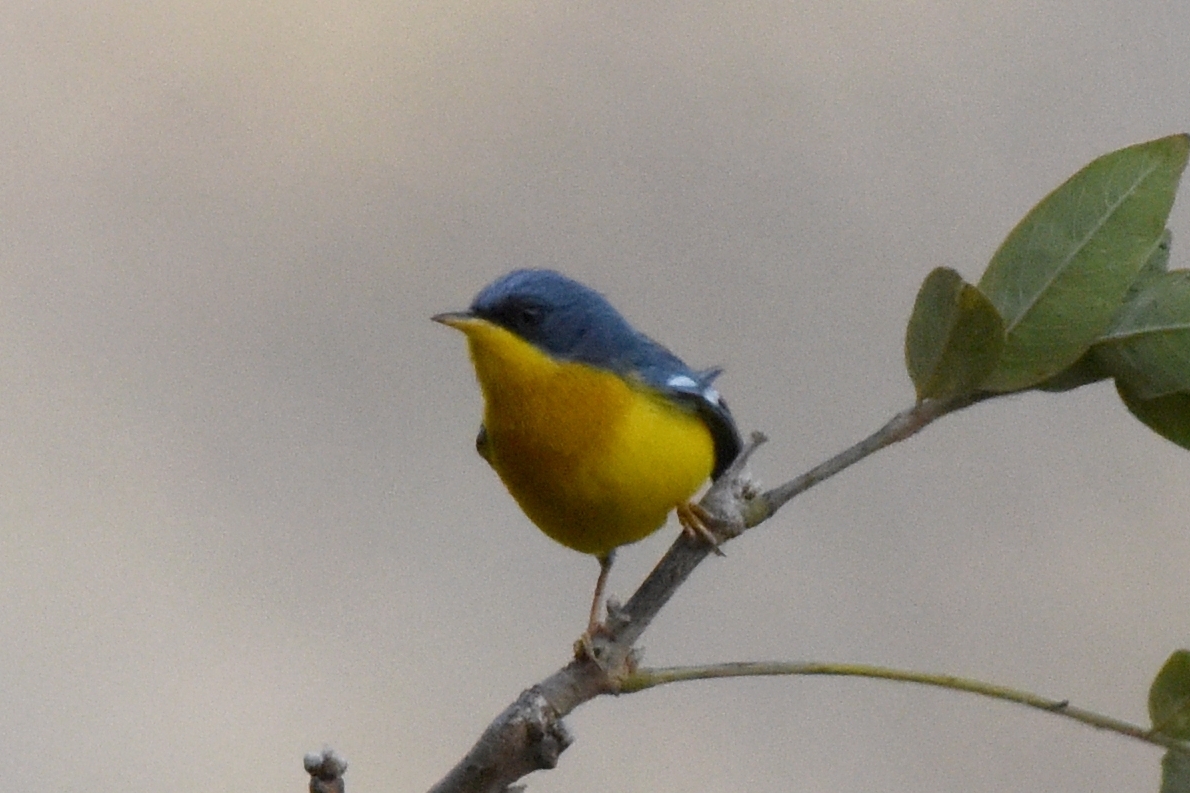
The tropical parula (Setophaga pitiayumi) is a species of passerine bird in the family Parulidae, the New World warblers. It is found in the U. S. state of Texas, Mexico, and every Central American country. Its range continues in every mainland South American country (though in Chile only as a vagrant), on Trinidad, and as a vagrant on the Falkland Islands.
Taxonomy and systematics
The tropical parula was formally described in 1817 as Sylvia pitiayumi. It was sequentially placed in genera Parula and Dendroica. Beginning in 2011 taxonomic systems merged both of those genera into its present genus Setophaga. In the twentieth century some authors proposed that the tropical parula and the northern parula (Setophaga americana) should be lumped as a single species. They do form a superspecies. The tropical parula has also borne the English names Sennett's warbler, olive-backed warbler, Pitiaymi warbler, and tropical parula warbler.
The tropical parula's further taxonomy is unsettled. The IOC, AviList, the Clements taxonomy, and the American Ornithological Society assign it these nine subspecies:
S. p. nigrilora (Coues, 1878)
S. p. pulchra (Brewster, 1889)
S. p. insularis (Lawrence, 1871)
S. p. graysoni (Ridgway, 1887)
S. p. inornata (Baird, SF, 1864)
S. p. cirrha (Wetmore, 1957)
S. p. pacifica (Berlepsch & Taczanowski, 1884)
S. p. alarum (Chapman, 1924)
S. p. pitiayumi (Vieillot, 1817)
However, since 2016 BirdLife International's Handbook of the Birds of the World has treated S. p. graysoni as a full species, the Socorro warbler.
This article follows the majority nine-subspecies model.
Description
The tropical parula is about 11 cm (4.3 in) long and weighs 6.5 to 8.0 g (0.23 to 0.28 oz). Adult males of subspecies S. p. nigrilora have a mostly blue-gray head with black lores and a small black mask. Their upperparts are also mostly blue-gray with an olive mantle. Their wings are blue-gray with white tips on the greater and median coverts that show as...