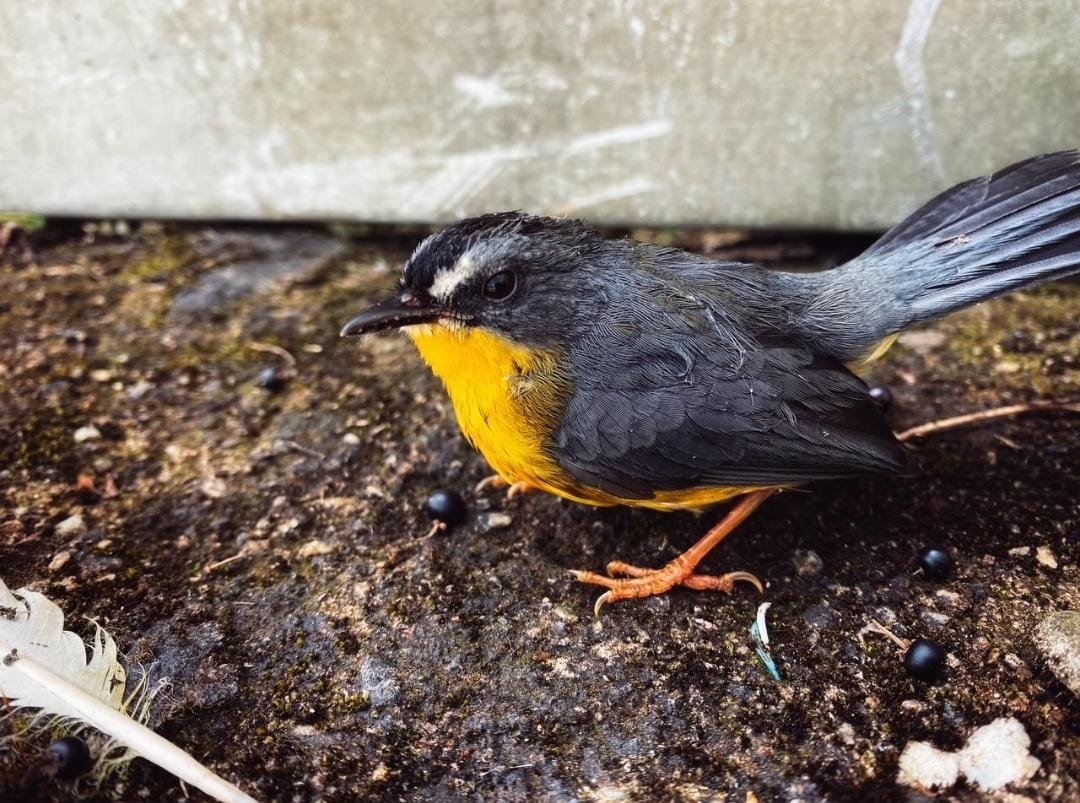
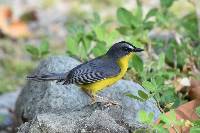
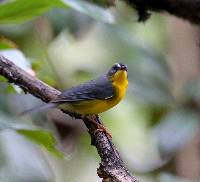
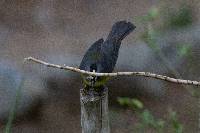
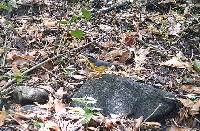
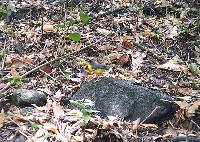
The grey-and-gold warbler (Myiothlypis fraseri) is a species of bird in the family Parulidae, the New World warblers. It is found in Ecuador and Peru.
Taxonomy and systematics
The grey-and-gold warbler was formally described in 1884 with the binomial Basileuterus fraseri. The specific epithet fraseri honors Louis Fraser, who collected the first specimen. By 2007 taxonomic systems had begun to resurrect genus Myiothlypis, which had been erected in 1850, for the grey-and-gold warbler and many other species.
The grey-and-gold warbler has two subspecies, the nominate M. f. fraseri (Sclater, PL, 1884) and M. f. ochraceicrista (Chapman, 1921).
Description
The grey-and-gold warbler is about 14 cm (5.5 in) long. Males weigh an average of 12 g (0.42 oz) and females average 12 g (0.42 oz). The sexes have the same plumage. Adults of the nominate subspecies have a lemon-yellow crown stripe with black borders, black lores, and a white streak above the lores on an otherwise blue-gray face. The center of their back is dull olive and the rest of their upperparts are blue-gray. Their wings and tail are blackish gray with blue-gray feather edges. Their chin is white and the rest of their underparts are yellow that is lightest on the undertail coverts. Subspecies M. f. ochraceicrista has an ochraceous-orange crown stripe and is otherwise like the nominate. Both subspecies have a brown iris, a black bill, and yellow-brown legs and feet.
Distribution and habitat
Subspecies M. f. ochraceicrista of the grey-and-gold warbler is the more northerly of the two. It is found in western Ecuador from southern Esmeraldas Province south at least to southern Guayas Province and on Puna Island in the Gulf of Guayaquil. The nominate is found west of the Andes from Chimborazo Province in central Ecuador south into far northwestern Peru's Lambayeque Department. The species inhabits the understory of a variety of landscapes including drier to humid deciduous forest and scrublands. The two subspecies possibly...