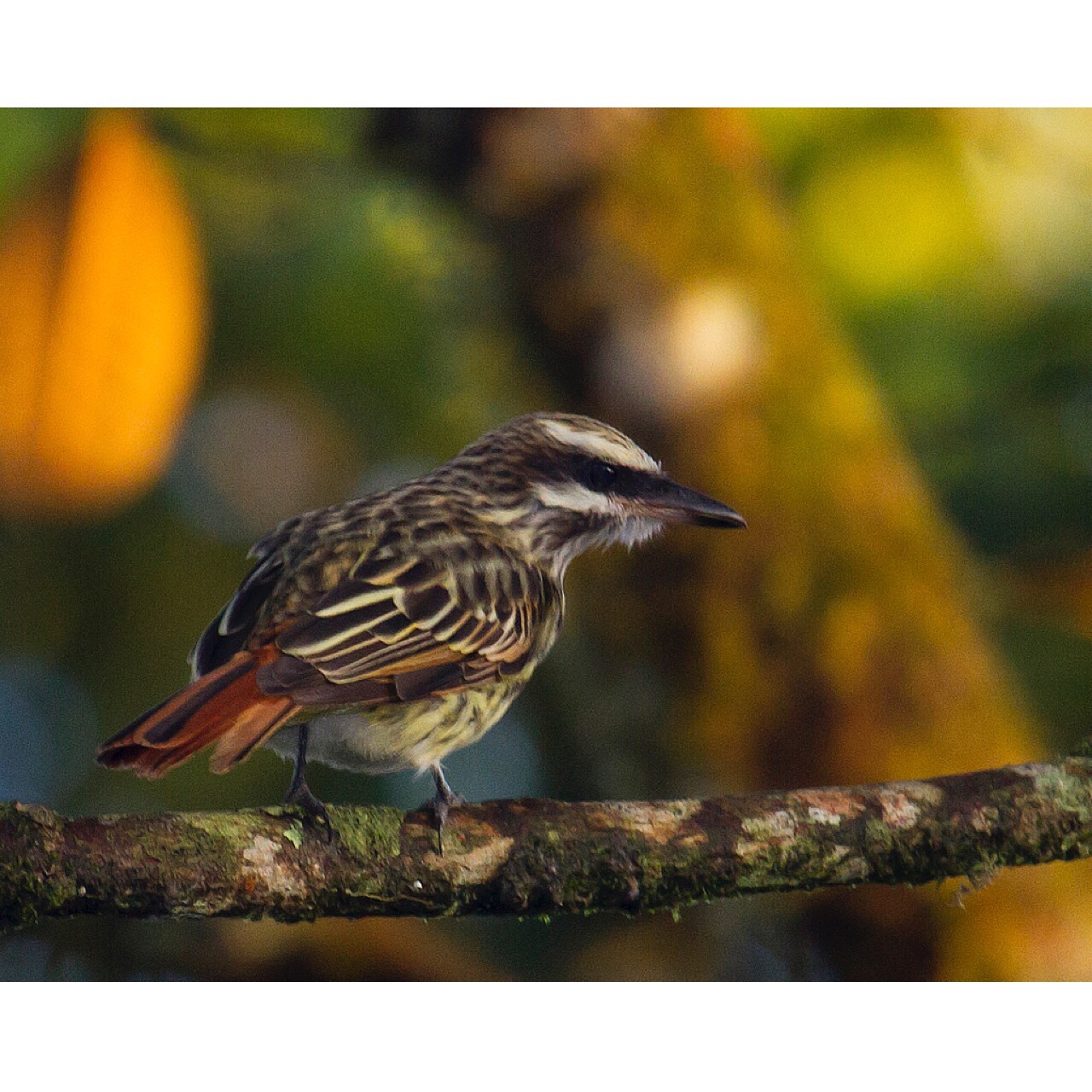
The streaked flycatcher (Myiodynastes maculatus) is a passerine bird in the family Tyrannidae, the tyrant flycatchers. It is found in Mexico, in every South American country except El Salvador, in Trinidad and Tobago, in every mainland South American country (though only as a vagrant to Chile), and as a vagrant to Bonaire.
Taxonomy and systematics
The streaked flycatcher's taxonomy is unsettled. The IOC, the North and South American Classification Committees of the American Ornithological Society, and the Clements taxonomy assign it these seven subspecies:
m. insolens Ridgway, 1887
M. m. difficilis Zimmer, JT, 1937
M. m. nobilis Sclater, PL, 1859
M. m. chapmani Zimmer, JT, 1937
M. m. maculatus (Statius Müller, PL, 1776)
M. m. tobagensis Zimmer, JT, 1937
M. m. solitarius (Vieillot, 1819)
What is now M. m. solitarius was originally described as a species, Tyrannus solitarius. Though it was later moved to genus Myiodynastes it was treated by many authors as a full species into the twentieth century. By about the middle of the century most taxonomists had reassigned it as a subspecies of M. maculatus. BirdLife International's Handbook of the Birds of the World (HBW) long treated the streaked flycatcher as a single species but beginning in 2016 split M. solitarius as the "southern streaked flycatcher". It calls M. maculatus with other six subspecies the "northern streaked flycatcher". Clements does recognize some partial separation between the two within the single species, calling them respectively the "streaked flycatcher (southern)" and "streaked flycatcher (northern)".
This article follows the single-species, seven-subspecies, model.
Canopy Camp - Darien, Panama
Description
The streaked flycatcher is 20.5 to 23 cm (8.1 to 9.1 in) long and weighs 36.5 to 50 g (1.3 to 1.8 oz). The sexes have the same plumage. Adults of the nominate subspecies M. m. maculatus have an olive to olive-brown crown and nape with thin cinnamon edges on the feathers and a large,...