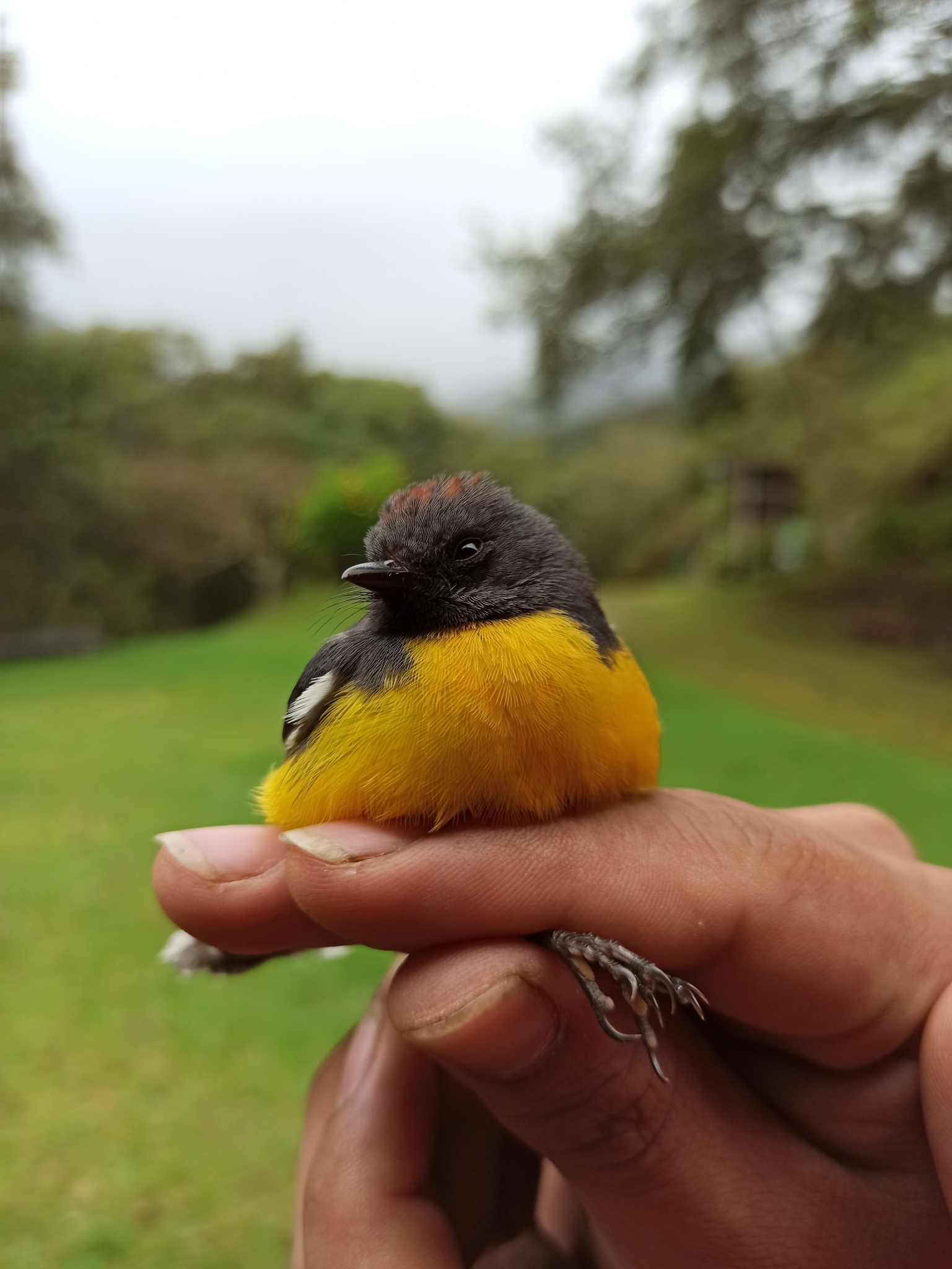
Whitestarts are New World warblers in the genus Myioborus. The English name refers to the white outer tail feathers which are a prominent feature of the members of this genus ("start" is an archaic word for "tail"). The species in this genus are also often called "redstarts".
Taxonomy
The genus Myioborus was introduced in 1865 by the American naturalist Spencer Baird with Setophaga verticalis d'Orbigny & Lafresnaye, 1837, as the type species. This taxon is now considered to be a subspecies of the slate-throated whitestart (Myioborus miniatus). The genus name combines the Ancient Greek μυια/muia, μυιας/muias meaning "fly" with -βορος/-boros meaning "-devouring".
The stronghold of the whitestarts is northern South America, although a few species range along the Andes as far south as north-western Argentina, while others range north through Central America and as far north as the United States, in the case of the painted whitestart. Most species are restricted to mountain forest and woodland. The ancestral Myioborus warblers, together with those in the genus Basileuterus seem to have colonised South America early, perhaps before it was linked to the northern continent, and these two genera provide most of the resident warbler species of that region.
Name
Whitestart is the name used for all species in this genus by the International Ornithological Congress, while the Clements checklist, and the American Ornithological Society's North and South American Classification Committeess use "redstart". Myioborus species are not closely related to the various species called redstarts in the family Muscicapidae or to the American Redstart.