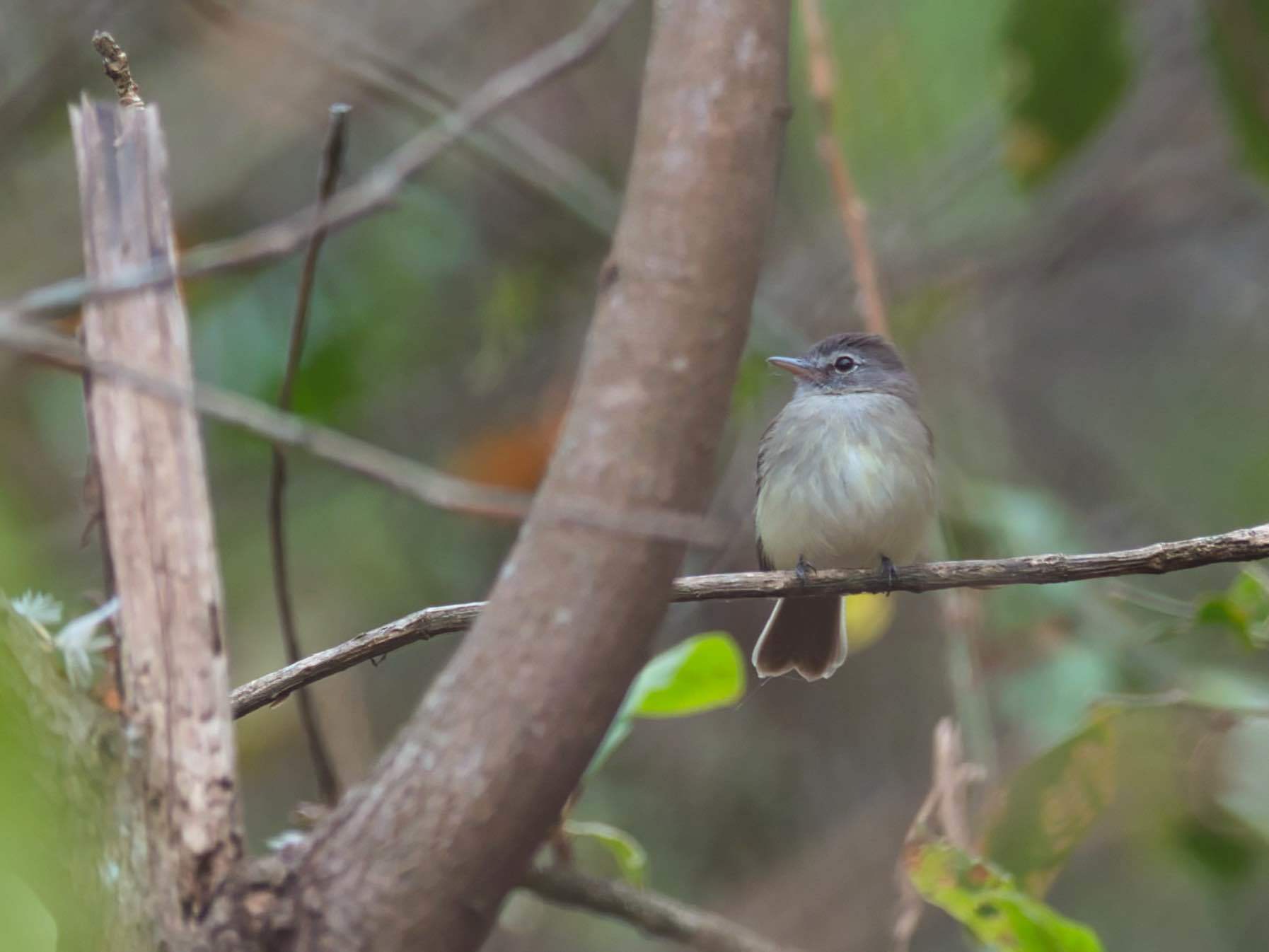
The grey-breasted flycatcher (Lathrotriccus griseipectus) is a species of bird in the family Tyrannidae, the tyrant flycatchers. It is found in Ecuador and Peru.
Taxonomy and systematics
The grey-breasted flycatcher was originally described as Empidonax griseipectus. Many authors retained it in Empidonax through most of the twentieth century. By the very early twenty-first century it was generally agreed to properly belong to Lathrotriccus which had been erected in 1986.
The grey-breasted flycatcher is monotypic. It shares genus Lathrotriccus with Euler's flycatcher (L. euleri).
Description
The grey-breasted flycatcher is about 13 cm (5.1 in) long and weighs about 11 g (0.39 oz). The sexes have the same plumage. Adults have a gray crown, nape, and cheeks. They have a whitish broken eye-ring and a faint whitish stripe above the lores. Their upperparts are gray with a tinge of brown or olive. Their wings are dusky with whitish ends on the coverts that show as two wing bars. Their secondaries and tertials have whitish edges. Their tail is dusky. Their throat is grayish white, their breast is washed with a darker gray, and their belly is white to whitish with a pale yellow tinge. They have a dark iris, a black maxilla, a pale orange-yellow mandible, and blackish brown legs and feet.
Distribution and habitat
The grey-breasted flycatcher has a disjunct distribution. It is found intermittently along the western slope of the Andes from central Esmeraldas Province in Ecuador south into northern Peru as far as northern Piura Department. It is also found on the eastern Andean slope in Peru in the valleys of the Chinchipe and Marañón rivers, respectively in eastern Piura and northern Cajamarca Department. The species apparently previously had a larger range. It inhabits the lower levels of humid and deciduous forest and woodland and especially favors viny tangles. In elevation it occurs from sea level to mostly below 800 m (2,600 ft) but reaches 1,700 m (5,600 ft) in...