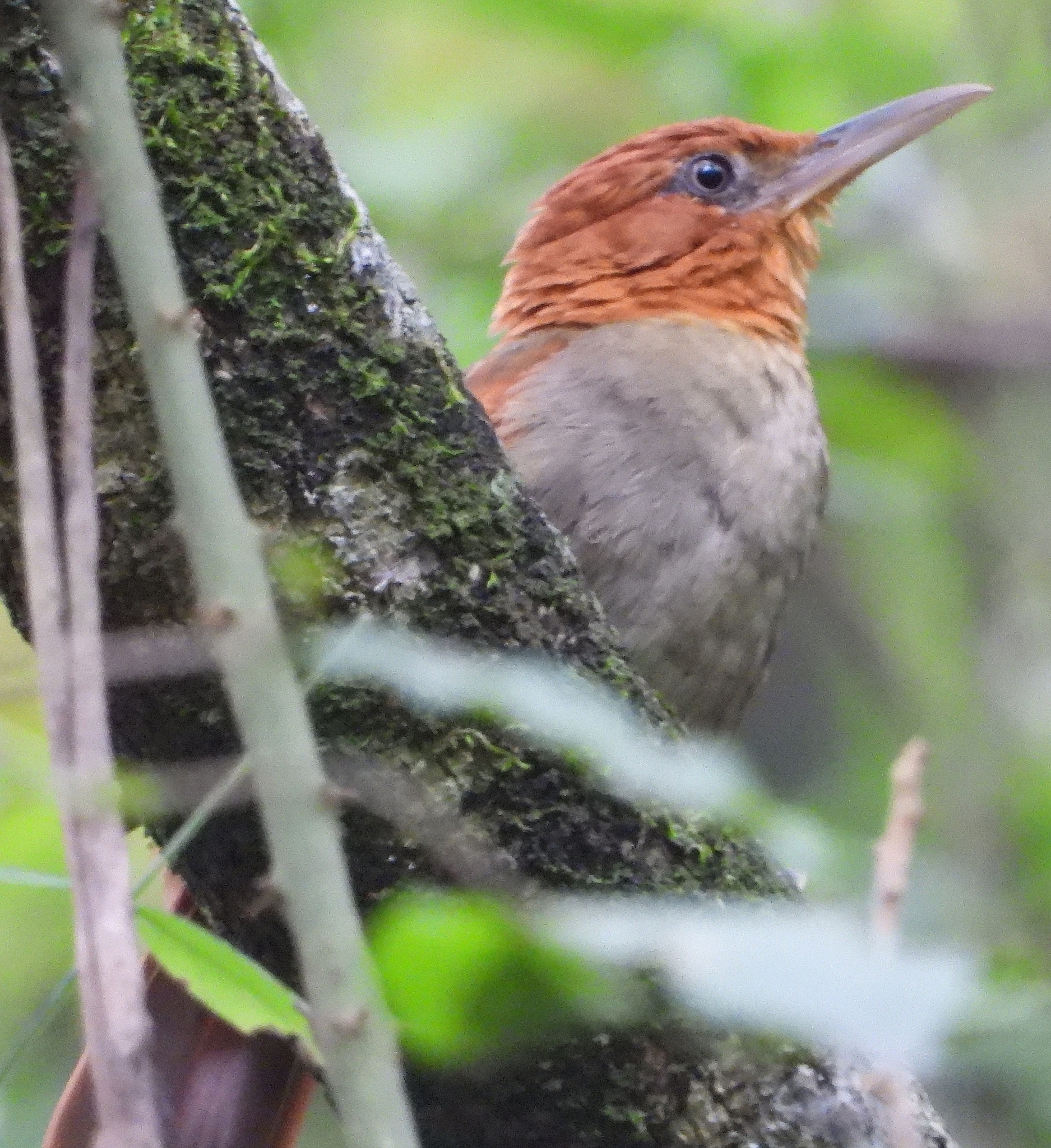
The henna-hooded foliage-gleaner (Clibanornis erythrocephalus) is a Near Threatened species of bird in the Furnariinae subfamily of the ovenbird family Furnariidae. It is found in Ecuador and Peru.
Taxonomy and systematics
The henna-hooded foliage-gleaner has previously been placed in genera Automolus and Hypocryptus but genetic data place it firmly in Clibanornis. It has two subspecies, the nominate C. e. erythrocephalus (Chapman, 1919) and C. e. palamblae (Zimmer, JT, 1935).
Description
The henna-hooded foliage-gleaner is about 21 cm (8.3 in) long and weighs about 48 g (1.7 oz). It is a large, boldly-patterned foliage-gleaner with a thick, slightly decurved, bill. The sexes have the same plumage. Adults of the nominate subspecies have a unique henna (orange-rufous) head, neck, wings, and tail. Their back is brownish olive. Their underparts are mostly pale brownish gray with a rufous crissum. Their iris is variable from yellow to gray-brown, their maxilla gray or blackish gray, their mandible whitish or horn with a dusky end, and their legs and feet olive or gray. Subspecies C. e. palamblae is a paler rufous where the nominate is henna, and has a grayer (less brownish) back and a paler buff breast and belly.
Distribution and habitat
The nominate subspecies of the henna-hooded foliage-gleaner has a disjunct distribution. One population is found in west-central Ecuador's Manabí and Guayas provinces. The other is from far southern Guayas and Auzuay provinces south through El Oro and Loja into Peru's extreme northwestern Department of Tumbes. Subspecies C. e. palamblae is found further south, in the Peruvian departments of Piura and Lambayeque. The species inhabits deciduous and semihumid forests and woodlands, mostly on the lower slopes of the west side of the Andes. It favors areas with many species of Malvaceae, the mallow family. In Ecuador it mainly occurs between elevations of 400 and 1,800 m (1,300 and 5,900 ft) and in Peru between 400 and 1,500 m (1,300 and...