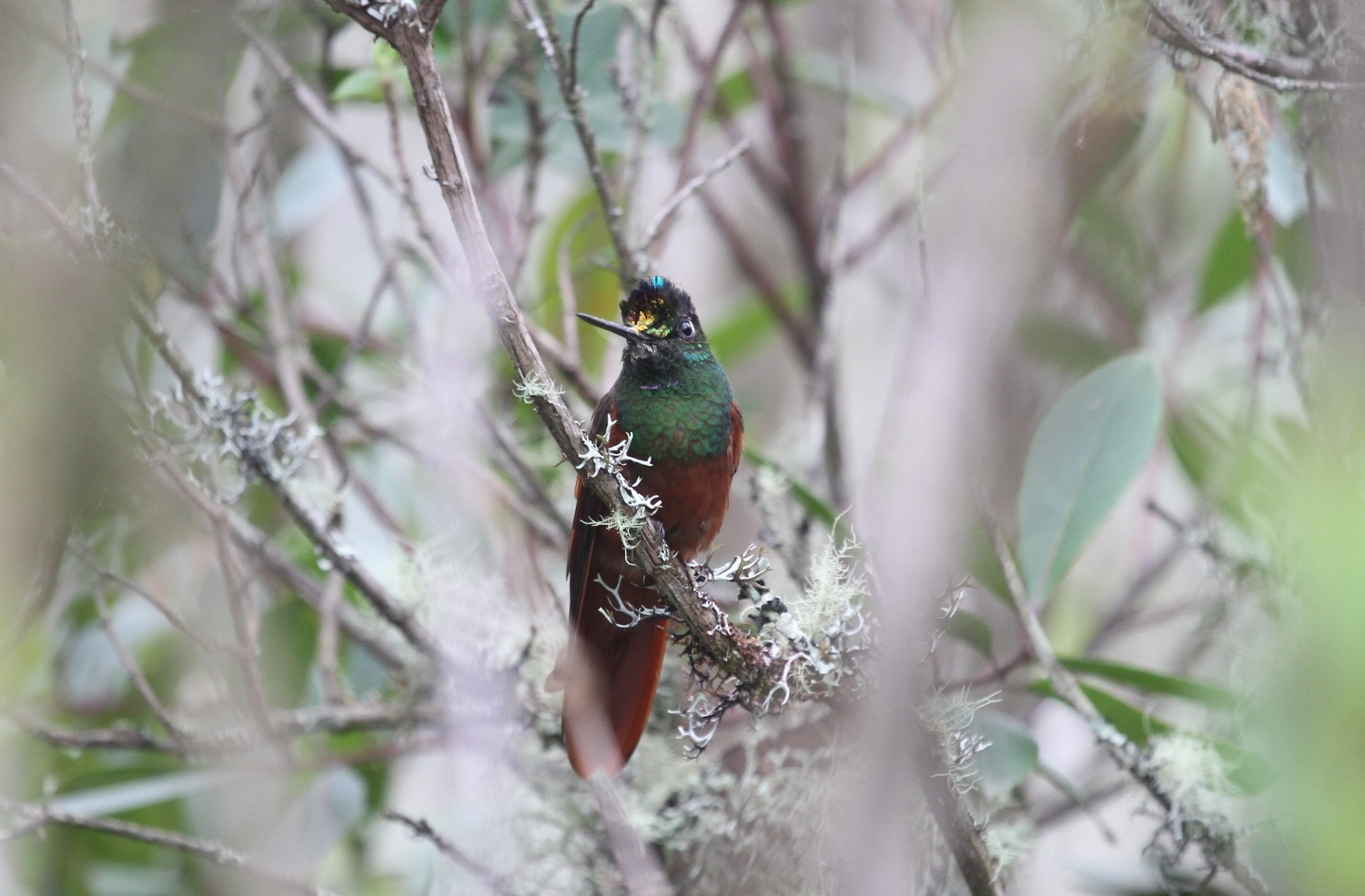
The rainbow starfrontlet (Coeligena iris) is a species of hummingbird in the "brilliants", tribe Heliantheini in subfamily Lesbiinae. It is found in Ecuador and Peru.
Taxonomy and systematics
The rainbow starfrontlet has these six subspecies:
C. i. hesperus Gould (1865)
C. i. iris Gould (1853)
C. i. aurora Gould (1853)
C. i. flagrans Zimmer, JT (1951)
C. i. eva Salvin (1897)
C. i. fulgidiceps Simon (1921)
Early in the 20th century, subspecies C. i. hesperus, C. i. aurora, C. i. eva were considered to be separate species. "Striking differences between subspecies suggest that several are very close to species status...further gathering and analysis of evidence is needed, however, in order to produce coherent revision of species limits in this complex."
Description
The rainbow starfrontlet is 12.5 to 14 cm (4.9 to 5.5 in) long. Males weigh 6.7 to 8.8 g (0.24 to 0.31 oz) and females 6 to 8.1 g (0.21 to 0.29 oz). Both sexes have a long, straight, black bill, with the female's being somewhat longer than the male's. Both sexes have a white spot behind the eye. Both sexes also have a forked tail, but the male's is more deeply indented than the female's. The subspecies differ significantly in their plumage.
Males of the nominate subspecies have a glittering yellow-green forecrown that transitions through golden yellow to blue on the crown. Their upperparts are mostly blackish with a green sheen and are chestnut on the lower back and rump. The throat and chest are glittering emerald green and the throat has a small violet spot. The belly, undertail coverts, and tail are chestnut. Nominate females are generally similar to the males but with less of a metallic sheen, and juveniles are similar to adult females.
Males of subspecies C. i. hesperus have a dark golden-red crown with a blue stripe, a golden green back, green underparts with a violet throat spot, and bronzy tips on the chestnut tail feathers. Females are a duller version of the male. Males of...