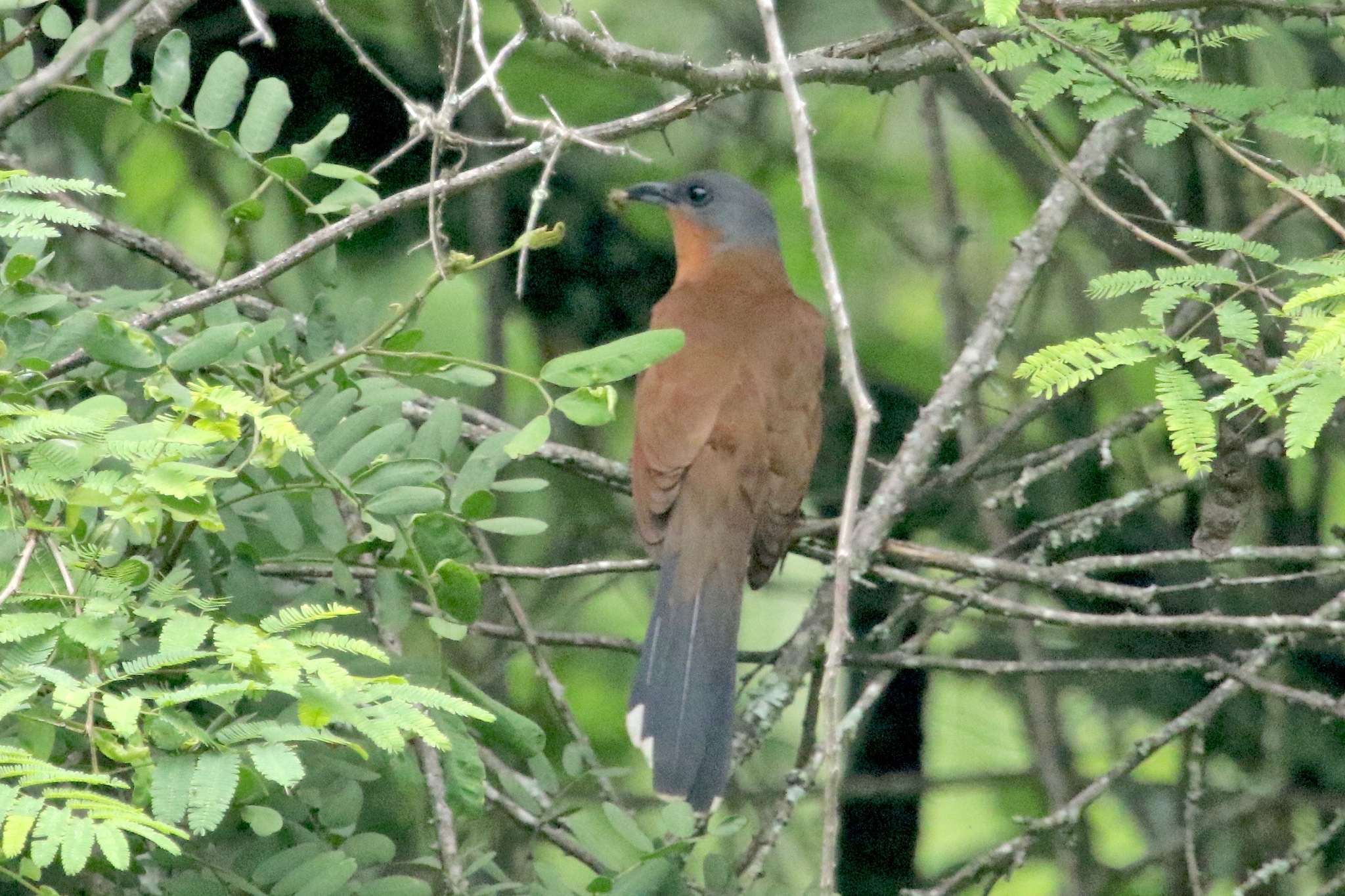
Coccyzus is a genus of cuckoos which occur in the Americas. The genus name is from Ancient Greek kokkuzo, which means to call like a common cuckoo. The genus includes the lizard cuckoos that were formerly included in the genus Saurothera.
Taxonomy
The genus Coccyzus was introduced in 1816 by the French ornithologist Louis Pierre Vieillot to accommodate a single species, Comte de Buffon's "Coucou de la Caroline", now the yellow-billed cuckoo. This which is therefore the type species. The genus name is from the Ancient Greek kokkuzō meaning "to cry cuckoo".
The results of a molecular phylogenetic study of the cuckoo family by Michael Sorenson and Robert Payne that was published in 2005 lead to a reorganization of some of the genera. Based on this study, the genera Saurothera (the lizard cuckoos) and Hyetornis (chestnut-bellied and bay-breasted cuckoos) were lumped with Coccyzus while the ash-colored cuckoo and dwarf cuckoo, at one time separated in Micrococcyx, were found to be closest relatives of the little cuckoo, formerly in Piaya. These three species were placed in the resurrected genus Coccycua.
Species
The genus contains 13 species:
Image
Common name
Scientific name
Distribution
Black-billed cuckoo
Coccyzus erythropthalmus
Eastern North America, the Caribbean, Central America, and the Andes
Yellow-billed cuckoo
Coccyzus americanus
Eastern United States, Central America, and eastern South America
Pearly-breasted cuckoo
Coccyzus euleri
Argentina, Bolivia, Brazil, Colombia, Ecuador, French Guiana, Guyana, Paraguay, Suriname, Peru, and Venezuela
Mangrove cuckoo
Coccyzus minor
southern Florida in the United States, the Bahamas, the Caribbean, both coasts of Mexico and Central America, and the Atlantic coast of South America as far south as the mouth of the Amazon River.
Cocos cuckoo
Coccyzus ferrugineus
Costa Rica
Dark-billed cuckoo
Coccyzus melacoryphus
Argentina, Bolivia, Brazil, Colombia, Ecuador, French Guiana, Guyana, Paraguay,...