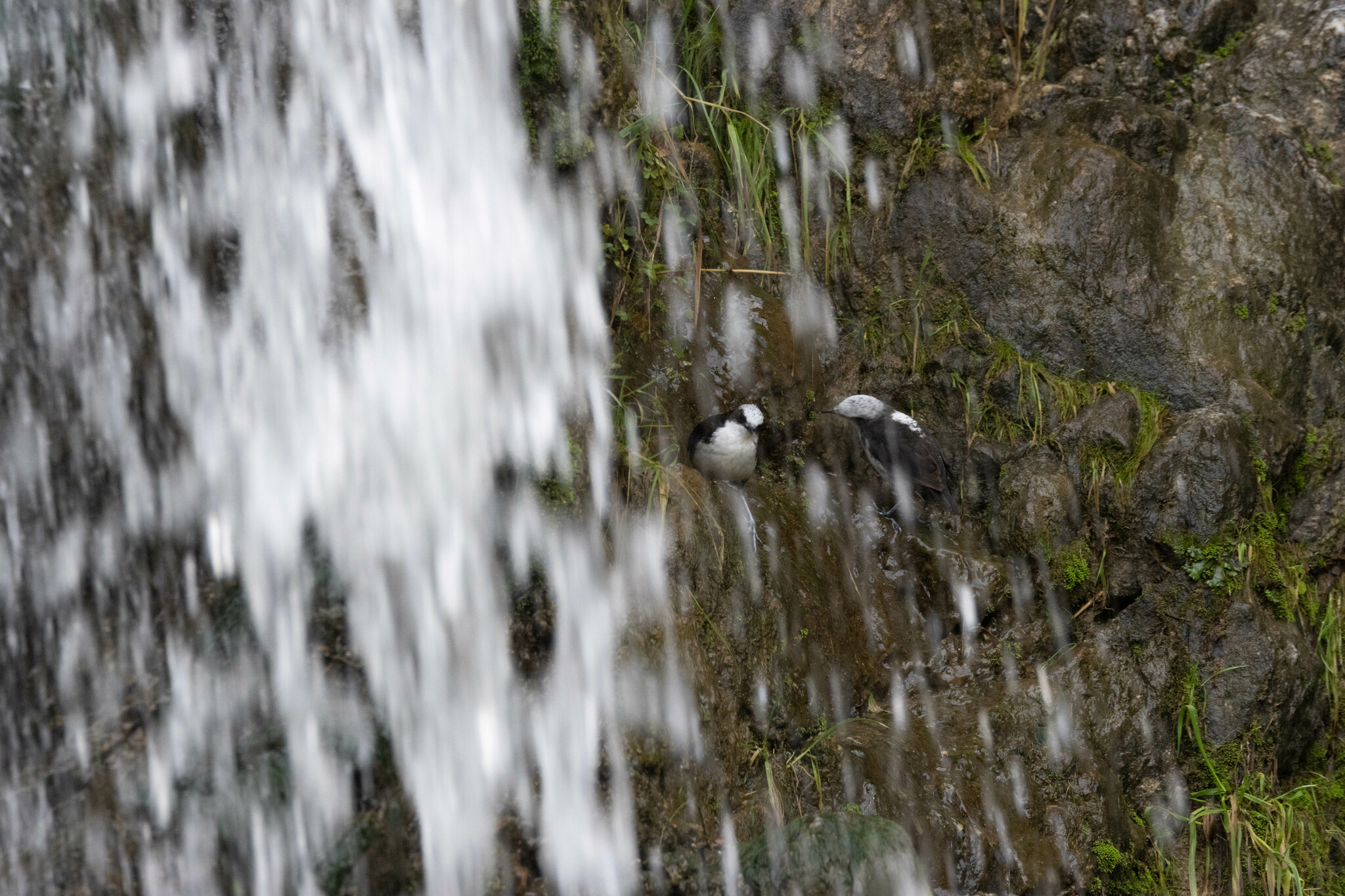
Dippers are members of the genus Cinclus in the bird family Cinclidae, so-called because of their bobbing or dipping movements. They are unique among passerines for their ability to dive and swim underwater.
Taxonomy
The genus Cinclus was introduced by the German naturalist Moritz Balthasar Borkhausen in 1797 with the white-throated dipper (Cinclus cinclus) as the type species. The name cinclus is from the Ancient Greek word kinklos that was used to describe small tail-wagging birds that resided near water.
Cinclus is the only genus in the family Cinclidae. The white-throated dipper and American dipper are also known in Britain and America, respectively, as the water ouzel (sometimes spelt "ousel") – ouzel originally meant the only distantly related but superficially similar Eurasian blackbird (Old English osle). Ouzel also survives as the name of a relative of the blackbird, the ring ouzel.
The genus contains the following five species:
Image
Common name
Scientific name
Distribution
White-throated dipper or European dipper
Cinclus cinclus
Europe, the Middle East, Central Asia, and the Indian subcontinent
Brown dipper
Cinclus pallasii
Mountains of the east Palearctic
American dipper
Cinclus mexicanus
Mountainous regions of North America from Alaska to Panama
White-capped dipper
Cinclus leucocephalus
Bolivia, Colombia, Ecuador, Peru, and Venezuela
Rufous-throated dipper
Cinclus schulzii
Argentina and Bolivia
A 2002 molecular phylogenetic study of the dippers looked at the DNA sequences of two mitochondrial genes. It found that the Eurasian white-throated dipper and brown dipper are sister species as are the South American white-capped dipper and rufous-throated dipper. The study also showed that the dipper family, Cinclidae, is most closely related to the thrush family, Turdidae.