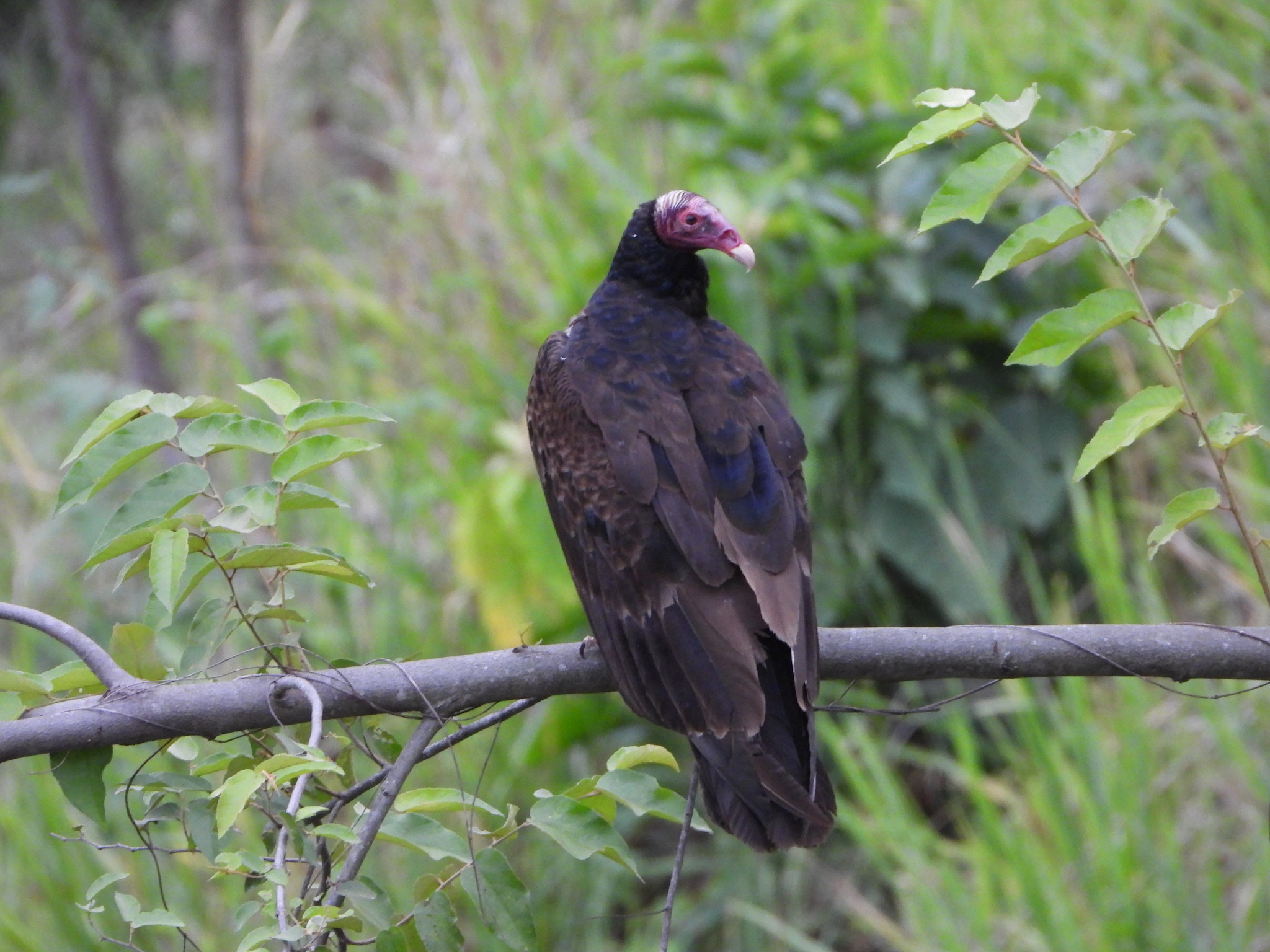
Cathartidae, commonly known as New World vultures and condors, are a family of birds of prey consisting of seven extant species in five genera. It includes five extant vultures and two extant condors found in the Americas. They are known as "New World" vultures to distinguish them from Old World vultures, with which the Cathartidae does not form a single clade despite the two being similar in appearance and behavior as a result of convergent evolution.
Like other vultures, New World vultures are scavengers, having evolved to feed off of the carcasses of dead animals without any notable ill effects. Some species of New World vulture (Cathartes sp.) have a good sense of smell, whereas Old World vultures find carcasses exclusively by sight. Other adaptations shared by both Old and New World vultures include a bald head, devoid of feathers which helps prevent rotting matter from accumulating while feeding, and an extremely disease-resistant digestive system to protect against dangerous pathogens found in decaying meat.
Taxonomy and systematics
A pervious nostril is typical of the family.
The family Cathartidae was introduced (as the subfamily Cathartinae) by the French ornithologist Frédéric de Lafresnaye in 1839. The New World vultures comprise seven species in five genera, being Coragyps, Cathartes, Gymnogyps, Sarcoramphus, and Vultur. Of these, only Cathartes is not monotypic. The family's scientific name, Cathartidae, comes from cathartes, Greek for "purifier". Although New World vultures and Old World vultures are not very closely related, they share many resemblances because of convergent evolution. Phylogenetic analyses including all Cathartidae species found two primary clades. The first consists of black vultures (Coragyps atratus) together with the three Cathartes species (lesser yellow-headed vultures (C. burrovianus), greater yellow-headed vultures (C. melambrotus), and turkey vultures (C. aura)), while the second consists of king vultures (Sarcoramphus papa), California...