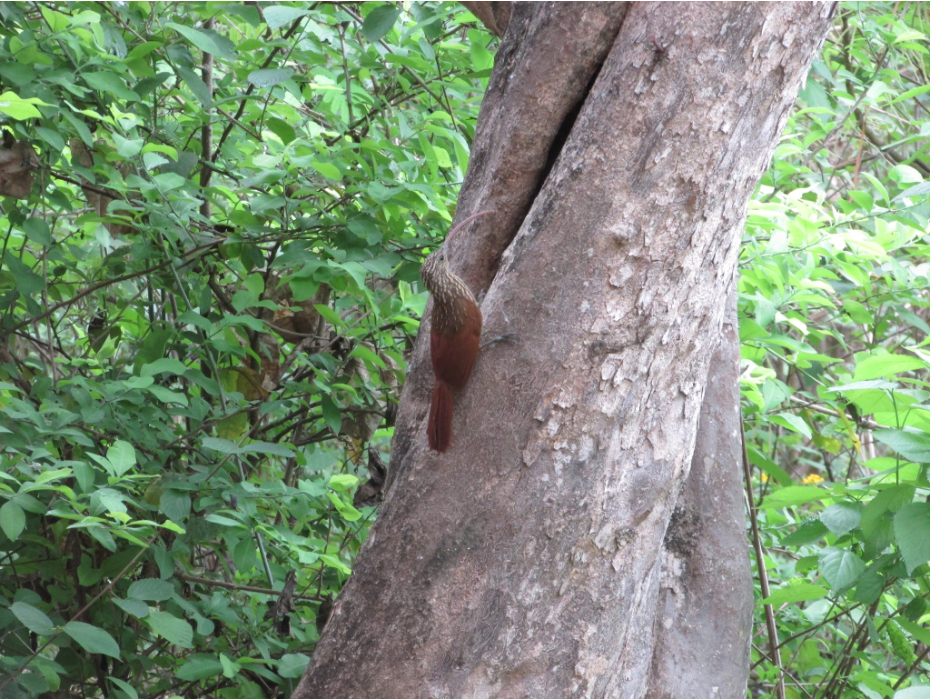
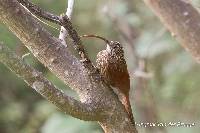
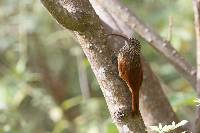
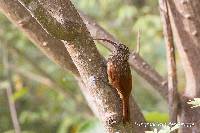
The red-billed scythebill (Campylorhamphus trochilirostris) is a species of bird in the subfamily Dendrocolaptinae of the ovenbird family Furnariidae. It is found in Argentina, Bolivia, Brazil, Colombia, Ecuador, Panama, Paraguay, Peru, and Venezuela.
Taxonomy and systematics
The red-billed scythebill has these 12 subspecies:
C. t. brevipennis Griscom, 1932
C. t. venezuelensis (Chapman, 1889)
C. t. thoracicus (Sclater, PL, 1860)
C. t. zarumillanus Stolzmann, 1926
C. t. napensis Chapman, 1925
C. t. notabilis Zimmer, JT, 1934
C. t. snethlageae Zimmer, JT, 1934
C. t. major Ridgway, 1911
C. t. trochilirostris (Lichtenstein, MHC, 1820)
C. t. devius Zimmer, JT, 1934
C. t. lafresnayanus (d'Orbigny, 1846)
C. t. hellmayri Laubmann, 1930
The red-billed scythebill and black-billed scythebill (C. falcularius) have at times been considered conspecific and also as sister species, but genetic data indicate neither is true. The red-billed and curve-billed scythebill (C. procurvoides) have also been suggested as sister species. Some of the subspecies are difficult to distinguish from each other. In addition, a small number of additional subspecies have been suggested to be split from existing ones.
C. t. brevipennis at Darien, Panama
Description
The red-billed scythebill is 22 to 28 cm (8.7 to 11 in) long and weighs 30 to 55 g (1.1 to 1.9 oz). It is a slim, medium-sized woodcreeper with a very long, slim, dramatically decurved bill. The sexes have the same plumage. Adults of the nominate subspecies C. t. trochilirostris have a thinly streaked face and neck with a weak supercilium. Their crown, nape, and back are reddish olive-brown, with the back being somewhat lighter. Their crown has longish whitish to ochraceous spots with narrow blackish edges; the spots narrow on the nape and become thin streaks on the upper back. Their rump is cinnamon-rufous that contrasts little with the back, their flight feathers are rufous-chestnut, and their tail is a slightly darker rufous-chestnut....