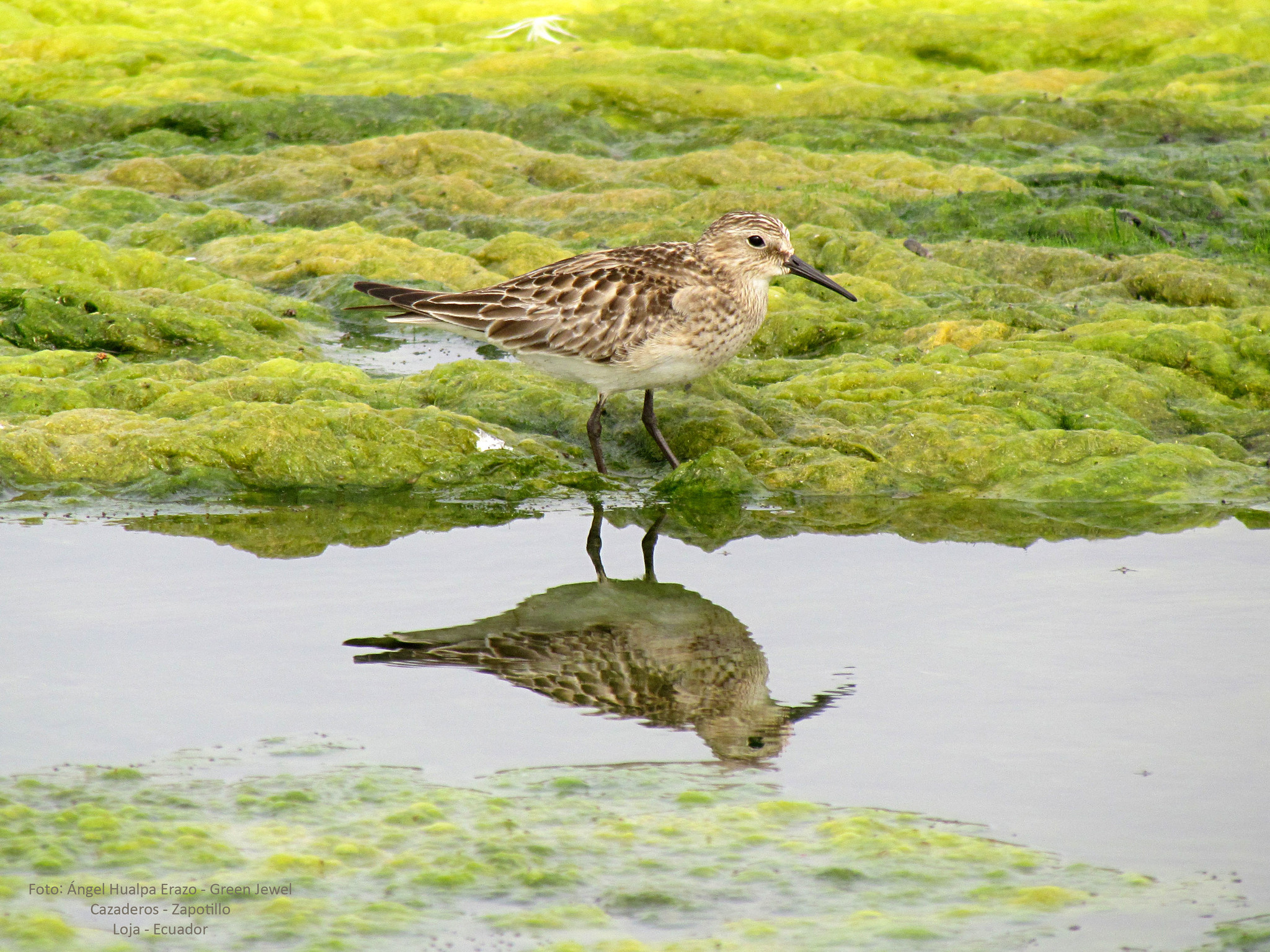
Baird's sandpiper (Calidris bairdii) is a small shorebird. It is among those Calidris species which were formerly sometimes included in the genus Erolia, which was subsumed into the genus Calidris in 1973. The genus name is from Ancient Greek kalidris or skalidris, a term used by Aristotle for some grey-coloured waterside birds. The English name and specific bairdii commemorate Spencer Fullerton Baird, 19th-century naturalist and assistant secretary of the Smithsonian Institution.
Description
Adults have black legs and a short, straight, thin dark bill. They are dark brown on top and mainly white underneath with a black patch on the rump. The head and breast are light brown with dark streaks. In winter plumage, this species is paler brownish grey above. This bird can be difficult to distinguish from other similar tiny shorebirds; these are known collectively as "peeps" or "stints".
One of the best identification features is the long wings, which extend beyond the tail when the bird is on the ground. Only the white-rumped sandpiper also shows this, and that bird can be distinguished by its namesake white rump patch.
Standard Measurements
length
14–17 cm (5.5–6.7 in)
wingspan
36–40 cm (14–16 in)
weight
32–63 g (1.1–2.2 oz)
wing
117.6–125.3 mm (4.63–4.93 in)
tail
50–57 mm (2.0–2.2 in)
culmen
20.5–24.5 mm (0.81–0.96 in)
tarsus
21.3–24.2 mm (0.84–0.95 in)
Ecology
Chicks on the ground, camouflaged
Eggs in a nest
Baird's sandpiper breeds in the northern tundra from far eastern Siberia to western Greenland. They nest on the ground, usually in dry locations with low vegetation.
It is a long-distance migrant, wintering in western and southern South America, from Peru to as far south as Tierra del Fuego. This species is a rare vagrant to western Europe. It breeds on barren high arctic coasts and hills, and on migration and in winter, it regularly uses lake...