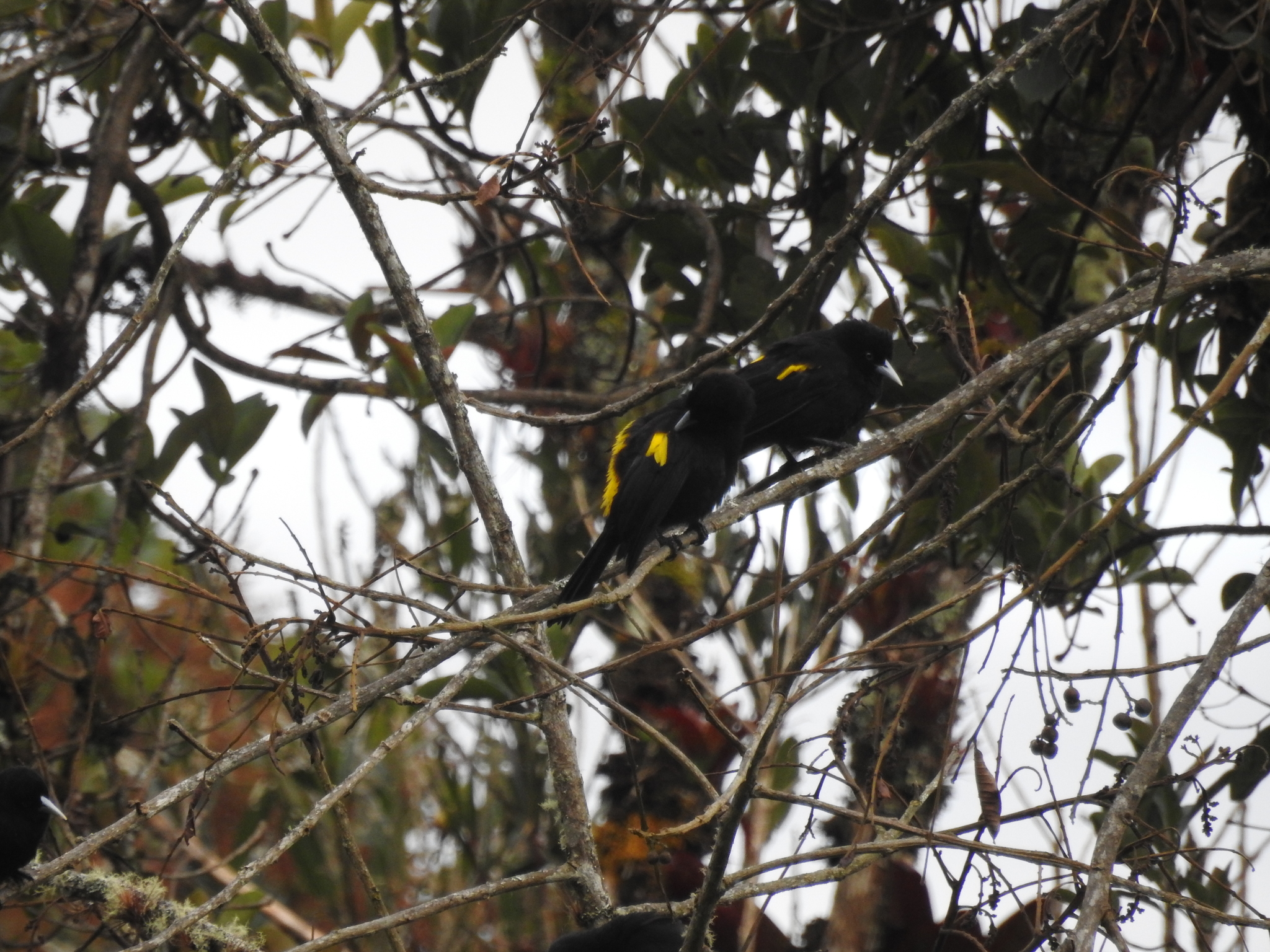
The mountain cacique (Cacicus chrysonotus) is a species of bird in the family Icteridae, the oropendolas, New World orioles, and New World blackbirds. It is found in Bolivia, Colombia, Ecuador, Peru, and Venezuela.
Taxonomy and systematics
The mountain cacique has a complicated taxonomic history. It was formally described in 1838 with the binomial Cacicus Chrysonotus . In the first half of the twentieth century many authors placed it in genus Archiplanus which was later merged into Cacicus.
As of late 2025 taxonomic systems assign the mountain cacique these three subspecies:
C. c. leucoramphus (Bonaparte, 1845)
C. c. peruvianus Zimmer, JT, 1924
C. c. chrysonotus d'Orbigny & Lafresnaye, 1838
However, in the second half of the twentieth century and well into the twenty-first many authors treated chrysonotus as a species, the "southern mountain cacique" and the other two as the "northern mountain cacique". The IOC and BirdLife International's Handbook of the Birds of the World kept them separate until 2023. The Clements taxonomy recognizes some distinction within the species, calling C. c. chrysonotus the "mountain cacique (Bolivian)" and grouping the other two subspecies as the "mountain cacique (golden-shouldered)". "A formal analysis of vocal differences, including assessment of homologous vocalizations and analysis of intraspecific variation, and assessment of gene flow across contact zones is needed."
Description
Mountain caciques are about 25 to 30 cm (9.8 to 12 in) long. Males weigh about 92 to 98 g (3.2 to 3.5 oz) and females about 64 to 67 g (2.3 to 2.4 oz). The sexes have essentially the same plumage though females are a duller black than males. Adults are almost entirely glossy black. Their lower back and rump are yellow, and some individuals have some to much yellow on the upperwing coverts. They have a blue to bluish white iris, a pale yellow-ivory to greenish ivory bill with a bluish gray base, and black legs and feet. Juveniles...