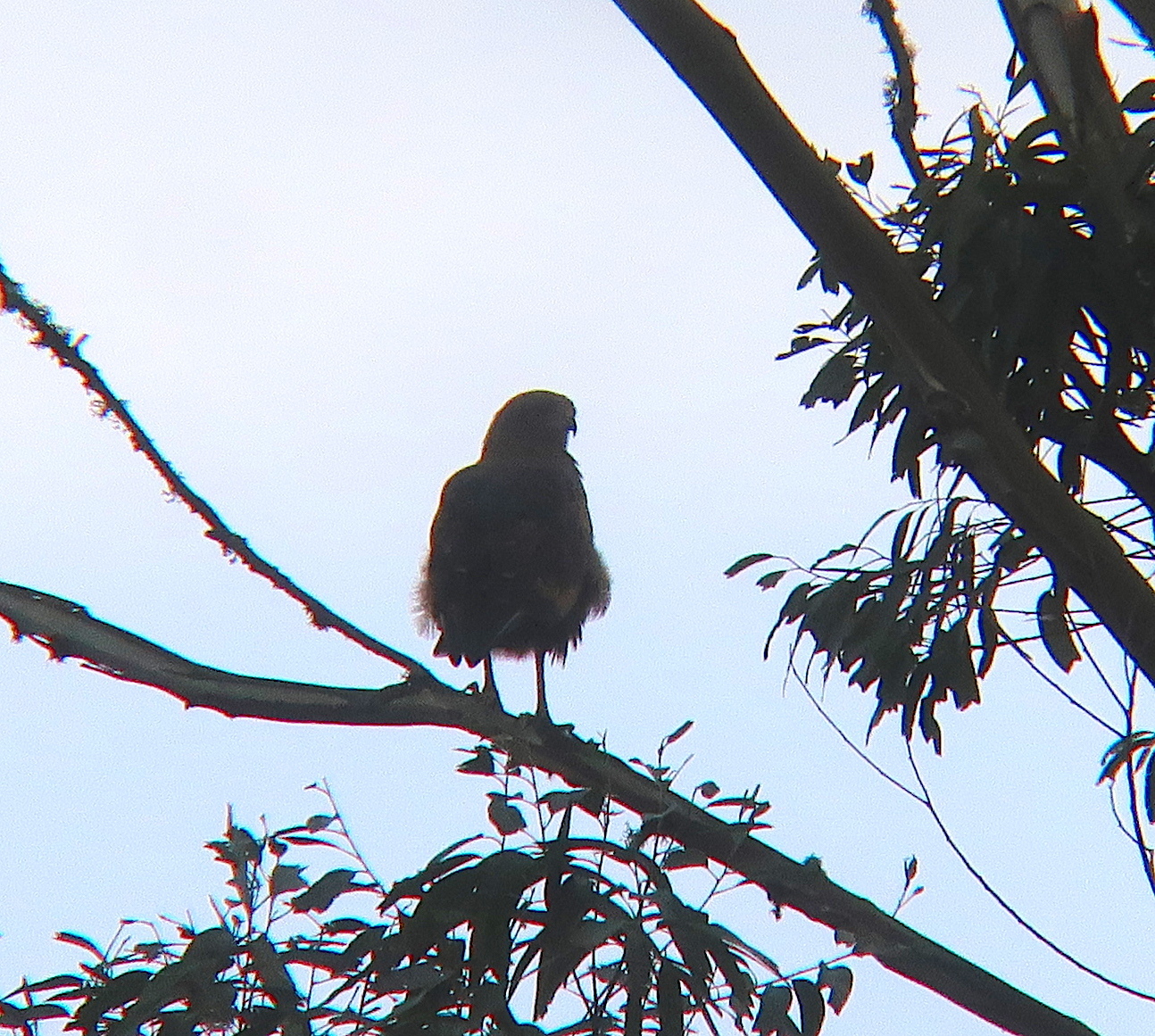
Buteogallus is a genus of birds of prey in the family Accipitridae. All members of this genus are essentially neotropical, but the distribution of a single species extends slightly into the southwestern United States. Many of the species are fond of large crustaceans and even patrol long stretches of shore or riverbank on foot where such prey abounds, but some have a rather different lifestyle. Unlike many other genera of raptor, some members are referred to as "hawks", and others as "eagles".
Most of the species have a characteristic tail pattern. This consists of a black base, a wide white middle band, a wide black band, and a quite narrow white band on the feathertips that is often hard to discern or may be lost when the feathers are very worn. Only the white-necked hawk and the rufous crab hawk have a very different tail patterns (see also below).
Taxonomy
The genus Buteogallus was introduced in 1830 by the French naturalist René Lesson to accommodate the rufous crab hawk, which is therefore the type species. The name is a portmanteau of the genus name Buteo introduced in 1779 by Bernard Germain de Lacépède for the buzzards, and the genus Gallus introduced in 1760 by Mathurin Jacques Brisson for the junglefowl. The genus now contains nine species.
Harpyhaliaetus is a former genus of eagles described by Frédéric de Lafresnaye in 1842. Two species were recognized: Harpyhaliaetus coronatus and Harpyhaliaetus solitarius. However, more recent studies have led to this genus being merged into Buteogallus.
Species
The solitary eagles (formerly Harpyhaliaetus) are a more inland relative of the "black-hawk" group of Buteogallus – in phenotype they are essentially hefty common black-hawks with lighter body plumage and in one species a small crest. Insofar as there are differences in anatomy, these seem to be related to the different prey they hunt (namely reptiles). Together with the savanna hawk, they seem to be close to some species that were uncomfortably placed...