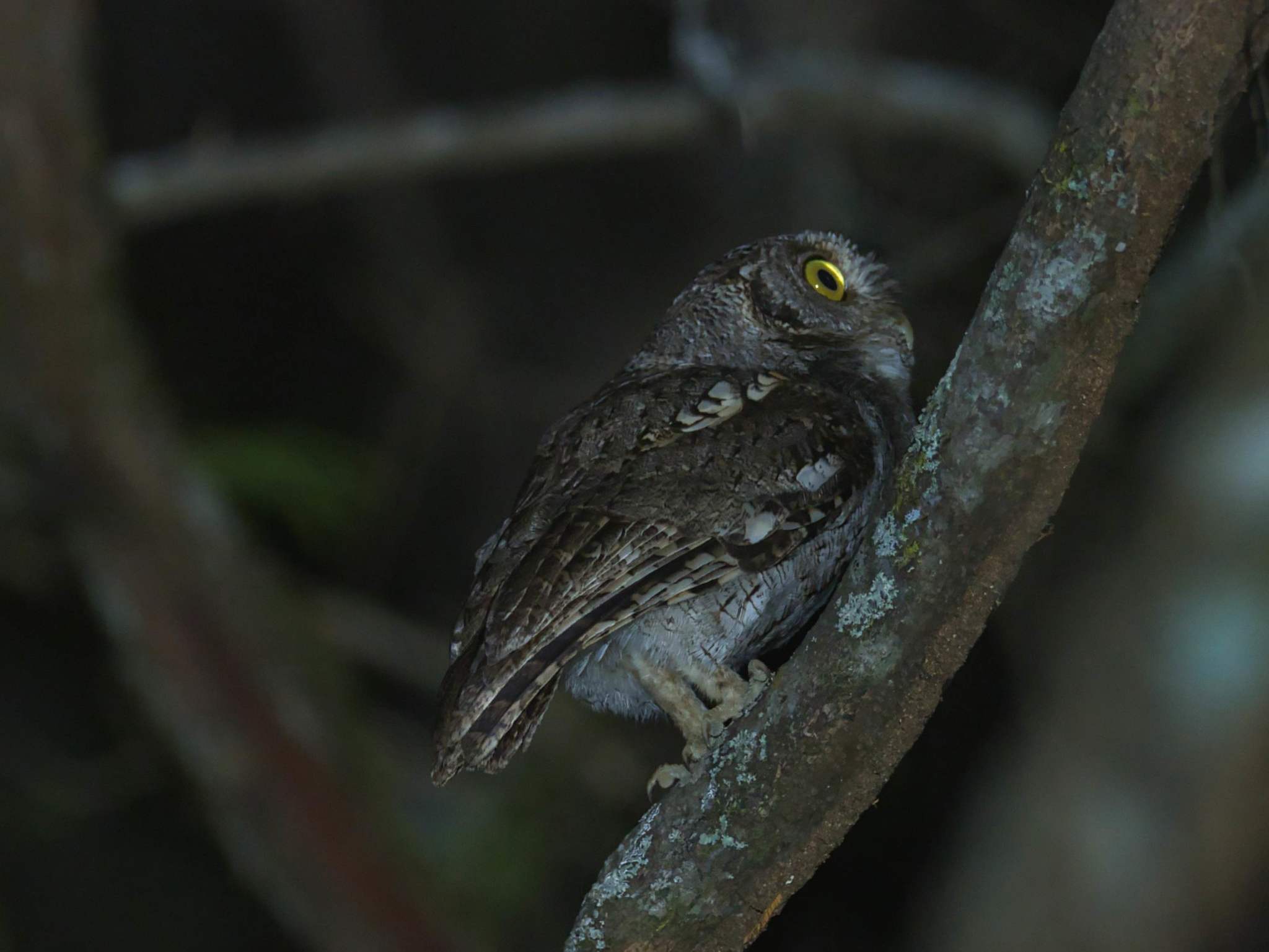
The true owls or typical owls (family Strigidae) are one of the two generally accepted families of owls, the other being the barn owls and bay owls (Tytonidae). This large family comprises roughly 230 living or recently extinct species in 23 genera. The Strigidae owls have a cosmopolitan distribution and are found on every continent except Antarctica.
Morphology
Cross sectioned great grey owl specimen showing the extent of the body plumage, Zoological Museum, Copenhagen
Skeleton of a Strigidae owl
Typical owls (hereafter referred to simply as owls) generally share an extremely similar body plan, though they vary greatly in size, with the smallest species, the elf owl, being a hundredth the size of the largest, the Eurasian eagle-owl and Blakiston's fish owl. They tend to have large heads, short tails, cryptic plumage, and round facial discs around the eyes. The family is generally arboreal (with a few exceptions like the burrowing owl) and obtain their food on the wing. The wings are large, broad, rounded, and long. As is the case with most birds of prey, in many owl species females are larger than males.
Because of their nocturnal habits, they tend not to exhibit sexual dimorphism in their plumage. Specialized feathers and wing shape suppress the noise produced by flying, both taking off, flapping and gliding. This silent flight allows owls to hunt without being heard by their prey. Owls possess three physical attributes that are thought to contribute to their silent flight capability. First, on the leading edge of the wing, there is a comb of stiff feathers. Second, the trailing edge of the wing contains a flexible fringe. Finally, owls have downy material distributed on the tops of their wings that creates a compliant but rough surface (similar to that of a soft carpet). All these factors result in significant aerodynamic noise reductions. The toes and tarsi are feathered in some species, and more so in species at higher latitudes. Numerous species of owls in the...