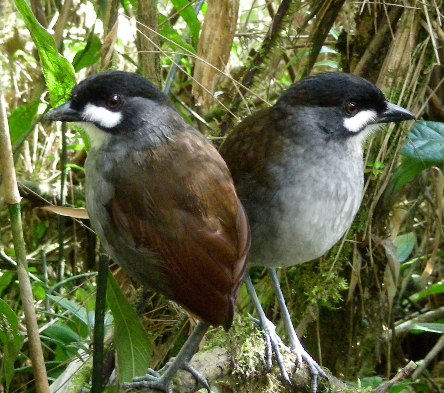
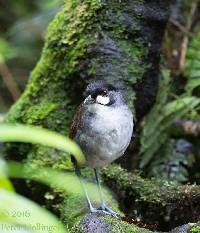
The jocotoco antpitta (Grallaria ridgelyi) is an endangered species of bird in the family Grallariidae. It is found in Ecuador and Peru.
Taxonomy and systematics
The jocotoco antpitta is monotypic. Its closest relatives appear to be the chestnut-naped antpitta (G. muchalis) and the pale-billed antpitta (G. carrikeri).
The jocotoco antpitta's specific epithet honors the ornithologist Robert S. Ridgely, who took part in the initial documentation of this species in 1997. The common name refers to the local name of the bird, jocotoco, which is onomatopoetic after its hooting call.
Description
Grallaria antpittas are a "wonderful group of plump and round antbirds whose feathers are often fluffed up...they have stout bills very short tails". The jocotoco antpitta is the largest member of its family. It is 20 to 24 cm (7.9 to 9.4 in) long and weighs about 150 to 200 g (5.3 to 7.1 oz). The sexes have the same plumage. Adults have a black crown and brownish olive nape. They have a large, somewhat shaggy, fan-shaped white patch from the bill to below the eye. Their ear coverts are gray. Their upperparts are brownish olive with a black wash that lessens from the mantle to the rump. Their tail is reddish brown. Their flight feathers have blackish inner webs and cinnamon outer webs, and their upperwing coverts are brownish olive with a black band. Their throat is snowy white. Their underparts are mostly light gray that is darker on the flanks which also have a brownish olive wash. Their undertail coverts are brownish olive with fine black bars. Both sexes have a dark red to crimson reddish brown iris, a black bill, and blue-gray legs and feet. Juveniles are similar to adults but more muted and with a chestnut crown.