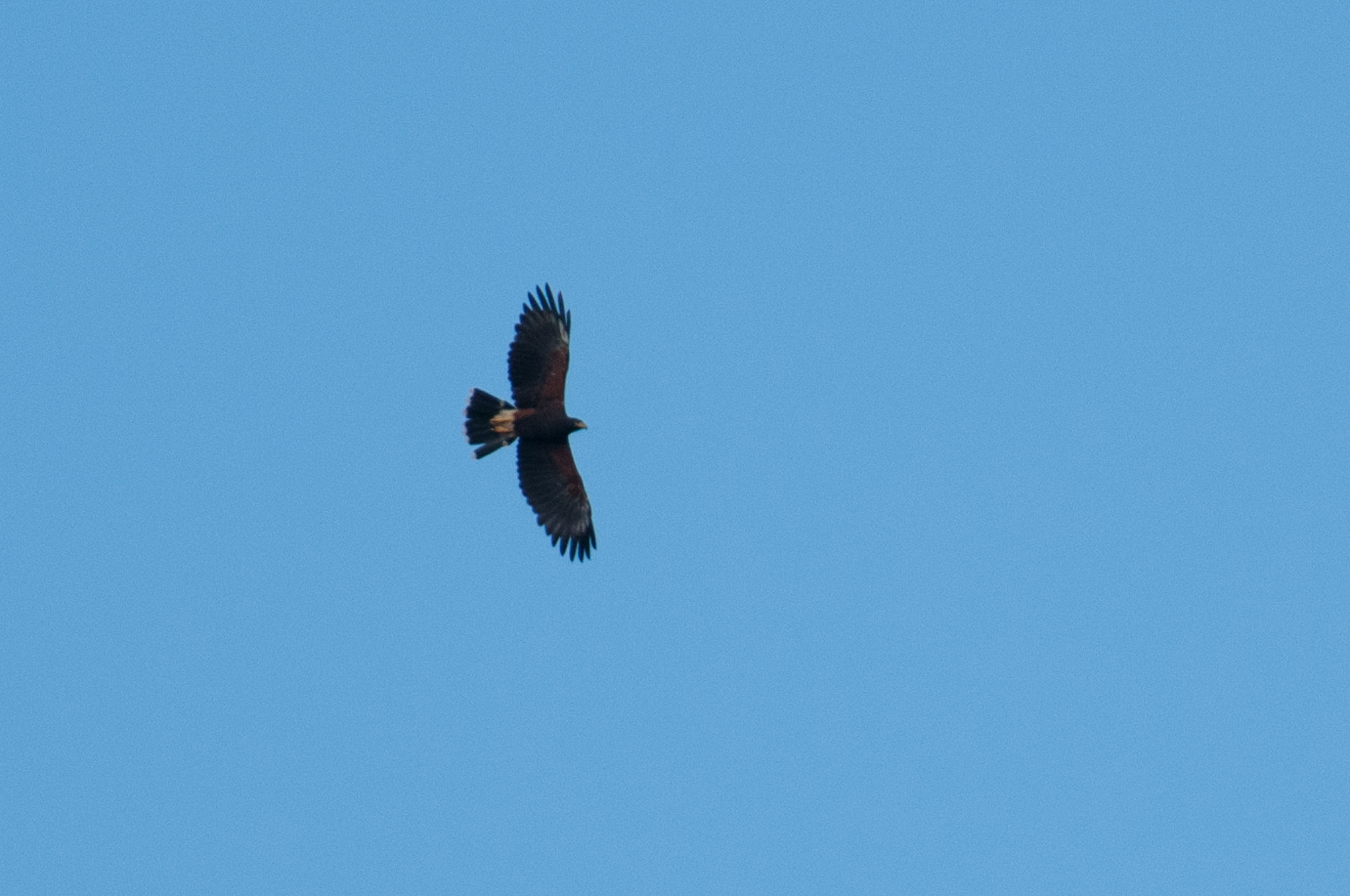
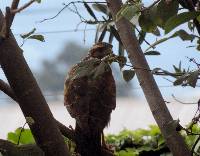
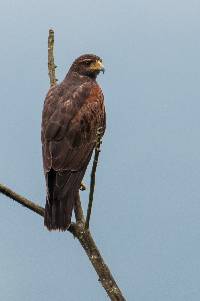
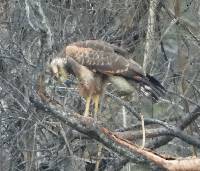
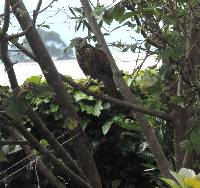
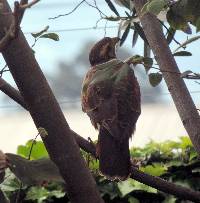
Parabuteo unicinctus is a medium-large bird of prey that breeds from the southwestern United States south to Chile, central Argentina, and Brazil. It contains two subspecies, the Harris's hawk (P. u. harrisi) and the bay-winged hawk (P. u. unicinctus). The species is also occasionally referred to as the dusky hawk and known in Latin America as the peuco.
Harris's hawk is notable for its behavior of hunting cooperatively in packs consisting of tolerant groups, while other raptors often hunt alone. Harris's hawks' social nature has been attributed to their intelligence, which makes them easy to train and has made them a popular bird for use in falconry.
Etymology
The name is derived from the Greek para, meaning beside, near or like, and the Latin buteo, referring to a kind of buzzard; uni meaning once; and cinctus meaning girdled, referring to the white band at the tip of the tail. John James Audubon gave this bird its English name in honor of his ornithological companion, financial supporter, and friend Edward Harris.
Taxonomy
Robert Ridgway placed Harris's hawk in its own new subgenus Urubitinga (Antenor) in 1873, and introduced the generic name Parabuteo in 1874. Richard Bowdler Sharpe also separated Harris's hawk to a monotypic genus, Erythrocnema, in 1874. In his Catalogue of Birds in the British Museum, Sharpe gives an extensive synonymy, with various authors having earlier placed P. u. harrisi in three genera and P. u. unicinctus in eleven.
There are two subspecies of Harris's hawk:
Image
Subspecies
Distribution
Harris's hawk
(P. u. harrisi)
Southwestern United States, Mexico, much of Central America, and western South America south to western Peru.
Bay-winged hawk
(P. u. unicinctus)
Eastern and southern South America.
The range of the two subspecies overlap in northern South America, coexisting as far south as Peru. It is unknown if they interbreed where they coexist. P. u. unicinctus is smaller than the northern...