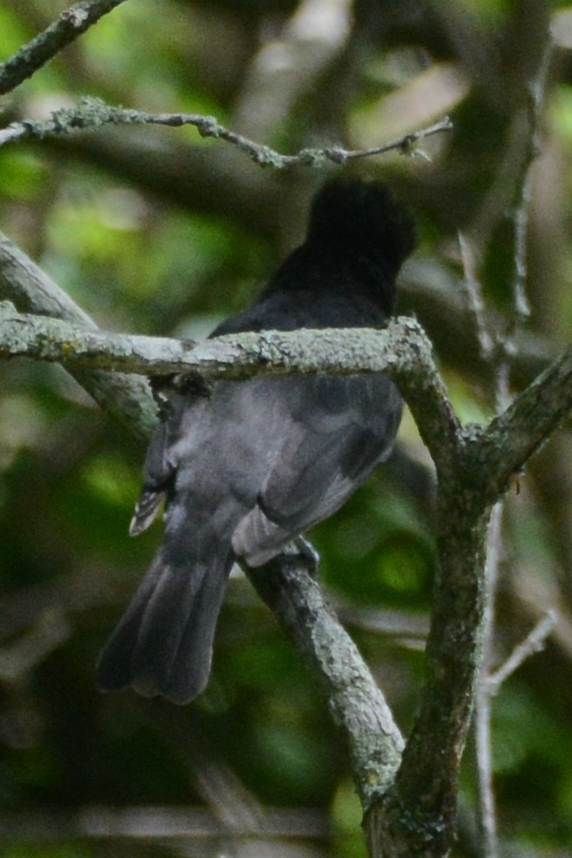
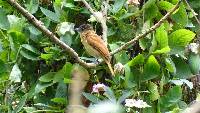
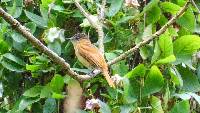
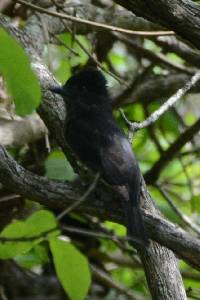
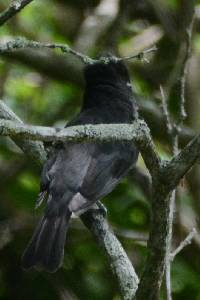
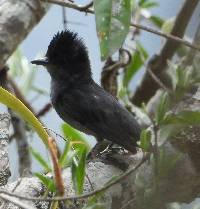
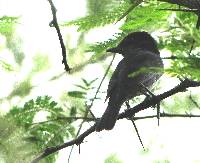
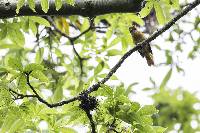
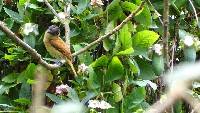
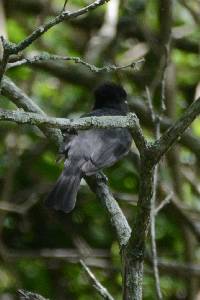
The one-colored becard (Pachyramphus homochrous) is a species of bird in the family Tityridae, the tityras, becards, and allies. It is found in Colombia, Ecuador, Panama, Peru, and Venezuela.
Taxonomy and systematics
The one-colored becard was originally described in 1859 as Pachyramphus homochrous, its current binomial. For a time it and several other becards were placed in genus Platypsaris which was merged by most taxonomists into Pachyramphus in 1973. It is now one of 18 becards in genus Pachyramphus that had been introduced in 1839 by George Gray. The genus Pachyramphus has variously been assigned to the tyrant flycatcher family Tyrannidae and the cotinga family Cotingidae. Several early twenty-first century studies confirmed the placement of Pachyramphus in Tityridae and taxonomic systems made the reassignment. In 1998 the American Ornithological Society was unsure where to place the genus and listed its members as incertae sedis but in 2011 moved them to Tityridae.
The one-colored becard has three subspecies, the nominate P. h. homochrous (Sclater, PL, 1859), P. h. quimarinus (Meyer de Schauensee, 1950), and P. h. canescens (Chapman, 1912).
Description
The one-colored becard is about 16.5 cm (6.5 in) long and weighs about 35 g (1.2 oz). The species is sexually dimorphic. Adult males of the nominate subspecies have a mostly dark slaty gray head and upperparts with a slightly darker crown and lighter rump. Their wings and tail are dark slaty gray with paler edges on the remiges. Their underparts are a somewhat paler gray their upperparts. They sometimes have a faint pinkish wash on the throat and a slight dusky tinge on the breast and upper belly. Adult females have a rufous-chestnut to rufous tawny crown, upperparts, and tail. Their wings have cinnamon-edged primaries and cinnamon-edged rufous secondaries and coverts. They have a whitish cinnamon spot above the lores on an otherwise buff-cinnamon face. Their underparts are mostly buffy cinnamon that is more...