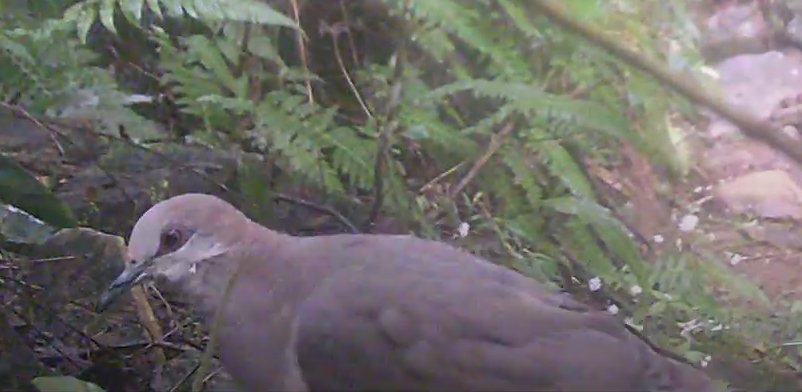
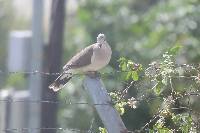
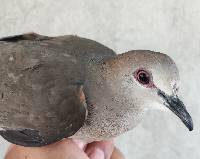
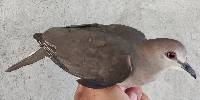
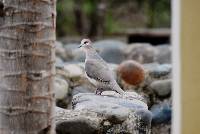
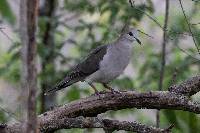
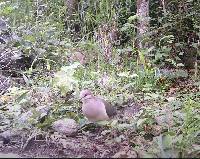
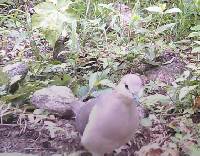
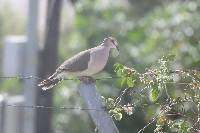
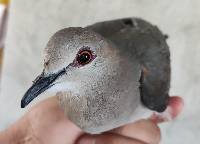
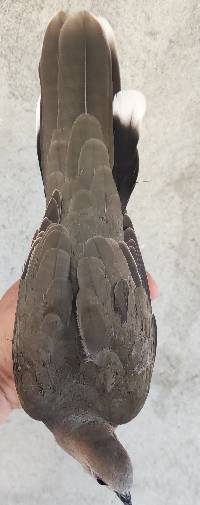
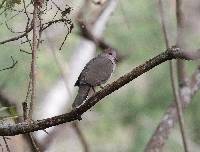
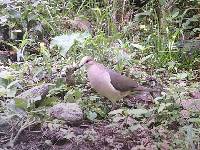
The white-tipped dove (Leptotila verreauxi) is a large New World tropical dove. Its scientific name commemorates the French naturalists Jules and Edouard Verreaux.
Distribution and habitat
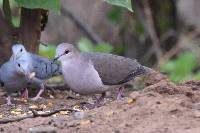
Sabal Palm Sanctuary - Texas
White-tipped Dove with White-winged Dove in bg - Sabal Palm Sanctuary, Texas
The dove is a resident breeder from southernmost Texas in the United States through Mexico and Central America south to western Peru and central Argentina. It also breeds on the offshore islands of northern South America, including Trinidad and Tobago and the Netherlands Antilles. It inhabits scrub, woodland and forest.
The following subspecies are recognized:
L. v. capitalis – Nelson, 1898: Tres Marías Islands
L. v. angelica – Bangs & Penard, TE, 1922: found from Texas and coastal Mexico
L. v. fulviventris – Lawrence, 1882: southeast Mexico to Guatemala and Belize
L. v. bangsi – Dickey & Van Rossem, 1926: west Guatemala to western Nicaragua and Honduras
L. v. nuttingi – Ridgway, 1915: Lake Nicaragua
L. v. verreauxi – Bonaparte, 1855: the nominate taxon, found from Nicaragua to Venezuela
L. v. tobagensis – Hellmayr & Seilern, 1915: Tobago
L. v. hernandezi – Romero-Zambrano & Morales-Sánchez, 1981: southwest Colombia
L. v. decolor – Salvin, 1895: found west of the Andes from Colombia to northern Peru
L. v. brasiliensis – (Bonaparte, 1856): found in most of the Amazon north of the Amazon River
L. v. approximans – Cory, 1917: northeast Brazil
L. v. decipiens – (Salvadori, 1871): found in much of central South America
L. v. chlorauchenia – Sclater, PL & Salvin, 1870: southern Bolivia and southeast Brazil south to northern Argentina
The subspecies chlorauchenia was formerly known as chalcauchenia, but the former name was found to have precedence in 2023.
Subspecies
The following subspecies are recognized:
L. v. capitalis – Nelson, 1898: Tres Marías Islands
L. v. angelica – Bangs & Penard, TE, 1922: found from Texas and coastal...