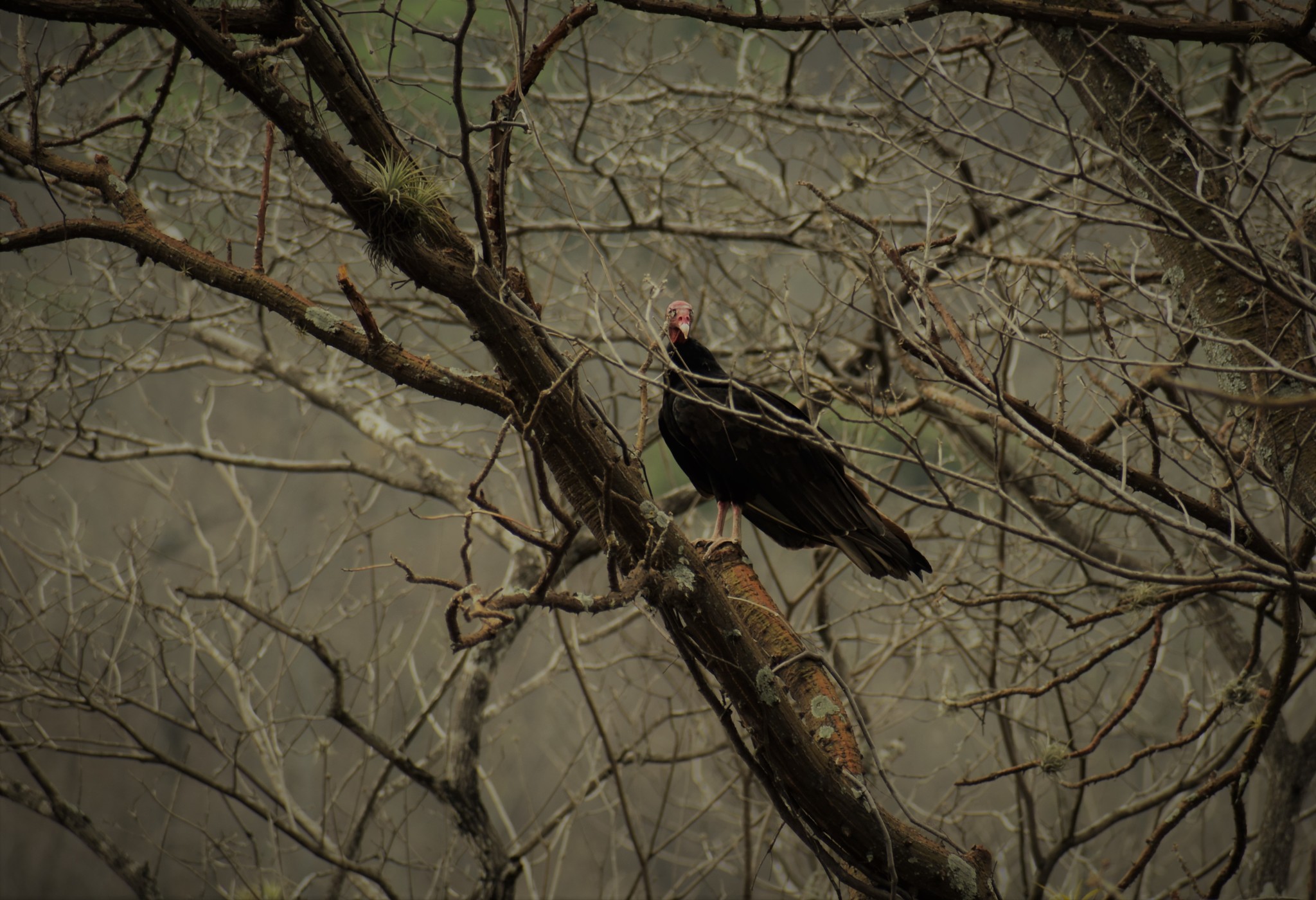
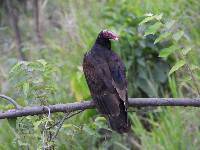
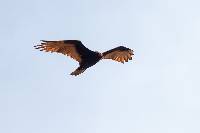
The turkey vulture (Cathartes aura) is the most widespread of the New World vultures. One of three species in the genus Cathartes of the family Cathartidae, the turkey vulture ranges from southern Canada to the southernmost tip of South America. It inhabits a variety of open and semi-open areas, including subtropical forests, shrublands, pastures, and deserts.
Like all New World vultures, it is not closely related to the Old World vultures of Europe, Africa, and Asia. However, the two groups strongly resemble each other due to convergent evolution.
The turkey vulture is a scavenger and feeds almost exclusively on carrion. It finds its food using its keen eyes and sense of smell, flying low enough to detect the gasses produced by the early stages of decay in dead animals. In flight, it uses thermals to move through the air, flapping its wings infrequently. It roosts in large community groups. Lacking a syrinx—the vocal organ of birds—its only vocalizations are grunts or low hisses. It nests in caves, hollow trees, or thickets. Each year it generally raises two chicks, which it feeds by regurgitation. It has very few natural predators. In the United States, the vulture receives legal protection under the Migratory Bird Treaty Act of 1918.
Names
It is also known in some North American regions as a "buzzard" or "turkey buzzard," which in the Old World instead refers to members of the genus Buteo. In some areas of the Caribbean it is known as the "John crow" or "carrion crow."
Turkey Vulture (Cathartes aura) Archived 2009-04-30 at the Wayback Machine . peregrinefund.org
Taxonomy
The turkey vulture received its common name from the resemblance of the adult's bald red head and dark plumage to that of the male wild turkey. "Vulture" is from the Latin vulturus ("tearer"), describing its feeding habits. The word buzzard is used by some North Americans to refer to this bird; in the Old World that term refers to members of the genus Buteo. The turkey vulture was first formally...