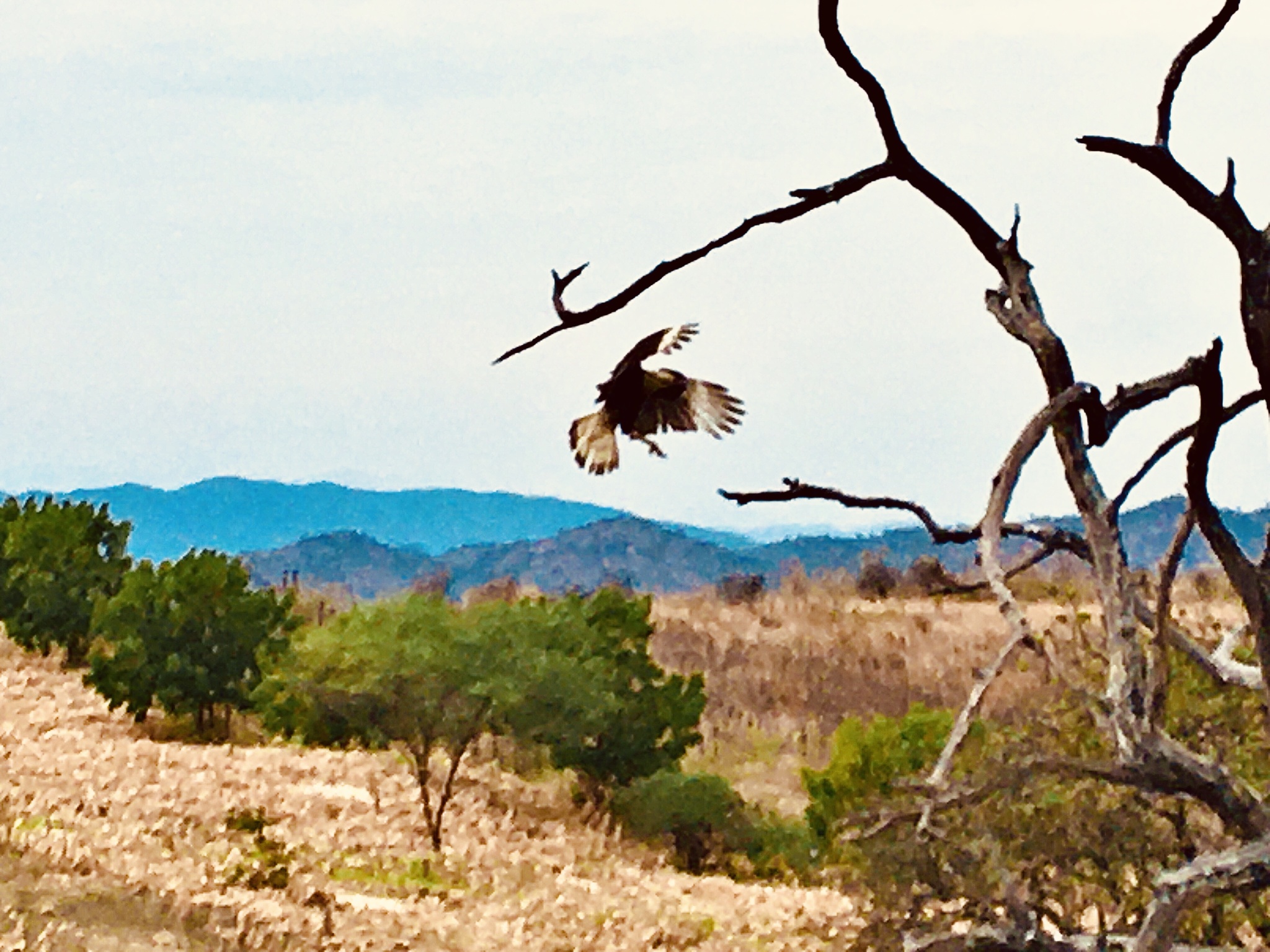
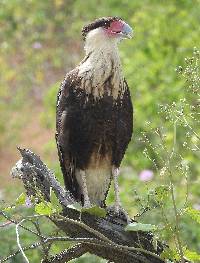
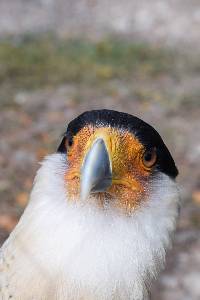
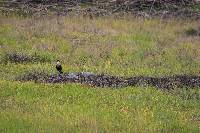
The crested caracara (Caracara plancus) is a bird of prey (raptor) in the falcon family, Falconidae. It was formerly placed in the genus Polyborus before being given in its own genus, Caracara. It is native to and found in the southern and southeastern United States, Mexico (where it is present in every state) and the majority of mainland Latin America, as well as some Caribbean islands. The crested caracara is quite adaptable and hardy, for a species found predominantly in the neotropics; it can be found in a range of environments and ecosystems, including semi-arid and desert climates, maritime or coastal areas, subtropical and tropical forests, temperate regions, plains, swamps, and even in urban areas. Documented, albeit rare, sightings have occurred as far north as Minnesota and the Canadian provinces of Alberta, Ontario, and Prince Edward Island. The southern extent of the crested caracara's distribution can reach as far as Tierra del Fuego and Magallanes Region, Chile.
Etymology
The word "caracara" ultimately traces its origins to Old Tupi karakará. Further etymology is uncertain, but it is assumed to be onomatopoeic, imitating the bird's call.
The crested caracara is also known as the Mexican eagle, although it is not a true eagle. This stems from a 1960 proposal by Rafael Martín del Campo [es], supposedly based on an analysis of pre-Conquest imagery, that the "bird atop a prickly pear" associated with the mythical founding of Tenochtitlan was a caracara, and not a golden eagle (which is a rare sight in Mexico, especially as far south as Tenochtitlan) as is traditionally depicted. Nonetheless, since at least the Spanish Conquest, the golden eagle has been the bird irrevocably associated with the founding myth, featuring prominently in independent Mexico's national insignia as well as being its national animal.
Balduin Möllhausen, the German artist accompanying the 1853 railroad survey (led by Lt. Amiel Weeks Whipple) from the...