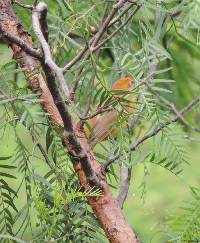
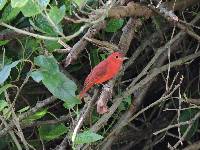
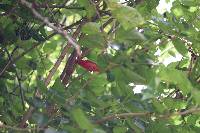
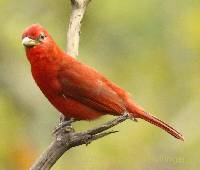
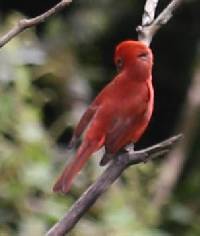
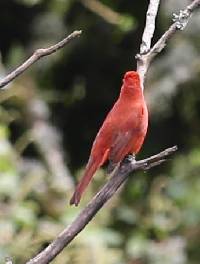
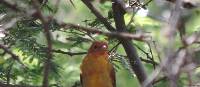
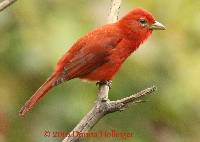
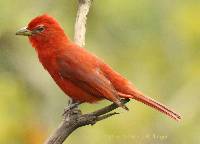
The summer tanager (Piranga rubra) is a medium-sized American songbird. Formerly placed in the tanager family (Thraupidae), it and other members of its genus are now classified in the cardinal family (Cardinalidae). The species's plumage and vocalizations are similar to other members of the cardinal family.
Taxonomy
The summer tanager was formally described by the Swedish naturalist Carl Linnaeus in 1758 in the tenth edition of his Systema Naturae under the binomial name Fringilla rubra. Linnaeus based his description on the "summer red-bird" described and illustrated by Mark Catesby in his The Natural History of Carolina, Florida and the Bahama Islands which was published in 1729–1732. Catesby gave the location as Carolina, Linnaeus specified America; the type location is now South Carolina. The summer tanager is the type species of the genus Piranga that was introduced by the French ornithologist Louis Pierre Vieillot in 1808. The genus name Piranga is from Tupi Tijepiranga, the name for an unknown small bird; the specific rubra is from Latin ruber meaning "red".
Two subspecies are recognised:
Image
Subspecies
Range
South Padre Island, Texas
P. r. cooperi
Ridgway, 1869
breeds in southwest USA and north Mexico, winters in south Mexico
South Padre Island, Texas
P. r. rubra
(Linnaeus, 1758)
breeds in east USA, winters in Central and North South America
Description
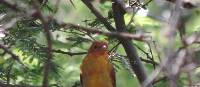
Adults have stout, pointed bills and measure 17 cm (6.7 in) in length and weigh a mean 30.1 g (1.06 oz), ranging from 25.8–33.6 g (0.99–1.19 oz). Wingspan ranges from 28 to 30 cm. Adult males are rose red and similar in appearance to the hepatic tanager, although the latter has a dark bill; females are orangish on the underparts and olive on top, with olive-brown wings and tail. As with all other birds, all red and orange colorations are acquired through their diet.
The summer tanager has an American robin-like song, similar...