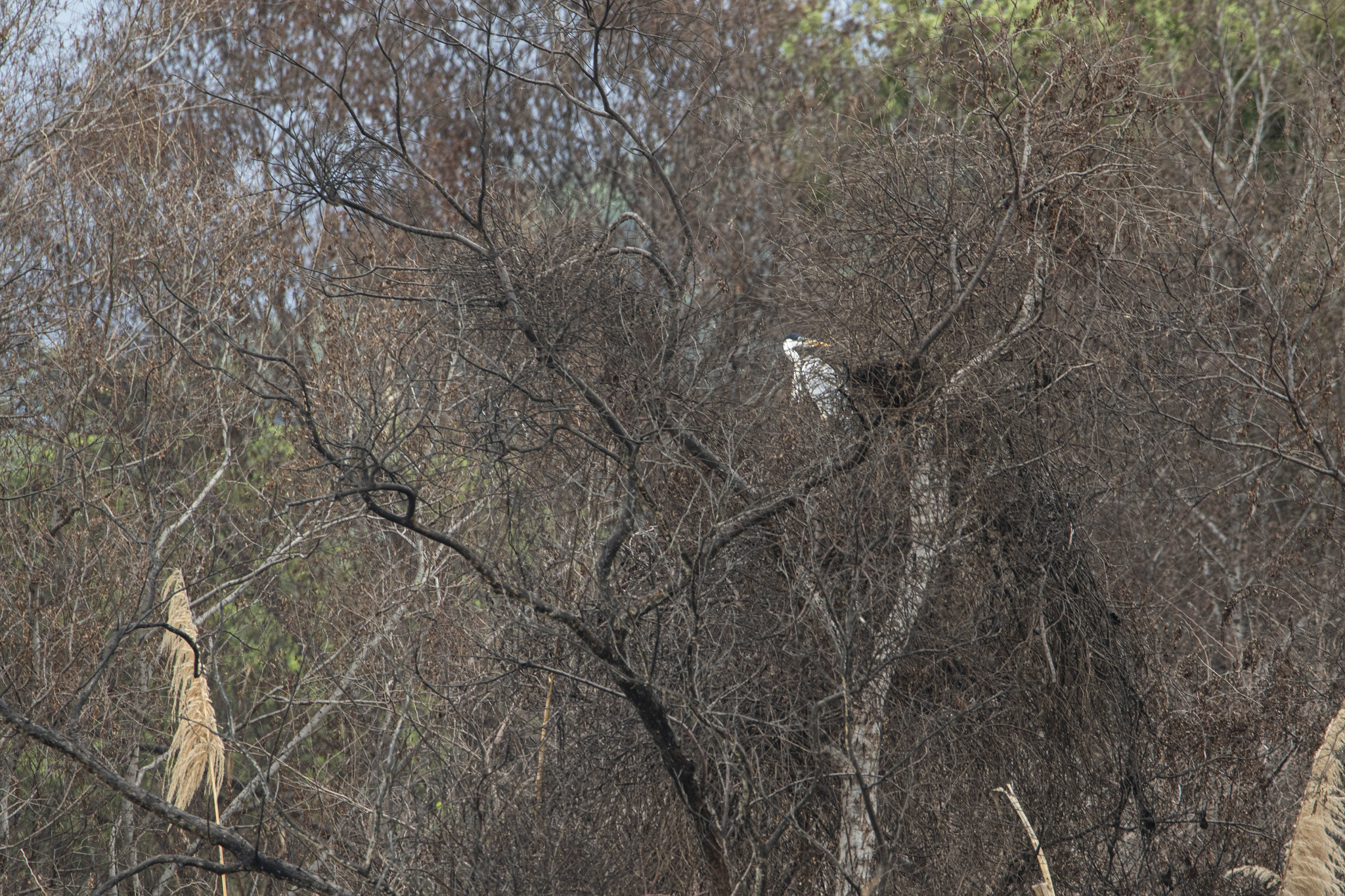
The cocoi heron (Ardea cocoi) is a species of long-legged wading bird in the heron family Ardeidae found across South America. It has predominantly pale grey plumage with a darker grey crest. A carnivore, it hunts fish and crustaceans in shallow water.
Taxonomy and evolution
The cocoi heron was originally described by Carl Linnaeus in his 1766 12th edition of Systema Naturae.
The cocoi heron forms a superspecies with the similar Afro-Eurasian grey heron and North and Central American great blue heron, with all of these species showing similar skeletal morphology.
The origin of its species name is unknown, but may be related to the common name in Chile cuca, which in turn denotes the bird's call note. It is more widely known in South America as garza mora or "black heron".
Etymology
The origin of its species name is unknown, but may be related to the common name in Chile cuca, which in turn denotes the bird's call note. It is more widely known in South America as garza mora or "black heron".
Distribution and habitat
The cocoi heron occurs throughout much of South America except in the Andes and in some parts of Argentina. It is native in Argentina, Panama, Suriname, Colombia, Venezuela, Bolivia, Brazil, Chile, Ecuador, French Guiana, Guyana, Paraguay, Peru and Uruguay. Overall, the cocoi heron is notably widespread and ranges from Central America to the mainland shores on the Strait of Magellan, but is rarely found further south than Chubut in Argentina. It has an estimated extent of occurrence of 20600000 km.
It inhabits the wetter parts of the Chaco and occurs as a vagrant in the Falkland Islands, Saint Helena, Ascension Island and Tristan da Cunha. It is a regular, non-breeding visitor to Trinidad and Tobago. The habitat comprises almost any body of water or wetland away from dense forest; including lake shores, swamps, rivers and estuaries. Gallery forest, grassland and beaches have also been reported to be suitable feeding grounds. Pastures appear to be disfavoured...