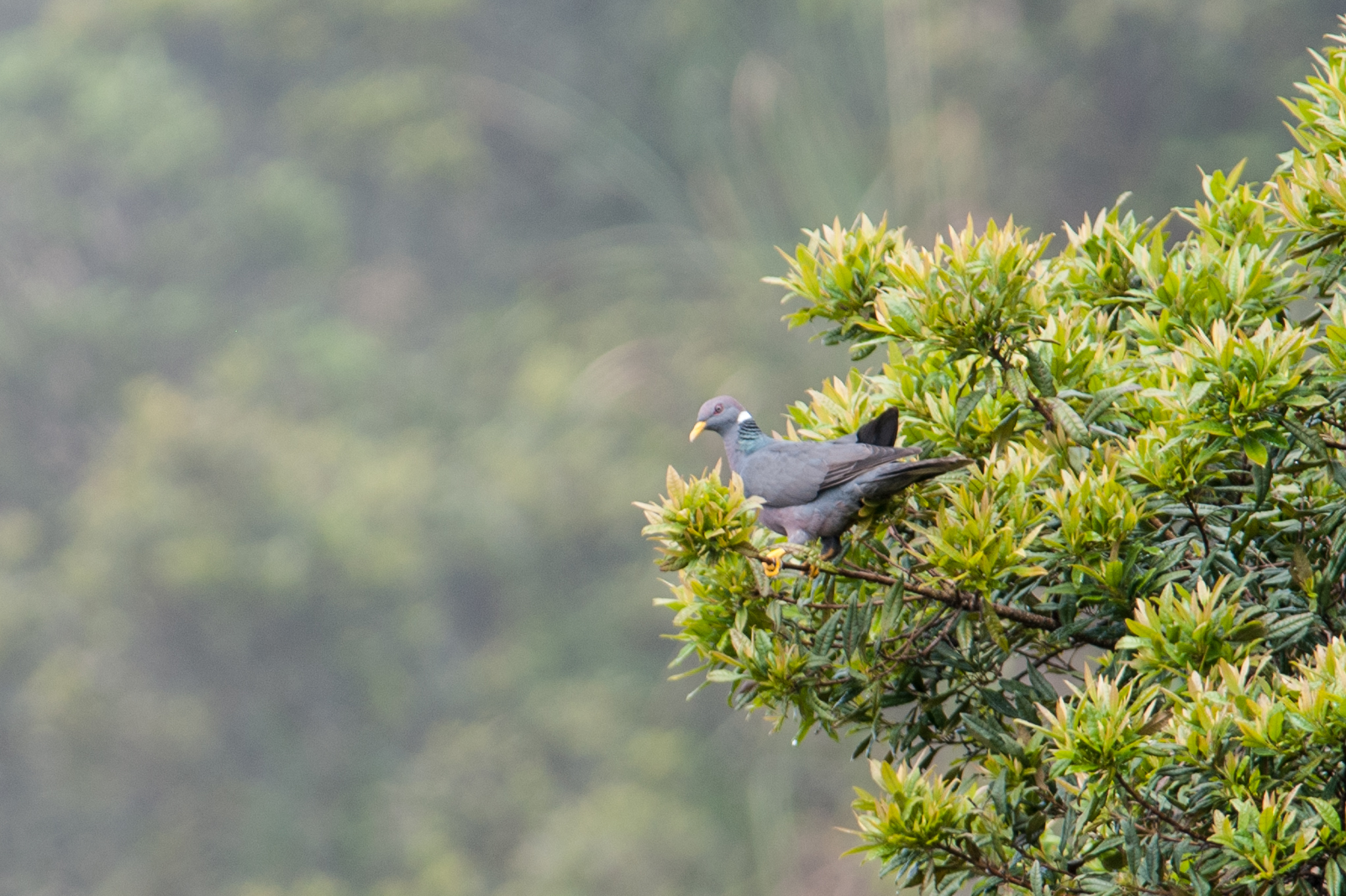
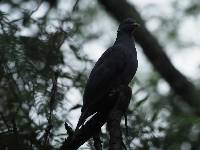
The band-tailed pigeon (Patagioenas fasciata) is a pigeon native to the Americas, and one of the largest pigeons in this region. It is largely gray, but with a thin white collar on the nape and a purple-gray breast.
Description
The band-tailed pigeon is one of the largest pigeons in the Americas, measuring 33 to 40 cm (13 to 16 in) long and weighing 226–460 g (8.0–16.2 oz), with the males on average slightly larger than females, but with much overlap. Although sometimes cited as the largest North American pigeon, the red-billed pigeon (P. flavirostris) is about the same size, weighing 268–424 g (9.5–15.0 oz). Band-tailed pigeons have thick-based, pointed wings, with a wingspan of 66 cm (26 in).
The plumage is gray, somewhat darker above. The head and underparts have a faint pink cast, especially in the adult male; the belly is nearly white. The distal half of the tail is also pale (except in the subspecies of Baja California) with a darker gray band at the base, whence the English name. The bill and feet are yellow, good identification marks at sufficiently close range. Adults have green iridescence on the back of the neck, adjacent to the thin white collar on the nape. Juvenile birds have pale feather edges above, giving a scaly appearance, and lack the white collar and neck iridescence.
Taxonomy
Its closest living relatives are the Chilean pigeon P. araucana and the ring-tailed pigeon P. caribaea, which form a superspecies within Patagioenas.
Patagioenas fasciata albilinea in the Andes near Quito, Ecuador; note the all-yellow bill
Patagioenas fasciata fasciata in Arizona; upper body; note the black tip on the bill
Six subspecies are accepted; they form two groups of three subspecies, with some authorities splitting these two groups into separate species, the northern band-tailed pigeon (Patagioenas fasciata) and the southern band-tailed pigeon (Patagioenas albilinea).