The blue-backed conebill (Conirostrum sitticolor) is a species of bird in the family Thraupidae (South American tanagers).
It is found in Bolivia, Colombia, Ecuador, Peru, and Venezuela.
Its natural habitat is subtropical or tropical moist montane forests.
Taxonomy
The blue-backed conebill was described by French ornithologist Frédéric de Lafresnaye in 1840 who placed it in the genus Conirostrum, along with the other species of conebills. It was originally called the purple conebill, with two of its subspecies, C. s. intermedium and C. s. cyaneum, being described as different species, the Venezuelan purple conebill and the Peruvian purple conebill, respectively. There are currently three recognized subspecies:
C. s. sitticolor - (Lafresnaye, 1840): Central Ranges of Colombia, through Ecuador into the west slopes of the Andes of northwestern Peru
C. s. intermedium - (Berlepsch, 1893): the Andes of western Venezuela in the states of Mérida and Táchira
C. s. cyaneum - (Taczanowski, 1875): the eastern slopes of the Andes from northern Peru into central Bolivia.
Description
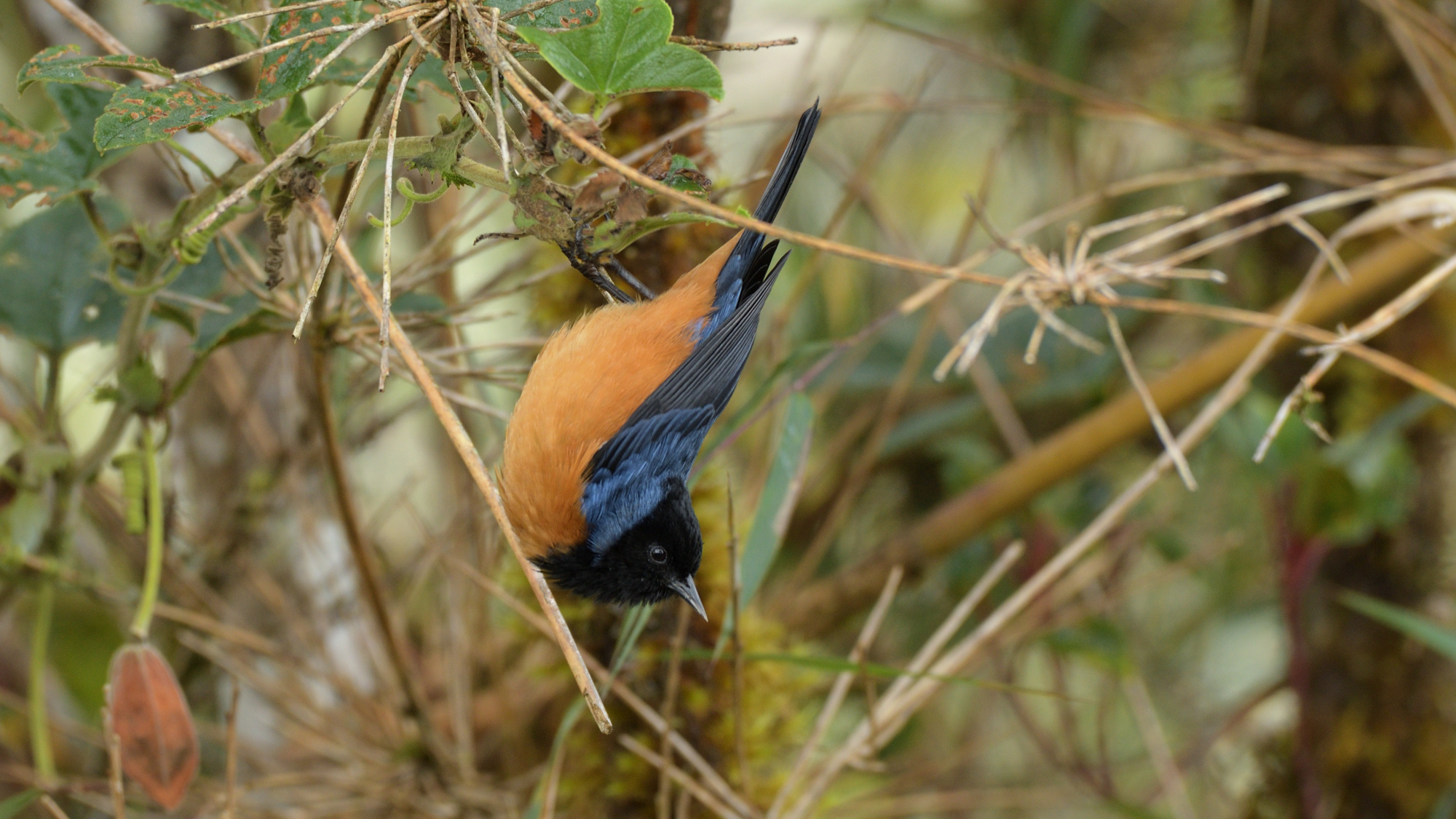
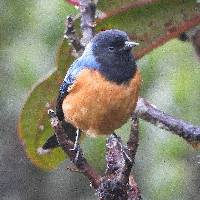
The blue-backed conebill is a small bird, weighing 11-13g. While subspecies differ slightly in appearance, all subspecies have some amount of black on their head, a blue back, rump, and tail, and an orange underside. The nominate subspecies, C. s. sitticolor has a fully black head and throat, and black wings, while C. s. cyaneum has a black cheek, chin, lore, and crown with a blue post-ocular stripe and throat, and blue wings. As the name would indicate, C. s. intermedium has an appearance intermediate between the two subspecies, with a black face, throat, and crown, a blue post-ocular stripe that doesn't extend past the eye and black wings.
Behaviour
A blue-backed conebill foraging for insects on a Cacalote plant
Like other conebills, the blue-backed conebill is an insectivore, foraging for insects mainly in the canopies of trees. It is often found in mixed species flocks alongside other insectivore species...