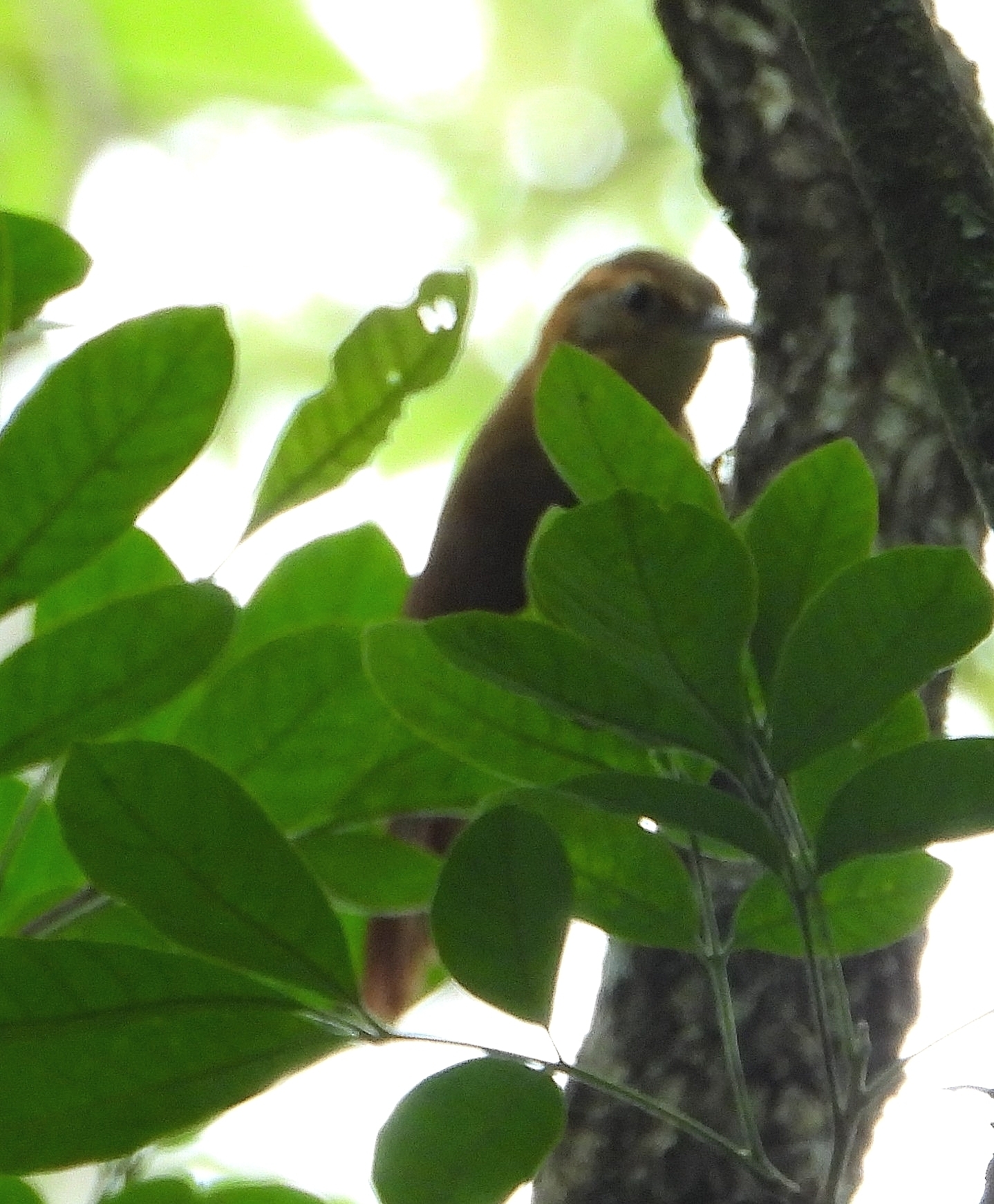
Syndactyla is a genus of foliage-gleaners, birds in the ovenbird family Furnariidae. It now includes the two recurvebills.
The recurvebills are restricted to humid forests in the South American countries of Bolivia, Peru and Brazil. Their common name refers to the peculiar bill-shape, which, at least in the case of the larger-billed Peruvian recurvebill, is an adaptation for manipulating bamboo stems. Both species are overall rufescent brown. The SACC reclassified the recurvebills from the genus Simoxenops to Syndactyla based on studies from Dewberry (2011).
Taxonomy
The genus Syndactyla was introduced in 1853 by the German naturalist Ludwig Reichenbach to accommodate Xenops rufosuperciliatus Lafresnaye, the buff-browed foliage-gleaner. This is therefore the type species by monotypy. The name comes from Ancient Greek σύν (sún), meaning "together", and δάκτυλος (dáktulos), meaning "finger". Members of this genus are most closely related to the foliage-gleaners in the genus Anabacerthia. The recurvebills, S. ucayalae and S. striata, were formerly placed in their own genus Simoxenops, and S. roraimae was formerly placed in the genus Automolus.
The genus contains eight species:
Image
Scientific name
Common Name
Distribution
Syndactyla rufosuperciliata
Buff-browed foliage-gleaner
eastern foothills of Central Andes ; also southern Atlantic forest, northeastern Argentina and Uruguay
Syndactyla dimidiata
Planalto foliage-gleaner
Brazil
Syndactyla roraimae
Tepui foliage-gleaner
tepuis
Syndactyla subalaris
Lineated foliage-gleaner
northern Andes
Syndactyla ruficollis
Rufous-necked foliage-gleaner
southern Ecuador and northern Peru
Syndactyla guttulata
Guttulate foliage-gleaner
Venezuelan Coastal Range
Syndactyla ucayalae
Peruvian recurvebill
southeastern Peru and sparsely present across Amazonia
-
Syndactyla striata
Bolivian recurvebill
Yungas