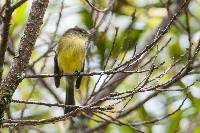
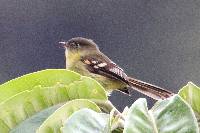
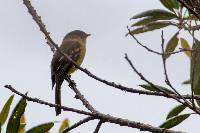
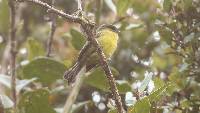
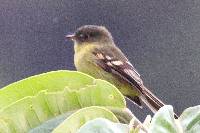
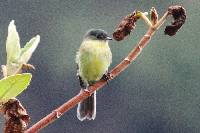
The orange-banded flycatcher (Nephelomyias lintoni) is a species of bird in the family Tyrannidae, the tyrant flycatchers. It is found in Ecuador and Peru.
Taxonomy and systematics
The orange-banded flycatcher was originally described in 1951 as Myiophobus lintoni. Its specific epithet honors M. Albert Linton, who at the time was the president of the Academy of Natural Sciences of Philadelphia. A study published in 2009 determined that the orange-banded flycatcher and two other species did not belong in Myiophobus so the genus Nephelomyias was created for them in 2010.
The orange-banded flycatcher is monotypic. It and the ochraceous-breasted flycatcher (N. ochraceiventris) are sister species and form a superspecies.
Description
The orange-banded flycatcher is 12.5 to 13 cm (4.9 to 5.1 in) long; two males weighed 9.5 and 10 g (0.34 and 0.35 oz). The sexes are very similar. Adult males have a very dark brownish olive crown with a partly hidden yellow, orange, or rufous patch in the middle. Both sexes have a thin very pale yellow eye-ring on an otherwise dark brownish olive face. Their back and rump are dark brownish olive. Their wings are dusky with thin buffy or whitish edges on the flight feathers and wide cinnamon, ochraceous, or buffy tips on the wing coverts; the latter show as two wing bars. Their tail is dusky. Their throat is whitish yellow and their underparts are yellow with an olive wash on the sides of the breast. Adult females have a smaller, dull brown, crown patch or none at all. Adults have a grayish yellow iris, blackish legs and feet, and a bill with a blackish maxilla and an orange mandible with a black tip. Juveniles do not have a crown patch; their wing bars are a deeper rufous buff and their underparts are paler than adults'. Their bill is yellow but for a black tip on the maxilla.
Distribution and habitat
The orange-banded flycatcher is found on the eastern slope of the Andes from Azuay and Morona-Santiago provinces in southern Ecuador south into far northern...