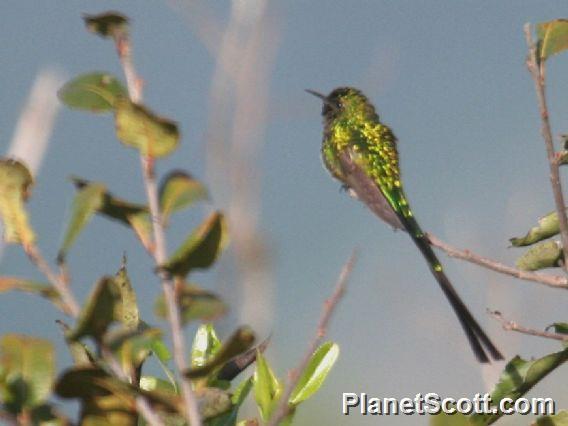
The green-tailed trainbearer (Lesbia nuna) is a species of hummingbird in the "coquettes", tribe Lesbiini of subfamily Lesbiinae. It is found in Bolivia, Colombia, Ecuador, Peru, and possibly Venezuela.
Taxonomy and systematics
The taxonomy of the green-tailed trainbearer is not settled. The International Ornithological Committee (IOC) recognizes these six subspecies:
L. n. gouldii Loddiges (1832)
L. n. gracilis Gould (1846)
L. n. aureliae Weller & Schuchmann (2004)
L. n. pallidiventris Simon (1902)
L. n. huallagae Weller & Schuchmann (2004)
L. n. nuna Lesson (1832)
The Clements taxonomy and BirdLife International's Handbook of the Birds of the World (HBW) recognize a seventh, L. n. boliviana (Boucard, 1892) that the IOC treats as a synonym of the nominate subspecies.
Though the green-tailed trainbearer shares its genus with the black-tailed trainbearer (L. victoriae), they might not be especially closely related. All of the subspecies except the nominate (and boliviana) have at various times been suggested as separate species. Two additional subspecies have been proposed as well, but the weight of evidence is that they are hybrids of the two trainbearers.
Description
The male green-tailed trainbearer is 15.3 to 17 cm (6.0 to 6.7 in) long including the 10.6 to 13.6 cm (4.2 to 5.4 in) long tail. Females are about 11.6 cm (4.6 in) long including their 4.5 to 6.2 cm (1.8 to 2.4 in) long tail. The species weighs 3.1 to 4.3 g (0.11 to 0.15 oz). It has a short, straight, black bill. Males of the nominate subspecies are almost entirely glittering emerald green; the throat is iridescent emerald green and the lower belly grayish with green dots. Its tail is long, forked, and black with green tips to the feathers. The nominate female is similar but has white underparts with glittering green spots and a shorter tail. Juveniles are similar to the adult female but the male in addition has green spots on the throat.