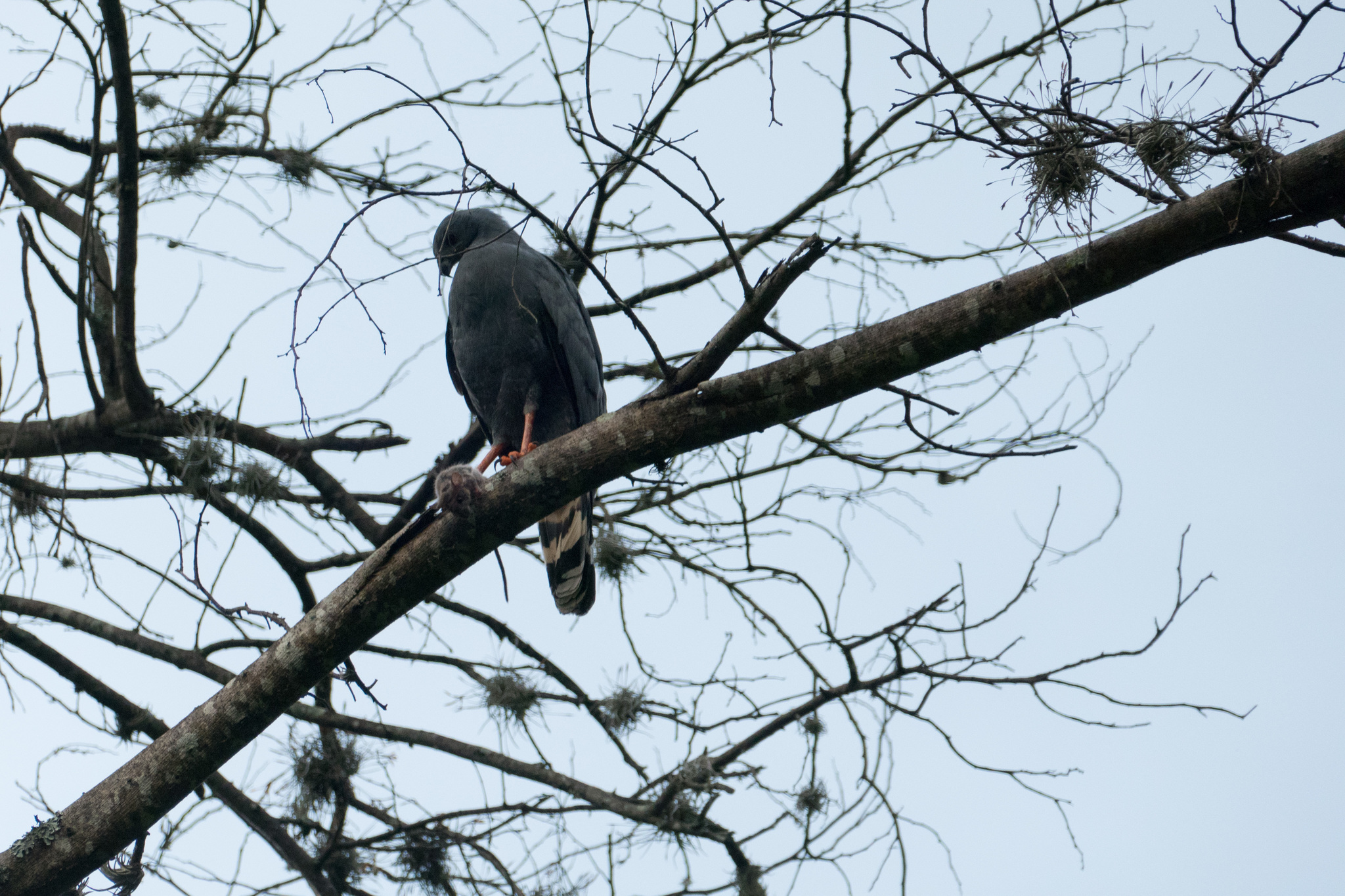
The crane hawk (Geranospiza caerulescens) is a species of bird of prey in the family Accipitridae. It is the only species placed in the genus Geranospiza.
Taxonomy
The crane hawk used to be many species that were recently lumped into one. Those species are now designated as subspecies. Color varies clinally, though, and it is now commonly accepted that they comprise one species. There are also two species of harrier-hawks in Africa of the genus Polyboroides that, while they are morphologically and behaviorally similar, are not very closely related. They serve as a good example of convergent evolution.
Six subspecies are recognised:
Geranospiza caerulescens livens Bangs & Penard, TE, 1921 – northwest Mexico
Geranospiza caerulescens nigra (Du Bus de Gisignies, 1847) – Mexico to central Panama
Geranospiza caerulescens balzarensis Sclater, WL, 1918 – east Panama to northwest Peru
Geranospiza caerulescens caerulescens (Vieillot, 1817) – east Colombia to the Guianas to east Peru and Amazonian Brazil
Geranospiza caerulescens gracilis (Temminck, 1821) – northeast Brazil
Geranospiza caerulescens flexipes Peters, JL, 1935 – south Brazil to Paraguay, Bolivia, north Argentina and Uruguay
G. c. nigra, Mexico
G. c. flexipes, Pantanal, Brazil
Habitat and distribution
Crane hawks occur in tropical lowlands at the edge of forests and are almost always closely associated with water. It is found in Argentina, Belize, Bolivia, Brazil, Colombia, Costa Rica, Ecuador, El Salvador, French Guiana, Guatemala, Guyana, Honduras, Mexico, Nicaragua, Panama, Paraguay, Peru, Suriname, Trinidad, Uruguay, and Venezuela. They are an irruptive and local migrant, probably moving in response to changing water conditions.
Behavior
These hawks often forage by scanning from a perch or on the wing and swooping down to grab prey. However, they are notable for having "double-jointed" tarsal bones, allowing them to reach into tree cavities and extract prey, a trait they share with the...