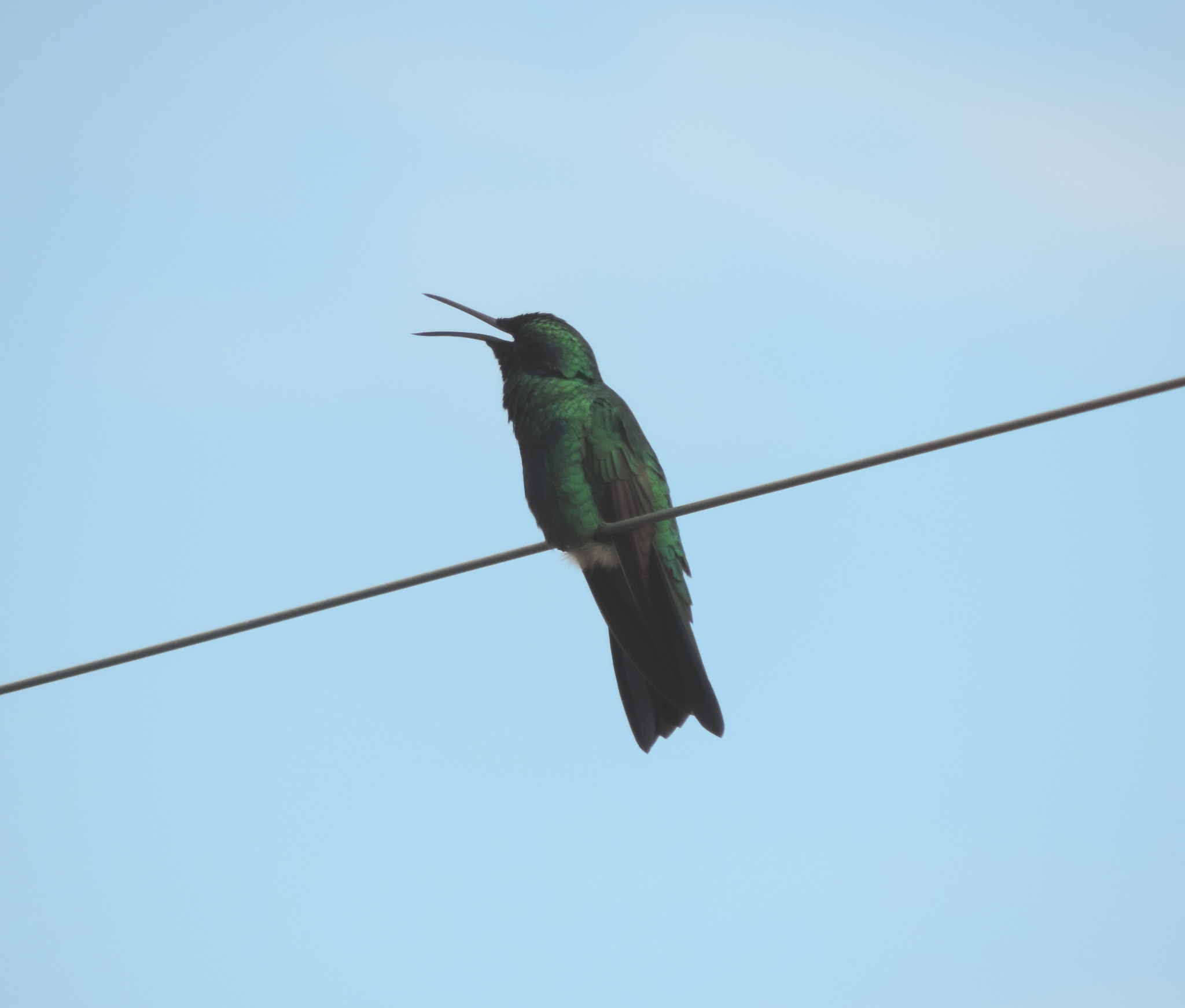
The violetears are hummingbirds of the genus Colibri. They are medium to large species found in Mexico, and Central and northern South America. The Mexican violetear occasionally wanders as far north as the United States and even Canada.
Violetears have ample rounded tails and short or medium black bills. Three of the four species have a mainly green plumage. The males have a violet blue patch running back and down from the eye, which is erected when they are excited, and a glittering throat patch. The female plumage is generally like the male's, but the ear and throat patches are smaller.
Violetears build substantial cup nests into which two white eggs are laid. They have loud persistent songs, often repetitions of double notes.
These birds come readily to artificial nectar feeders, and show no fear of humans. They are aggressively territorial, and at feeders or flowering shrubs they spend much time chasing other hummingbirds, rather than feeding.
Species
The genus contains five species:
Genus Violetear – Spix, 1824 – five species
Common name
Scientific name and subspecies
Range
Size and ecology
IUCN status and estimated population
Brown violetear
Colibri delphinae (Lesson, 1839)
Mexico to northern and western South America
Size:
Four subspecies
C. c. cabanidis (Heine), 1863)
C. c. cyanotus (Bourcier, 1843)
C. c. kerdeli Aveledo & Perez, 1991
C. c. crissalis Todd, 1942
Costa Rica, Panama, and the Andes (from Bolivia and northwards)
Size: