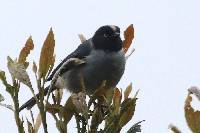
The black-headed hemispingus (Pseudospingus verticalis) is a species of bird in the family Thraupidae, the tanagers and allies. It is found in Colombia, Ecuador, Peru, and Venezuela.
Taxonomy and systematics
The black-headed hemispingus has a complicated taxonomic history. It was formally described in 1840 with the binomial Nemosia verticalis. In 1896 Hans von Berlepsch erected the genus Pseudospingus for this species and the drab hemispingus (P. xanthophthalmus). In 1947 John T. Zimmer merged Pseudospingus into the genus Hemispingus. Based on studies published between 2014 and 2016, taxonomic systems re-split many species from the genus Hemispingus. They resurrected genus Pseudospingus, creating the black-headed hemispingus' current binomial.
The black-headed hemispingus shares the genus Pseudospingus with the drab hemispingus. It is monotypic.
Description
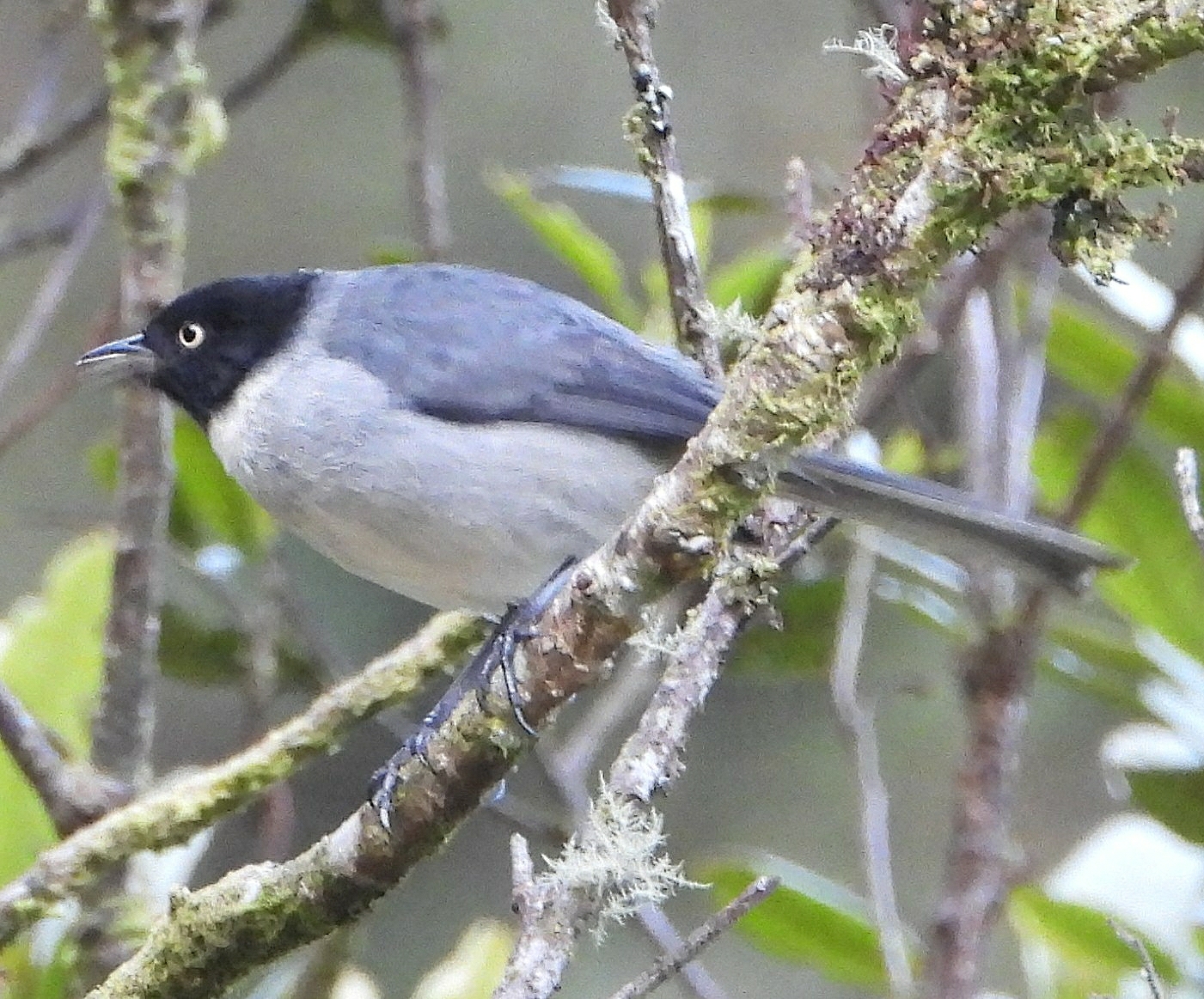
The black-headed hemispingus is about 14 cm (5.5 in) long and weighs 12 to 15.7 g (0.42 to 0.55 oz). Adults have a mostly black head with a wide clay-colored central stripe from the forehead to the middle of the crown. Their upperparts and tail are dark gray. Their upperwing coverts are dark gray with faint brown edges. Their flight feathers are dusky with brown edges on the outer ones and dark gray edges on the inner ones. Their underparts are mostly pale gray with a whitish belly and a buff tinge on the undertail coverts. They have a white iris, a thin blackish bill, and blackish legs. Immatures are much like adults but with a black and white throat and mostly whitish underparts with gray sides and flanks.