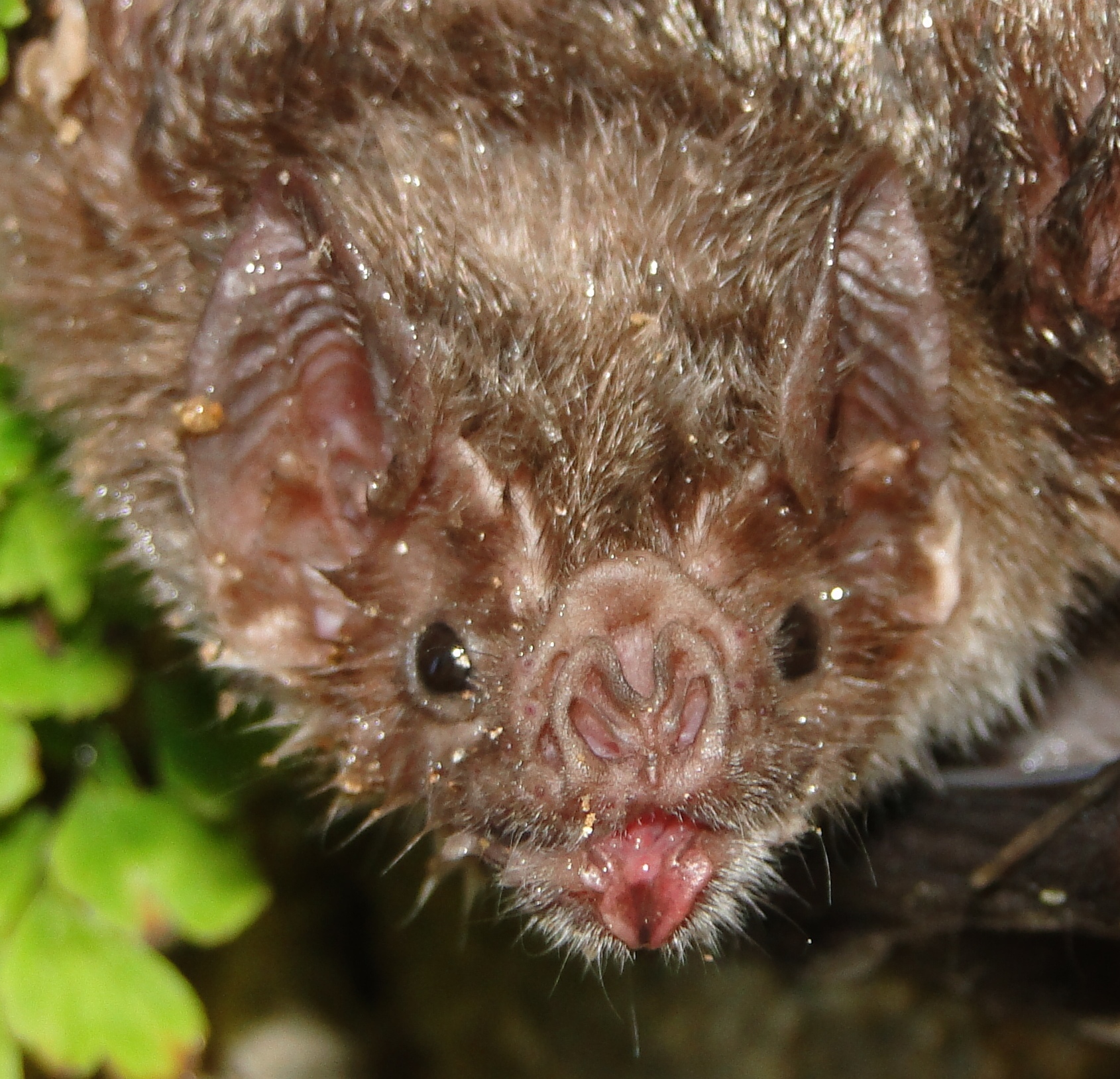
The common vampire bat (Desmodus rotundus) is a small, leaf-nosed bat native to the Americas. It is one of three extant species of vampire bats, the other two being the hairy-legged and the white-winged vampire bats.
The common vampire bat practices hematophagy, mainly feeding on the blood of livestock. The bat usually approaches its prey at night while they are sleeping. It then uses its razor-sharp teeth to cut open the skin of its hosts and lap up their blood with its long tongue. The species is highly polygynous, and dominant adult males defend groups of females. It is one of the most social of bat species with a number of cooperative behaviors such as social grooming and food sharing. Because it feeds on livestock and is a carrier of rabies, the common vampire bat is considered a pest. Its conservation status is categorized as least concern by the International Union for Conservation of Nature because of "its wide distribution, presumed large population tolerance of a degree of habitat modification, and because it is unlikely to be declining at nearly the rate required to qualify for listing in a threatened category."
Taxonomy
The common vampire bat was first described as Phyllostoma rotundum by Étienne Geoffroy Saint-Hilaire in 1810. Another description was published in 1826 as a new species Desmodus rufus by Maximilian Wied, in the second volume of his work detailing his explorations in Brazil, erecting a new genus Desmodus.
The species received several scientific names before being given its current one—Desmodus rotundus—by Oldfield Thomas in 1901. It is classified under the subfamily Desmodontinae along with two other species: the hairy-legged vampire bat (Diphylla ecaudata) and the white-winged vampire bat (Diaemus youngi). These three species compose the "true" vampire bats, as opposed to the "false" vampires of the family Megadermatidae and the spectral bat. All three species of Desmodontinae specialize in feeding on the blood of warm-blooded animals....